Showing posts with label Albuquerque. Show all posts

Saturday, March 21, 2015

The Grim Reaper or A Prank

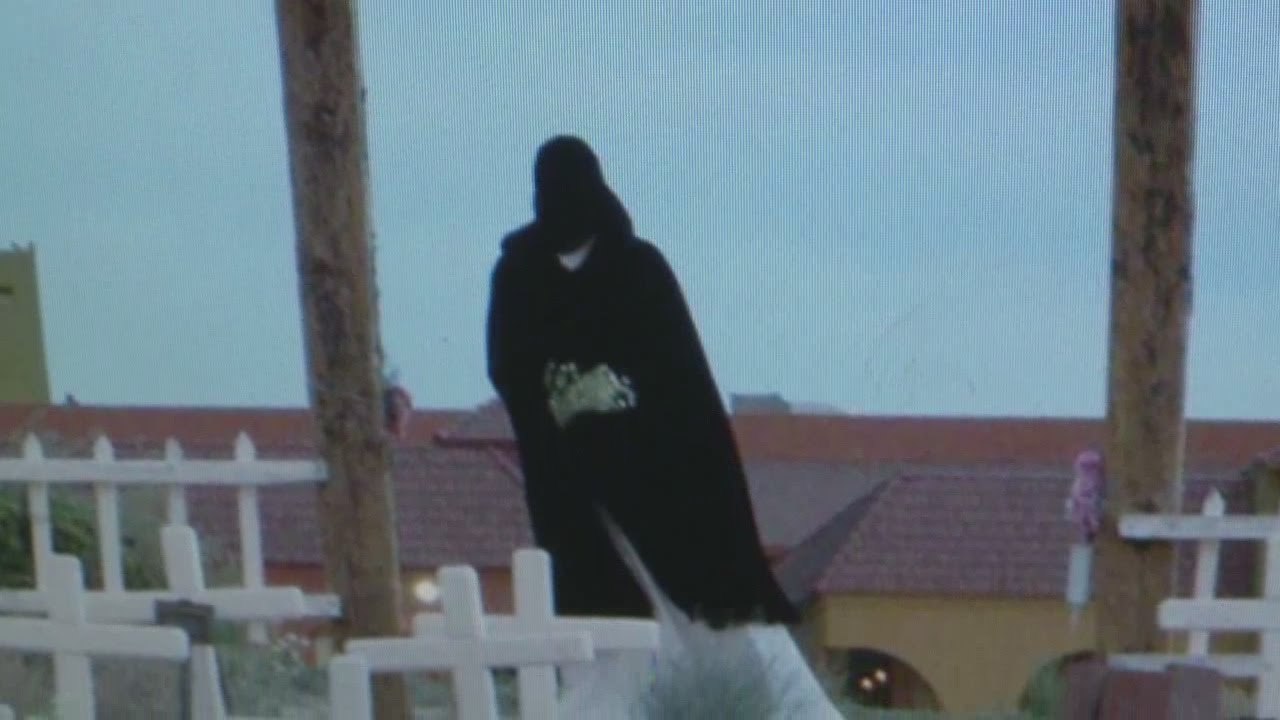
This past August 2014 in my hometown, Albuquerque, New Mexico a strange sight
Various photos snapped.
literally stopped traffic along I-25 near the Gibson exit.

An old cemetery, San Jose del El Rosano was divided into separate parts with the construction of this interstate years ago. Because of this sections of this cemetery are right next to this highway. One part even sits between one of the roads’ on ramps and the overpass.

During the week of August 12th during the supermoon people saw something they described as “weird” and “scary.” Many not only stopped their cars but then got out to take a closer look.

Several witnesses snapped photographs and one person took raw video of the dark figure that stood before them. What frightened these witnesses was a very tall figure standing at one entrance to the cemetery.

Most did not know what to make of this dark figure, dressed in black its face completely obscured by darkness. Some stated it appeared to carry a bouquet of flowers in its hands, others stated it carried something green near its midsection that was glowing.


One witness that stopped, Michelle Gonzales stated she moved to approach this figure when another witness stopped her. He felt that was an unwise decision since they did not know for certain what this figure was doing there.

Several witnesses at the cemetery and many more who viewed the photos taken afterwards felt this figure was the Grim Reaper. But most after the fact stated it was obviously just a man perpetrating a prank.

Several witnesses that saw this figure with their own eyes were not so sure this simple explanation was the right one. They stated that this was something more.

Rumors spread afterward that the “man” seen standing in this cemetery that day was arrested--the authorities were called to the scene --but there is no record anyone was arrested.

Later, a local TV news team interviewed this man when he appeared again and it was determined that he was was indeed human. 

Sunday, June 1, 2014

New Mexico: Haunted KiMo Theatre


KiMo Theatre
The KiMo Theatre is located in downtown Albuquerque on Central Avenue. This street is the original Route 66 that went from east to west through my hometown. 

The KiMo, like many theatres, has a superstitious practice that is observed. This practice is to appease one ghost that resides in the building.

The KiMo was constructed in 1927, and is known for its unique Art Deco and Pueblo-style architecture. 

A statewide contest was held to name the new theatre and the winning name KiMo was submitted by the Governor of Isleta Pueblo, Pablo Aberta--who won 50 dollars for his entry.

The word KiMo translated means “Mountain Lion” in the Tewa language. This word is also loosely translated to mean “king of its kind.”

Photo: PETERSONLIVE.COM
This is a good description for this original movie house’s architecture, haunting and superstition are truly “one of a kind.”


Bobby Darnall
For decades the KiMo has housed the spirit of a restless child. In August of 1951 a 6-year-old boy, Robert “Bobby” Darnall was attending a screening of an Abbott and Costello movie at the KiMo with his parents.

Bobby was sitting in the balcony with friends when something on the screen frightened him. He ran down the stairwell just as a water heater or boiler in the basement under the lobby’s food concession counter exploded.

More than a dozen people were injured in this accident. Bobby was rushed to a hospital but died en route.


After his death, his ghost returned to the KiMo Theatre. Bobby’s spirit quickly gained a reputation for impish behavior. This haunting is sometimes classified as poltergeist activity.

Balcony stairs
A “lady” ghost wearing a bonnet is also seen walking through the hallways at the theatre. No one knows her backstory, but her presence appears to be residual in nature. She is seen going about her business and seems unaware of the living.

Bobby’s ghost, in comparison, is much more active. He likes to play tricks on both staff and patrons at the theatre. 

He is seen wearing a striped button-down shirt and blue jeans. He is often seen playing on the lobby’s staircases that lead to the balcony.

By 1977, the KiMo theatre was in significant disrepair. The citizens of Albuquerque approved a plan by the city to purchase the building--this saved it from being torn down. It has been completely restored to its original beauty. * 

Today the theatre is used for plays and musical performances.

View from stage
Ever since this renovation, Bobby is known to touch people. In particular, he likes to disturb live performances. Many actors have been tripped while performing on stage. 

Bobby also likes to make a variety of noises during performances.

* The KiMo Theatre is on National Register of Historic Places.

Shrine
Because of Bobby’s mischief, the staff and visiting actors have built a shrine for him near a backstage stairwell. 

Actors that perform at the KiMo often hang doughnuts on a string for Bobby from a water pipe that runs along a back wall of the theatre.

Often these treats are gone the next morning. Many of those left hanging have been found with little bite marks taken out of them.

This shrine and the doughnut offerings most often appear to appease Bobby’s spirit for the activity settles down.

A stage production that performed at the KiMo one December did not offer these doughnuts.

This production of A Christmas Carol was plagued by several mishaps. The director connected to this show had for some reason ordered the doughnuts taken down.

During this play's technical rehearsal, they had problems with both the lighting and sound. During their first performance everything went wrong.

Actors forgot their lines, some tripped, others fell off the stage. Electrical cables fell down, and other falling equipment fell right at dramatic parts in various scenes.

Prop windows and doors opened and closed randomly or wouldn't open to let actors exit the stage. There were so many disruptions the cast almost did not finish the show.

The next night’s performance went much more smoothly. The director, after the first performance, ordered the doughnuts be replaced.

The theatre’s Art Deco/Pueblo style:

Thunderbird
The swastika was a Native American symbol a long time before Hitler used it.
The one above is a Navajo symbol that represents a whirling log.

Wednesday, April 10, 2013

The Singapore Theory


Most ghost investigators have used this theory whether they know the name for it or not. 

This theory is in use when an investigator creates an environment that the ghost might be familiar with in hopes of attracting them. The Singapore Theory is sometimes called the “Theory of Familiarization” or just simply, “Paranormal Stimuli.”

The use of Trigger Objects that make a connection to the deceased in some way is this theory in use. An example of this is when toys are used to attract child spirits. * 

Some investigators slam the use of this theory because it doesn’t produce repeatable results. But I have found it does help attract activity that then can be captured on video or on a digital voice recorder.

I give The Singapore Theory credit for creating one standard practice when it comes to investigations. 

Most ghost hunters today realize that it is vital to do research on the history of a place before they investigate it. Of course, this research which often includes interviews with witnesses etc. is not a guarantee that the investigator knows what they might encounter, but it does help. 

For instance, if it is believed the former owner of home haunts it --familiar items such as music can be played or a passage from a book might be read out loud upping the chances a spirit might respond.

Let me mention here--99 percent of the time the specific identity of a ghost cannot be verified. But using items from a different era can draw spirits out regardless.

Here are a couple of examples of how I have put this theory to good use in the past. 

A few years back a team and I investigated a home that was given in trust to a local university in my area. Frank Hibben (1910-2002) built this home and taught at this university. Hibben was an archaeologist, anthropologist, and author. But his passion in life was “big-game hunting” --over the years he set many world records. 


The rooms in his home are filled with hundreds of mounted African animal heads. One room even has a mounted elephant head with footstools made out of its legs. When I first walked in, I ironically felt that there might be more animal spirits in this home than human.
.

I took one magazine that did a feature story on Hibben’s home and his passion for big-game hunting and used it during an EVP session. 

I mentioned his hunting feats and told him I was impressed with the quality of the taxidermy work. ** Our EMF’s went off, and we picked up a voice. But of course, I cannot verify this was Hibben responding.


Photo: Dave Dell
At another investigation, we put this theory into practice again. We investigated the St. James Hotel in Cimarron, New Mexico. On the second floor of this hotel in the front hall, there is a “poker room” where Bat Masterson and Wyatt Earp, etc. played poker. 

While we did an EVP session in this room, we used the poker chips and cards we had brought to play a round of poker.

Nothing happened while we were in the room but when we left after midnight to go outside for a break, one of our cameras picked up the lamp swinging in this room. We had the window open for it was hot in the hotel--but there was not even a hint of a breeze that night. This video is highlighted in a post I wrote about the St. James here.

A good example of The Singapore Theory in use is during Civil War re-enactments. Of course, these groups are not trying to attract paranormal activity but often they do. When you put on a uniform from another era and re-create a battle--sometimes ghost soldiers that “lived it” show up.

One investigator who used this theory was investigating a medieval monastery in England. He dressed up as a monk and entered the old chapel in hopes of stirring up activity. He got more than he bargained for. He feels that a ghost of a real monk knew he was not the real deal. Invisible hands literally shoved him out of the chapel.

*  In another post I wrote about TriggerObjects.

** I did admire the taxidermy work--but I do not like the concept of displaying trophies from hunting.

Wednesday, July 13, 2011

Day of the Dead


Within the Mexican culture, there are extensive beliefs in ghosts. These beliefs are based upon Mexico’s diverse past. 

Many of the ancient Maya and Aztec beliefs survived and evolved, along with the beliefs introduced by the Spanish colonists that came later. The modern “Day of the Dead” observance includes elements from both these pre-Colombian beliefs, and Christian elements. Mexican literature and films include many stories of ghosts interacting with the living.


The Day of the Dead, in Spanish, El Dia de los Muetos, is a holiday celebrated in Mexico, as well as by Hispanics living in the United States and Canada.


Marigold Parade
The South Valley community in my hometown, Albuquerque, New Mexico, celebrates Dia de los Muetos. One highlight is a beautiful Marigold Parade and Festival. I must mention that everyone in our community participates, not just Americans of Mexican heritage.

Families remember their deceased loved ones and honor them by building ofrendas—altars—where sugar skulls are placed, along with offerings of pan de muertos. 

Sugar Skulls
Sugar skulls are traditional Mexican folk art used to decorate, they are also given out during the festivities. Pan de muerto is a lightly sweetened bread that is placed upon the altars. Some of the dough is formed into bone-like shapes to decorate the top of the loaves.

These celebrations allow everyone to honor their dead by offering remembrances. Included in this celebration are blessings, poetry, and traditional foods. There is also an art market and a costume contest.


Click to enlarge
The traditional celebration focuses upon family and friends, gathering to remember family members who have died. Family members visit the graves of their loved ones, where people communicate with the souls of the departed-- private altars are often built containing the deceased' favorite foods and beverages. 

Photos and other memorabilia are placed upon this altar. 

Because the Day of the Dead occurs near Halloween, traditionally November 1st and 2nd causes some confusion, these two events have little in common. This ritual is not scary or gruesome. It is a beautiful ritual in which Mexicans remember their loved ones.

Sunday, May 1, 2011

Local News Story about my group Central New Mexico Ghost Investigations

The local CBS News affiliate in Albuquerque, New Mexico did a story about my team's investigations and one of our regular client’s stores—Prized Possessions. My group normally does not seek publicity. In fact word of mouth has always worked for us. But Channel 13 approached us and asked if they could do this story. We agreed. I appreciate the fact that they presented the story professionally.

Here is the video.