Showing posts with label folklore. Show all posts

Wednesday, June 17, 2015

Time Slips: Phantom House and Vanishing Hotel Room

Time slips is a phenomenon where a person or persons witness scenes or objects apparently from another time period--predominantly in the past.

One case of a phantom house being seen happened near Bury St. Edmunds, in Suffolk, England in 1926.

Bradfield St. George
church
Ruth Wynne had moved to the area recently to teach school. Wanting to explore her new home Wynne and a 14-year old pupil, a Miss Allington went for a walk from Rougham Green rectory toward Bradfield St. George church.

It was a cloudy day as the two women walked through a farmyard toward the road. Opposite them was a high brick wall and iron gates through which they saw a large Georgian house surrounded by tall trees.

Miss Wynne was surprised because no one had mentioned such a grand house being in the neighborhood. The two women unconcerned then proceeded to their destination the church which was only 300 feet away.

They returned home via a shortcut so they did not pass the stately house again.

It was a year later when both women walked the same footpath through the farmyard to the road but this time they where astonished to see there was no wall, iron gate or grand house.

Instead the area was overgrown with trees, weeds, plants and ponds. The two never saw the house again. They did research but where perplexed to find there was no record of a Georgian mansion existing in the area.

No one has been able to explain what the two women saw.

Another, more fanciful time slip story involves a mother and daughter whom are traveling together. This well-known legend is called The Vanishing Hotel Room.

They were returning from India and stopped at a hotel room in Paris. The mother fell ill so the daughter heads out to get some medicine for her mother.


When she finally returns to the hotel after hours of searching she does not recognize anyone and both the hotel room--they were staying in--and her mother have vanished.

In a classic ending it is stated the daughter never finds her mother or finds out what happens to her.

In another twist to the ending it is stated the daughter after a long investigation finds that the hotel management upon finding the mother has the plague has her moved from the hotel in order to avoid a public panic.

This story is cited in several books as a “true supernatural story.”  But this story is a classic example of folklore.

In a previous post the story of two English married couples in 1979 who stayed at an old-fashioned hotel in southern France on their way to Spain is shared. On the way back, the hotel that appeared to be from another era is no longer there.

Bold Street
The Bold Street, Liverpool time slip stories are also shared


In this post the Palace of Versailles time slip story is briefly mentioned. Both these stories are considered by some to be more credible and can be found here.

Sunday, November 30, 2014

A Blacksmith’s Ghost

Solomon Fenner lived in the village of Laceby in Lincolnshire England in 1710.

Fenner had briefly served in King William and Queen Mary’s army when he returned to his home to work as the village blacksmith--a trade he had apprenticed in as a youth.

He was not wealthy, but he made a comfortable living. He was known in Laceby as a pious man who attended church each Sunday. He gave what he could to the parish poor.

Solomon unmarried and in his 30s became enamored with a young woman, Rebecca Petitt who lived in the neighboring market town of Caistor.

Rebecca was widely admired for her long red hair and lovely green eyes. Her beauty plus the fact she was witty had guaranteed she had plenty of suitors. Rebecca’s father William Petitt had rejected all offers of marriage for he had plans to make a more advantageous match.

Petitt was a greedy man who owned several shops in Caistor. His goal was to accept a son-in-law who would also benefit him financially.

Laceby

Solomon Fenner showed up at the Petitt’s doorstep one Sunday afternoon to ask William for his daughter’s hand in marriage.

William not only rejected his offer, he had his servants throw Fenner out onto the street.

Over the next week, Solomon usually a calm man let this rejection fester. Bitterness overtook him, and he snapped.

He knew Petitt’s habit every Saturday was to visit a friend in Cabourne a hamlet that lay between Caistor and Laceby. Petitt would return home late at night after an afternoon of gambling and drinking.

The next Saturday Solomon seeing “red” lay in wait in the shadows. When Solomon spotted Petitt staggering down the Lincolnshire road, he leaped out and bludgeoned him to death with his hammer.

Solomon calmed down and looked down at his bloodied hands, he realized it was too late.

He ran to a nearby farmhouse and woke the inhabitants. He tearfully confessed what he had done. They detained him and sent for the authorities in Caistor.

They discovered Petitt’s bloody and battered body and knew Solomon Fenner was telling the truth.

Hanged and
Gibbeted
The night before Solomon was hanged, he expressed fear for his immortal soul. His body was gibbeted on a hill that overlooked Cabourne--and the scene of the crime.

Since a legend states that Solomon Fenner has not found rest.

According to Lincolnshire folklore, the ghost of Solomon Fenner approaches travelers who walk between Cabourne and Caistor late at night.

He is described as tall and robust as he steps out of the shadows wearing dirty clothes and carrying a bloodstained hammer in his hand. His eyes are red from weeping.

What his ghost does next remind one of The Rime of the Ancient Mariner   for his spirit then confronts these travelers.

He reassures them that they have nothing to fear for he will not harm them. He then tells them the story of his crime. He reminds them that all life is sacred.

It seems his punishment for taking a human life is to spend eternity telling others his crime.

Friday, May 23, 2014

Moonshine Warning


“…with streams of the clearest, coldest water, apples, and corn in abundance, nature seems to invite one to make a doubling or two for your own use.”
                                                           --Revenue Agent, 1904


Ruth Ann Musick is my favorite folklorist from West Virginia. She is deceased, but I always wonder if she might one day return as a ghost for her favorite tales to collect were ghost stories.

She often told the following story…

During Prohibition, stills and moonshiners could be found all over West Virginia.

One still was located in Smith Hollow. Charley Smith, who built this still was an odd sort. He was a confirmed bachelor and had only one true friend--Jim Hayward.

Both men lived in Smith Hollow and most every Friday at midnight Charley would make moonshine. Charley and Jim were the only two who knew where this still was located, so Charley had Jim stand watch while he made the corn liquor.

The two men had an agreement that if Jim spotted someone coming up the path, he would whistle like a whippoorwill. On several occasions, he had warned Charley with this signal.

After Charley made the liquor the two men would grab tin cups, they hid in a nearby oak tree, and drink their weekly portion. Jim started to resent Charley for he noticed his friend poured himself twice as much as he gave him.

He became more and more bitter but he never expressed his displeasure because he feared Charley would stop sharing his liquor.

Jim, a much older man, died one snowy Friday evening. Charley continued to make his weekly treks to the still. The Friday after Jim died, something unusual happened while Charley made a batch of liquor --he heard the familiar whistle of a whippoorwill.

Immediately he blew out his lantern and hid. After a few minutes, he called out, “Jim, Jim. Is that you, Jim?”

Charley heard the sound of the whippoorwill again and then the clatter of tin cups. Then all was silent. After this, every Friday night, Charley listened to the call of the whippoorwill and then the sound of tin cups banging together.

A year later, Charley was up at the still making his usual batch of liquor when something extra happened. He heard the sound of the whippoorwill and the tin cups hit, but this night he glanced over at the oak tree.

To his amazement, he saw Jim standing there holding a tin cup. Jim saluted Charley and said, “I finally got my fair share of the moonshine.” He then disappeared still holding the tin cup.


Terrified Charley ran all the way back to his cabin. He never again heard the sound of the whippoorwill or the clatter of tin cups. Jim apparently satisfied--never made another appearance.

Tuesday, January 21, 2014

Norwegian Ghost Folklore


The Draugen

The word Draugen is derived from the Norse “draugr” it is used traditionally to denote ghosts.

The Draugen is a wicked water ghost entity. They are said to be the ghosts of sailors or fishermen who lost their lives at sea. 

They then are doomed to haunt the waves. In these tales any man who takes to the sea dreads meeting up with this entity.

The Draugen is described as being monstrous in size covered in seaweed. He is seen only after dark during stormy seas. He is always seen rowing the remnants of his shattered boat. The legend states that the unlucky sailors that encounter him are first alerted to his presence by his terrible screams.

If sailors encounter the Draugen, it will drag their boats down to the depths of the sea and the men on board will all drown. Some of these unfortunate victims are then condemned to become Draugens.

There is only one way to escape this terrible fate. The sailor or sailors must reach the shore before the Draugen. But in one classic Draugen tale even though the sailor wins the race to the beach, the Draugen continues to pursue him.

This sailor out of desperation enters a dark churchyard and beseeches the spirits of the dead to protect him. Unfortunately, he is never seen again, but the next day the townsfolk find all the graves in this churchyard empty and covered in seaweed.

Today the Draugen is often associated with anything dark or mysterious about the sea. It is a well known mythical entity or “creature” from Northern Norway.

The Sea-Spirits

For almost 1000 years, it is believed "Old Norwegian Sea Chiefs" still haunt the furthermost coastlines of Norway’s remote isles.

All these spirits lost their lives at sea.

Their boats are seen rising out of stormy waves only to dip down again into oblivion.

It is believed if a person can catch a glimpse of these proud Norwegian forefathers it will bring them good luck.


But seeing them also brings sadness and a sense of loneliness, for these sailors, are doomed to search for a safe harbor to berth their vessels.

These tales always end tragically for the sea-spirits are never welcomed with open arms--so it is their fate to be always searching.

Sunday, December 15, 2013

East Tennessee Ghost Folklore


Old Apple Tree
Alexander Koltakov

Randy Russell and Janet Barnett in their book entitled, The Granny Curse, present a wonderful collection of ghost folklore from East Tennessee. * 

These legends have been passed down from one generation to the next for well over 200 years. They are some of the most entertaining I have ever read.

One of my favorite stories in this collection is entitled Growly Apples. This story is based upon an old superstitious belief that that the oldest apple tree in a mountain hollow is always haunted.

This tale is about a boisterous loud-mouthed man by the name of Sud. 

One Sunday afternoon after church, he is showing off for “the children” with various apple tricks when he catches half an apple in his mouth that he threw up in the air. Unfortunately, this large apple then lodged in his throat, and he chokes to death.

His family buries him in his favorite spot in the yard and promptly moves away. A few years later, his widow, who has remarried visits his grave to find the marker they placed on it is gone, and instead, a young apple tree stands in its place.

She informs the new owners that the roots of this tree probably grew right out of his mouth and eye sockets being as he was buried with the fruit still stuck in his throat.

When this tree matured several years later, the new owners soon discovered that if they picked apples from this tree, it would growl day and night until they returned the apples they chose to the ground under it. 

The apples themselves would growl and if anyone dared to eat one of them, their stomach would growl non-stop.

Sud’s old cabin is gone now but tourists today claim that this old apple tree still stands and people always hear it growling if they pick its fruit. It is said that if they are smart, they know they have encountered a ghost.


Another story from this collection I really like is about a “ghost horse.” This story is entitled, Ghost in the Fireplace.

An Irishman named Higgins, and his horse, named Cloud are inseparable.  But unfortunately,  a man who lives in a filthy shack on a nearby mountaintop murders him for his fine stallion. 

Cloud then tries to take revenge on the man who murdered his master.

An old belief in Tennessee is that if a person hears the crackle and pop in a fireplace, it is Satan snapping his fingers. After hearing this, one must be careful the house doesn’t burn down.

For years after this murder, people who lived in this mountaintop shack claimed they saw a shocking sight--Cloud’s thunderous hooves would be heard then he would emerge right out of the fireplace in search of his beloved master’s killer.

One of my all-time favorite ghost blogs is written by Fairweather Lewis. He has an interesting summary of the above story--which he calls, “Cloud Walks” on his blog. Click on the link to read it. Fairweather doesn't write anymore.

* Russell and Barnett’s book, The Granny Curse is available on Amazon.

Friday, December 13, 2013

The Headless Horseman of Lakey’s Creek


Lakey's Creek
This ghost story is one of the oldest told in the state of Illinois. It is so popular and has been told so often it is firmly entrenched in Southern Illinois folklore. Like many ghost stories, it is part fact, and part legend.

Lakey's Creek is in
Hamilton County
Lakey’s Creek, as it has been known since before the 1830s is where this story takes place. It was named “in tribute” for the man who died near it and supposedly haunts it. 

Today this creek is 1.5 miles east of McLeansboro.

In Illinois history, there was a man by the name of Joel Lakely who decided to settle near a shallow part of this creek. 

It was here that travelers could ford the water with ease. Lakey being a sociable man, liked the fact that most travelers in the area passed right by his new home.

Unfortunately, his son-in-law murdered him before he could complete his cabin. One morning his body was found propped against a tree. His head had been chopped off, with the same ax he had been using to cut down trees for his new home.

His body and head were buried near his unfinished cabin. This part of the story is true, but the son-in-law's name and motive are lost to history.

It was not long after his death, that travelers who forded this shallow area of the creek began to report a strange sight.

A typical witness report states that people would hear heavy horse hooves, behind them as they went to cross the creek. But when they turned to see who followed them, there was no evidence of another rider or horse.


Other witnesses experienced something more startling. They heard horse hooves, but when they turned, they saw a large black horse with a headless rider atop. They stated this strange apparition seemed to pursue them--at least until they reached the creek.

These accounts mention that this headless rider was always seen downstream from where the witnesses were. This was on the same side of the creek near where Lakey was murdered. 

This rider and his horse would not follow them across the stream but instead would turn back and go downstream.

This part of the legend is often used to enhance the story--for an old belief is ghosts cannot cross water.

Stories of sightings of this headless horseman have endured for over 200 years. This apparition is still seen today. 

The old ford along Lakey’s Creek has been abandoned for years--a modern bridge crosses the creek today. It is on this bridge where travelers report seeing this headless horseman.

Many of these witnesses are tourists who come to enjoy the area’s natural beauty. Most of them do not know the story behind this haunting.

Sunday, November 4, 2012

The Black Umbrella


One well-known African American ghost tale that is often retold is “Wait Until Martin (Emmet) Comes”. Black slaves in the southern United States originally shared this story before the Civil War. In a future post, I will discuss the rich African American oral tradition this story represents. Another less known African America ghost folktale from South Carolina is about a black umbrella. This tale takes place in the early 1930s.

“The living may forget the dead, but the dead never forget.”

One rainy afternoon as an elderly housekeeper went about her work she heard a mournful song being sung in a nearby cemetery. She grabbed her coat and crossed the road. She loved to sing in her church choir, and she was proud of her voice. Despite the rain, she felt compelled to join the mourners.

As she approached the grave she heard them singing:

“No more rain gonna wet you—
No more…
No more cold gonna chill you—
No more…
Oh lord, I wanna go home—
Go home...
Bring me home…”

The mourners continued to sing even when the wind picked up, and the rain came down harder. A tall male mourner dressed all in black with pale features approached the housekeeper. He handed her a black umbrella stating that a beautiful voice like hers should not get wet.

Eventually, the preacher who faced the grave offered a prayer and ended with a resounding “Amen”. The housekeeper bowed her head for a moment to offer her own silent prayer but when she looked up confusion overtook her. She looked around, but all the mourners were gone. The cemetery now was completely silent.

The sun was out, and the earth at her feet was dry. Scared she hurried back across the street. As she entered her employers’ house, she realized that she was still holding the black umbrella. She placed it in the corner of the entryway and returned to her work. Later that day as she left the lady of the house called out to her, “Betsy, you left your umbrella.”

She kept on walking and never looked back.

Saturday, October 13, 2012

Charms Used to Ward off Ghosts


As long as people have believed in ghosts, there have been countless “charms” described in the US, Great Britain, and Northern Europe that will keep spirits away from humans. * 

Of course all of these are based in Old Wives’ Tales, folklore and superstitions. I decided to write about them here because they are really fascinating and one has to wonder how people came to these conclusions.

For instant, did you know?

That a cock crowing in the morning is a charm against ghosts because at daybreak ghosts have to disappear. I guess the ghosts that are seen during the day don’t know this.

Hansel and Gretel used breadcrumbs so they would not lose their way home but did you know breadcrumbs are a charm against ghosts. The belief is if you have to walk along a lonely road alone at night, you must put breadcrumbs in your pockets. This will not only protect you against ghosts but also keep you from being scared.

Here’s one everyone should know—if you see a ghost all you have to do is be brave enough to walk around it nine times and it will disappear.

Did you know?

If you walk past a place at night that is known to be haunted just turn your pockets inside out and any ghosts about will not be able to harm you.

Both in Great Britain and the United States, the belief is if you leave a light on in one room of your home a ghost will never approach it especially if you use lit candles, which are considered powerful protection.

If you have ghosts in your home—you must scatter ashes on your floors, the next day if you see footprints in these ashes, it means the spirits will not return.

Did you know?

Ringing bells and banging on pots and pans usually make ghosts leave in a hurry. The reason for this is spirits can’t stand these noises. It is said Church bells especially are useful in this endeavor.

A classic belief is if you can call the ghost by their name it will banish them for good.

Ghosts can’t cross running water. So the belief is people must somehow get to the middle of a body of water or at least run across a bridge with flowing water below to avoid them.

An old belief is if you walk along a country lane, at night and see a ghost you must cross the road because spirits cannot cross a pathway to follow you. It is believed that once they are in a lane they are trapped—in other words, they have to continue following the same path so humans should just alter their route.

Did you know?

 You should always carry a key. The reason for this is you can get rid of a ghost by throwing this key at them.

Another belief is that you should always carry a knife. An old theory is ghosts are afraid of being cut.

Around Christmas people should carry holly because it is an evergreen. The belief is ghosts have no power over evergreens.

Did you know?

Last but not least...

Nets, sieves, and screens are considered to be suitable barriers against ghosts. The reason for this if they are hung over a keyhole no spirit can get in because they have to stop and count the holes, so it takes then past daybreak to finish counting them--this means just like the original charm on this list they just disappear. 

Another belief along this line involves leaving a newspaper close to a door or window because the spirit has to count every word before entering. 

In the Antebellum South people would wallpaper their walls with newspapers, first and foremost to insulate their homes but these newspapers were also used to confuse ghosts which it was said would have to read every single word before they could hurt someone.

I know these beliefs may sound silly, but fear and the power of suggestion often reinforced the views above. In fact, for years they were commonly practiced among people who believed they needed protection from ghosts.

*  Several of these charms were also used to ward off other dark forces, such as evil entities, witches, etc.

Monday, October 3, 2011

New Mexico Ghost Story: The Haunted Ride


This story is told in my state close to Halloween. It is stated that it is a true story. * I really like it because it is a ghost story with an unusual twist. 

There are many ghost stories that have a “hitchhiker” in them. This story also has a hitchhiker in it but it is not your typical hitchhiker story. For one thing in this story the hitchhiker is not the ghost…

This happened near a small mountain town in northern New Mexico. A young man was hitchhiking across the state on his way back to college. It was late at night and he was walking alongside the road when it started to thunder and lightning. 

Very quickly this young man was drenched in a typical desert rainstorm. Now cold and wet he can hardly see two feet in front of him. In despair he wonders if a car will ever pass.

Finally, he sees a pick-up truck coming toward him. It approached him slowly and stopped where he stood. The student without hesitation got into the truck and closed the door. 

As he wiped the water from his face he realized that no one was behind the wheel. He clutched the door handle intending to get out but the truck started to move and being on a hill it picked up speed quickly.

The man watched as the truck approached a sharp curve; terrified for his life he starts to pray. In the next moment he spots a black shadowy hand emerge from the rain through the drivers’ side window as the truck hits the curve. The hand grasps and moves the steering wheel. Now in shock, the student watches as the hand reappears each time the truck hits a curve to steer the truck.

As the rain finally stops the young man is able to muster enough courage to open the trucks’ door. He stumbles out and hits the road at a dead run too frightened to look back. 

At the bottom of the mountain he finds a cantina on the edge of a small town, he enters and orders a shot of tequila. Shaking and visibly upset he gasps out his story to the locals in the bar as he waits for his drink. The patrons at first think he must be drunk but when they realize he isn’t they start asking him questions in concern.

Fifteen minutes later two men walk into the same cantina. The taller one states to his companion, “Mira, Pedro, that’s the parasito that got in the truck while we were pushing it.”

I have read various versions of this story from Africa, Australia, and of course Ireland where I believe it originated. This story is told because of its humorous ending.  

Friday, September 16, 2011

Tailypo, Teeny Tiny, and The Satin Dress


In the 1970s one classic ghost story was published in two very different versions both in the form of children’s picture books. The first written by Joanna C. Galdone entitled “The Tailypo” is one of the most terrifying ghost stories for children ever published. 

To this day mothers and teachers’ alike will not read or tell this story to younger children who are easily frightened. The premise of the story is that a man who lives in a swamp tries to kill a critter he spots but he only manages to chop off its tail. He takes this tail home, cooks it and eats it.

What happens next—when the critter comes to demand its’ tail back is presented so subtlety by the author that it creeps up on you, in fact Joanna Galdone crafted this story so well it has given countless children nightmares. 

“Tailypo! Tailypo!  Where is my tailypo? Tailypo! I’m coming for my tailypo.” The critter gets closer and closer to the man’s shack until its’ two ears appear at the foot of his bed…

Part of the “terror” it inspires I think is because the critter even takes revenge on the man’s pack of hound dogs—this scene is left to the imagination of the reader, which makes it even more intense. 

If you have older children this is a must read ghost story for Halloween.

The second version of this traditional story—but very different in tone and feeling—is a children’s picture book by Paul Goldone entitled “The Teeny Tiny Woman.” 

This story follows a teeny tiny woman through her teeny tiny world. She goes to a graveyard and finds a teeny tiny bone just perfect for her soup—so she takes it home. 

Teeny tiny ghosts observe her as she takes it and then follow her home. “Where is my bone? I want my bone?” 

Their demands become louder and louder as the story progresses until frustrated the teeny tiny woman gives the bone back. 

This is essentially the same story as Tailypo but with a much more innocent, humorous twist. This book is perfect for young children at Halloween—they like to repeat the teeny tiny ghosts’ demands and then find the lurking ghost or ghosts on each page.

The two children’s stories above represent how American ghost stories--a rich oral tradition-- evolve. I often find other basic ghost stories in various forms being told in different regions of the United States.

 Another example of this is the one about a person being “dared” to go alone into a graveyard and leave evidence, such as a knife stuck in a grave, to prove they were there. I will give examples of this story here.

The classic version of the Tailypo, Teeny Tiny story is one sometimes-entitled “The Satin Dress.” This version is a lot darker and creepier in nature but is not as scary as Tailypo. This version has been around a lot longer. 

It is about a young woman who works in a factory in New York and has very little money. She is invited to a fancy dress party but has no money to buy an appropriate dress or the material to make one. A coworker suggests she rent one for the evening.

At a nearby pawnshop she finds a beautiful pink satin gown with matching accessories. She is able to rent the ensemble for a reasonable fee. 

The night of the party she puts the dress on and looks at her glowing reflection in her bathroom mirror. As she turns away she thinks she hears a strange ghostly whisper: “Give me back my dress.” 

Afraid she looks around, finding nothing she feels it must just be that she is excited about the coming evening.

When she arrives at the dance her card quickly fills up. She enjoys the evening as each of her partners adeptly guides her round the dance floor. 

Halfway through the dance to her chagrin she starts to feel light-headed and even nauseous. As one partner leads her out she again hears the ghostly whisper in her ear: “Give me back my dress.”

She tries to ignore the voice and her sick feeling but as she looks into the face of her present partner she knows she must leave quickly. She makes an excuse and some how makes her way outside. 

The fresh air makes her feel worse. She summons a cab to take her home and when she arrives home she staggers up the steps to her flat.

As she enters her apartment she barely makes it to her bedroom door before she hears the ghostly whisper for a third time: “Give me back my dress. You have stolen my dress.”

 Feeling faint the young woman falls upon her bed. Again she hears the voice in her ear: “I want it back.”

She is found the next day dead still wearing the pink dress. 

The autopsy report later stated she died from embalming fluid poisoning which had entered her pores. The police found the pawnshop receipt for the dress and questioned the owner. 

He sheepishly admitted that the pink dress that had killed the young woman had been removed from the body of a dead girl just before her casket was nailed shut and buried.

Wednesday, August 10, 2011

New Mexico Legend: La Llorona


Old Spanish song about La Llorona

Don’t go down to the river, child,
Don’t go there alone
For the sobbing woman, wet and wild,
Might claim you for her own

She weeps when the sun is murky red
She wails when the moon is old
She cries for her babies, still and dead,
Who drowned in the water cold

She seeks her children day and night,
Wandering, lost, and cold
She weeps and moans in dark and light,
A tortured, restless soul

Don’t go down to the river, child,
Don’t go there alone
For the sobbing woman, wet and wild,
Might claim you for her own


In another post, I talked about how children in New Mexico are very familiar with the La Llorona story. La Llorona is New Mexico’s most famous ghost. 

If you visit anywhere along the Rio Grande river in my state, you will encounter New Mexicans who will gladly relate their version of La Llorona. This story is told in other parts of the country, but the following version is one told often in New Mexico.


In the early 1700s, there was a young woman named Maria who lived in a small village along the Rio Grande. 

As Maria matured, she began to attract much attention in the village because she was very beautiful. Her family was very poor so her mother encouraged Maria to marry one of the local men. 

Maria with the firm self-belief that her beauty would someday attract a wealthy man refused.

One day a handsome young man rode into the village. He was the son of a rancher in Mexico. He wore nice clothes and rode a well-groomed horse with a fancy saddle—all the signs of a man of wealth.

Maria started to follow him around, she tried to catch his eye, but he only noticed the better dressed young girls in the village. At night he would play his guitar for the locals, many young ladies swooned at his golden voice. Maria was sure her heart would break.

Then one day as Maria shopped the young rancher stopped near her. Maria blushed with embarrassment because she wore an old dirty, tattered dress. 

But her blush caught his eye, and for the first time, he noticed how beautiful she was. He began to court Maria. 

Within a short time, he had paid Maria’s father a large dowry so he could marry her. Knowing his family would not accept his marriage to a woman from a lower class—the couple settled along the Rio Grande.

Over the next several years Maria’s husband worked as a merchant along the El Camino Real, and Maria bore him three children. But as the years passed Maria and her wealthy husband grew apart. 

He spent less and less time at home, and he showed no interest in their children. Maria began to suspect that he was seeing another woman while he was away.

Maria’s suspicions were confirmed when she spotted her husband riding in a buggy with a young beautiful woman by his side. Her heart was broken. 

She exploded in a jealous rage. Distraught she thought that if only she did not have the children, her husband would love her once more. 

In a rage, she dragged her children one by one to the river and held their heads under the water until they drowned.

Her senses lost to reality; she approached her husband and told him what she had done for him. Horrified he ordered her out of his life. 

Numb she wandered the streets of the village for several days crying for her children. The villagers started to call her La Llorona—meaning the wailing woman.

Maria realized she had lost everything that was dear to her so she went down to the river and cried for her children. 

She then flung herself into the river. Her body was never found. 

People in New Mexico still see a woman dressed all in white walking along paths near water. They hear Maria’s desperate cries for her children and then she slowly fades away.

Many believe she is condemned to wander, weeping and searching for her children. Others believe that she is a harbinger of death—if you see her someone will die.

Monday, May 23, 2011

New Mexico Legend: Fort Union's "The Death Waltz"

Fort Union Monument
Fort Union was a bustling frontier fort in the northeast corner of New Mexico for four decades. For many years it housed the only hospital west of the Mississippi River, it was a major supply depot for the west, and its soldiers defended the Santa Fe Trail against Indians and the rebel forces during the Civil War. 

It only lost prominence when the Santa Fe Railroad came in 1879, after this it’s usefulness faded slowly away.

When you visit the ruins of the fort today what greets you first is the wind. The fort sits on a grassy mesa top where the wind blows most days. Fort Union is the location for a ghost legend that is often retold.

Ruins of Officer's Row
When the captain’s sister-in-law Celia came to live at the fort she quickly became sought after for she was very beautiful. She loved to flirt. One lieutenant by the name of Johnny in particular became infatuated with her. 

He would fall into the depths of despair every time she flirted with another man. His friends tried to console him stating she was a fake and a flirt but he would not allow them to continue—refusing to hear them.

At an officer’s party Celia, to Johnny’s elation, agreed to dance with him. He could not believe his fortune as he whirled Celia around the dance floor in his arms. 

But before the music stopped the dance was interrupted by bad news—an Apache raid was in progress. Johnny was informed he would lead a troop of soldiers in defense. Celia clung to him begging him not to go. Overwhelmed by her response he proposed to her on the spot. She accepted and told him she would wait for him for she could not marry another. 

The dance continued after Johnny and his men left and Celia danced happily for the rest of the evening.

Within the week a small group of soldiers returned to the fort to report that the Apache’s had ambushed them and most had been lost. Johnny was not with these men. 

Celia upon hearing the news went into hysterics for the benefit of all present but within the week she was out and about flirting with every soldier who caught her eye.

A month later a young wealthy lieutenant arrived at the fort from the east. Celia immediately attached herself to him and before long she was planning a big fancy wedding. 

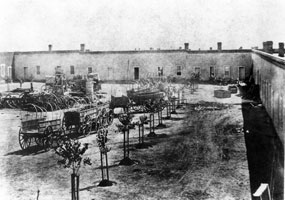
Mechanic's Corral
As the newly married couple danced together in celebration of their wedding a door banged open and a strong wind blew out all the candles in the room. A gruesome bloated corpse wearing an officers’ uniform entered the room, the soldier still bore the wounds caused by a hatchet blow to his head.

To Celia’s horror what remained of Johnny walked up to her and snatched her right out of her husbands arms. The music continued to play as Johnny whirled her endlessly around the dance floor. 

Frozen in horror a room full of people stood by helplessly. Celia shocked to her very core dropped lifelessly to the floor. Her new husband buried her at the fort and returned east never to return.

Some say the endless wind at the fort and the wail it brings with it is a sign that Johnny and Celia are still dancing.