Showing posts with label poet. Show all posts

Monday, May 13, 2019

Thomas Hardy’s Obsession with Ghosts


Thomas Hardy the author of Tess of the d’Urbervilles, The Mayor of Casterbridge, The Return of the Native, and Far From the Madding Crowd is considered one of the best Victorian English novelists.

In his later life, Hardy only wrote poetry. His poems were even more widely read than his books. They reflect his genius as a writer.

Hardy was born in Dorset, England in 1840. All his writings reflect where he grew up.

Hardy had a strong belief in ghosts, one reason for this, was Dorset, a rural part of England, defied the modern world and managed to hold on to its traditions for over a hundred years.

Before Hardy actually encountered ghosts late in life, he wished for this type of experience. In 1904, he told William Archer, a journalist that interviewed him---

“I would give ten years of my life. .to see a ghost—an authentic, indubitable spectre.” Hardy went on to point out that he was “cut out by nature to be a ghost-seer . . . If ever a ghost wanted to manifest himself, I am the very man he should apply to.”

Emma Lavinia Gifford
One of my favorite poems he wrote is entitled The Voice. Hardy wrote this poem soon after his first wife, Emma Lavinia Gifford died in 1912.

He and Emma had been estranged for twenty years at the time of her death, so this poem reflects his regret at the failure of their marriage.

The Voice

Woman much missed, how you call to me, call to me,
Saying that now you are not as you were
When you had changed from the one who was all to me,
But as at first, when our day is fair.

Can it be you that I hear? Let me view you, then,
Standing as when I drew near to town
Where you would wait for me: yes, as I knew you then,
Even to the original air-blue gown!

Or is it only the breeze, in its listlessness
Travelling across the wet mead to me here,
You being ever dissolved to wan wistlessness,
Heard no more again far or near?

Thus I; faltering forward,
Leaves around me falling,
Wind oozing thin through the thorn from norward,
And the woman calling.

This poem also reflects Hardy’s lifetime desire to encounter a ghost.

But some mistakenly think Hardy is claiming in this poem he did actually hear Emma calling him after her death. So he was accused of being delusional.

I think Hardy was actually just expressing his wish to encounter the ghost of the woman he once loved.

It is not through Hardy’s writings we know today that his wish for an encounter with the afterlife did eventually, come true, but from his second wife’s letters.

Florence Emily Dugdale
visiting seashore.
In 1914, Hardy married his secretary, Florence Emily Dugdale, who was 39 years younger than him. In 1919, Florence wrote a letter to a friend that Hardy had seen what he felt was a ghost.

Hardy and his sister Kate had been in the Stinsford churchyard on Christmas Eve. He had placed a sprig of holly on the grave of his grandfather, which he had never done before.

A strange man then greeted him, “A green Christmas” at which Hardy replied, “I like a green Christmas.” Hardy then watched as this stranger went into the church.

Curious, he followed this figure that wore old fashioned, 18th-century clothing. But no one was in the church. So Hardy saw and spoke to a Christmas ghost.

In 1927, Florence shared another encounter he experienced several years before his death. Hardy, Florence and five friends were having tea at Max Gate, his beloved home when he noticed a man he didn’t recognize standing right next to him.

Max Gate
He later asked Florence who the man was who had stayed so close to him during the party. She told her husband she had not seen this stranger.

Grave at Stinsford.
But Hardy insisted there was another person in the room. He told Florence he could still picture this stranger’s face.

Thomas Hardy died at the age of 87 in 1928. Only his heart was laid to rest at Stinsford, in the same grave with Emma, the rest of his body was cremated, and the ashes were placed in Poet’s Corner in Westminster Abby.

Florence died the same year as Hardy and is buried next to him.

Thursday, July 25, 2013

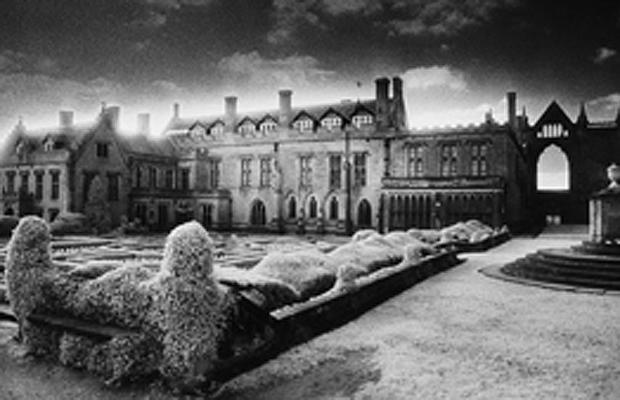
The Ghosts and Legends of Newstead Abbey


A virtual bevy of ghosts’ haunt Newstead Abbey located in Nottinghamshire, England. 

The Abbey was first used as a priory in the 1700s for the canons of the Order of St. Augustine or as they were known the Black Canons

In 1440 Sir John Bryon acquired the property and turned it into a mansion. For 300 years the Byron Family lived at Newstead. According to an old superstition, people become cursed and have bad luck if a religious home is then used for a personal or private residence.

Several generations of the Byron Family who lived at Newstead did experience bad luck and declining fortunes. 

By the time the last Lord Byron, the famous Romantic poet, lived at Newstead Abbey it was in bad shape. When he inherited the estate, his mother was too poor to live on the property and his father who was known as “Devil Byron” was forced to live in the mansion’s scullery--it being the only room in the home that had a roof that didn’t leak.


In 1818 Lord Byron sold the property to a friend, Thomas Wildman. The curse continued because the Wildman family experienced bad luck while living at Newstead. 

Several more families that owned the property after this were also plagued by bad luck. Besides the curse, it appears Newstead is haunted as well.

One of the ghosts seen on the grounds over the years is the “White Lady.” It is stated that this lady, Sophia Hyett was a fan of Byron’s poetry and that she lived nearby the Abbey. When the Wildmans’ discovered this, they gave her permission to roam their gardens whenever she liked. 

She is called the White Lady because she is always seen wearing a white dress. While alive, Sophia was timid. When strangers approached her, she would dive into nearby bushes. Her ghost is seen in Newstead’s expansive gardens--witnesses have reported that they have heard her sigh and state, “ Alas, my Lord Byran.” 


Newstead Abbey’s most talked about ghost is that of a tall, dark monk called the “Goblin Friar.” This spirit is considered a harbinger. It would only appear to heads of the Byron family just before something terrible or unhappy happened. 

This ghost appeared to Lord Byron the poet just before he married Anne Milbanke. This marriage was a disaster that lasted for only one year. Lord Byron wrote about his encounter with the Goblin Friar in a poem he wrote entitled, Don Juan.

Byron spotted yet another ghost in one of the Abbey’s bedchambers. He was sleeping in a room called the Rook Cell when he was startled out of a sound sleep by the sensation that something had entered the bed with him. 

As he sat up, he spotted a featureless, dark mass that had glowing red eyes. He watched as this form rolled off his bed and disappeared as it hit the floor. 

Yet on another occasion he saw a mysterious white vapor rising from the floor, which vanished without a trace.

Byron’s pet dog, a Newfoundland by the name of Boatswain also haunts Newstead. One of Lord Byron’s last wishes was to be buried with his beloved pet near the altar in the Abbey. 

Boatswain was buried there, but when Byron died in 1824, his last wish was ignored because he was not buried in the Abbey. It is stated that Boatswain’s ghost is seen wandering the property because he is looking for his master.

Another ghost is seen at the Abbey is called the “Rose Lady.” This entity is seen in a passageway located at the bottom of the staircase. 

When the Rose Lady appears she is always accompanied by the scent of roses or lavender that lingers after she disappears. 

One notable appearance she made in more recent years was in front of a group of people touring Newstead. The staff felt she made this appearance as a form of protest. The guides had not included her story in the tour--after she appeared they started to include her. Since she has not been seen as often.

The ghost of the second Lord John Byron who lived at Newstead in the mid 17th century was also seen, but just for a period of six months after his death. He died several hours after his wife died. 

Servants at the Abbey would see him sitting in his favorite chair by the fire in the Library smoking his pipe and reading a book. These servants then refused to enter this room for years afterward.


One legend connected to Newstead is about the rooks--cousins to the American crow-- that stay on the property. It is stated that these birds contain the souls of the Black Monks that once lived at the Abbey. 

The American author Washington Irving observed this phenomenon while staying at Newstead. 

He saw these rooks all leaving in the morning to search for food--he then saw them return in the evenings, en mass. These birds did this Monday-Saturday, but he was told that on Sundays they never left Newstead’s grounds. 

Irving didn’t believe this until he saw it with his own eyes. The belief that these rooks are the former monks is so strong that the hunting and shooting of them is strictly prohibited.

*  Lord Byron was an eccentric who held contempt for most women. But women loved his poems, so they overlooked this fact. It didn’t hurt that despite his clubfoot he was considered to be a very handsome man. During his life, he was involved in several high profile love affairs.