Showing posts with label farmhouse. Show all posts

Wednesday, July 22, 2015

Isle of Man’s Talking Mongoose


The “creature” in the following story has been compared to a German paranormal entity called a Kobold.

The Kobold like a poltergeist is a playful little spirit that plays tricks on humans. Kobolds can be malevolent or benevolent. They take on various forms including animals.

Photo James Irving took of Gef.
Irving farmhouse: Doarish Cashen
The story of the talking mongoose circulated in1930. It centered on an isolated hilltop farm near Dalby on the The Isle of Man. The owners of this farm, James and Margaret Irving witnessed a series of bizarre incidents.

They and their daughter 13-year old Voirrey started to hear an animal scratching behind the walls of their farmhouse—known as Doarish Cashen-- in September of 1931. Eventually, these sounds evolved into what sounded like a baby crying and then into clearly spoken English.

James, Margaret, and Voirrey Irving
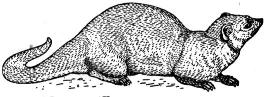
The entity that was talking introduced himself to the family as Gef, who claimed to be an earthbound spirit in the form of a mongoose. He told the family, he was born on June 7, 1852, in Delhi, India.

Voirrey Irving
Even though James and Margaret caught glimpses of Gef, the only person to actually see this spirit was Voirrey who described him as “a yellow rat-like creature, with a bushy tail.” Gef was friendly toward the Irving family, but he was also sometimes a nuisance to others.

When he wanted he could travel away from the farm and neighbors reported hearing odd sounds, which they believed was the Irving’s mongoose.

Gef loved to sing and knew the words to several favorite songs of the time.

He would spy on the Irving’s neighbors and return to share juicy gossip with the family.

The only proof he existed was the sounds he made, a few photos, Voirrey’s seeing him and the fact he moved or threw items around the farmhouse.

At one point he became so annoying to the family they announced they intended to move. This upset Gef so much he became more obedient.

The story about Gef eventually spread, journalists from all over flooded the Irving farm.

Harry Price, a famous paranormal investigator of the time visited the farm with a team. They found no conclusive evidence that Gef existed.

Photo Price's team took of Gef.
The family moved from the farm in 1937, later in 1947, the new owner claimed to have shot a “strange looking mongoose-like animal that he saw roaming his property.”

Some believe this was Gef, others felt Gef probably left the farmhouse along with the Irving family.

Still, others believed that Gef was just a fantasy that the Irving family made up to provide entertainment for themselves and neighbors.

Images of Gef for years were featured on beer mats in pubs across the Isle of Man.
Tuesday, January 20, 2015

The Dr. Mudd House

Dr. Samuel Mudd
Dr. Samuel Alexander Mudd was a farmer and practicing physician during the Civil War. He was a Confederate sympathizer and member of the Confederate underground.

He lived in Waldorf near Bryantown, Maryland with his wife and children. His farm was 30 miles south of Washington, D.C.

He was accused and convicted of being a part of John Wilkes Booth’s conspiracy to assassinate Abraham Lincoln.

Dr. Mudd met Booth three times in 1864--twice in Bryantown and once in Washington-- before Booth murdered Lincoln. At his trial, the doctor stated Booth was just a casual acquaintance.

After Booth shot Lincoln he broke his left leg as he leaped from Lincoln’s box to the stage at Ford’s Theatre.

Needing a doctor’s assistance, Booth and David Herold showed up at Dr. Mudd’s house at 4:00 a.m.

Mudd Farmhouse
The doctor stated at his military trial that he did not recognize Booth. He told the tribunal that when Booth and Herold arrived they gave the names of “Tyson” and “Henston.”

Dr. Mudd set and splintered Booth’s broken leg.

He stated he did not know about the assassination until he went to Bryantown to do an errand for his wife--Booth was still recovering in an upstairs bedroom of his home at the time.

Booth and Herold stayed at the doctor’s home for approximately 12 hours, paid him $12 for his services and then headed into the nearby Zekiah Swamp.

Shortly after this Dr. Mudd was arrested and charged with conspiracy for harboring Booth and Herold as they escaped.

Mudd was tried with 6 other men and 1 woman--Mary Surratt whose story I share here.

He was found guilty and sentenced to life imprisonment. He missed the death penalty by 1 vote.

Fort Jefferson prison
He was imprisoned at Ft. Jefferson in the Dry Tortugas located 70 miles from Key West, Florida.

In the summer of 1867, Yellow Fever broke out. The prison physician died. Dr. Mudd took over--he came down with the fever himself but recovered.

Because of his efforts all the decommissioned officers and soldiers signed a petition on his behalf.

President Andrew Johnson pardoned him in February of 1869. He returned home and continued his medical practice.

He died of pneumonia in January of 1883 after walking through the cold and snow to attend to a patient.

Dr. Mudd had 9 children and his descendants for many years worked tirelessly to clear his name. Historians today still debate whether he was innocent or guilty.

One compelling argument that he was guilty can be read here.

The results of an impressive “mock trial” that found him innocent can be read in the New York Times here.

Haunted Farmhouse

Today the Mudd farmhouse is run as a private museum. Several witnesses claim the house is haunted.

One author, Mike Ricksecker who wrote about this haunting in his book Haunted Maryland captured some interesting photos.

Danny Fluhart president of the Dr. Samuel A. Mudd Society told Ricksecker that no one is supposed to touch the bed that Booth stayed in on the 2nd floor.

Despite this rule, the staff is often frustrated to find they have to re-straighten it because the bed is mussed when they return to the museum in the morning. A distinct human-shaped impression is always discovered.

Bed Booth stayed in.
Click to enlarge
Ricksecker was in the home with Fluhart one Monday, when the museum was closed, they discovered the bed in this state and were able to take pictures.

The following video has staff and a Civil War reenactor talking about their encounters with a variety of paranormal activity at the farm. This video begins and ends with one group’s EVP sessions at this old farmhouse.

Saturday, December 13, 2014

Poltergeist: Fire Spook, Part l

This story is about how unexplained paranormal activity ruined one teenage girl’s life.

A worldwide firestorm was started in the winter of 1922 when two reliable witnesses confirmed that a family that lived on a farm located in Antigonish County in Nova Scotia was experiencing a terrifying haunting.

It was in January of this winter that Alex MacDonald his wife Janet and their 15-year old foster daughter Mary Ellen fled their home in terror.

Mr. MacDonald then had to walk a mile and a half twice a day to feed his livestock for he refused to stay any longer overnight at his farm. There was something malicious and deadly haunting the farmhouse.

Fires where starting faster than he could put them out without reasonable cause. The day the MacDonald’s left there were over a dozen fires that started within a 24-hour period.

The family had also experienced some bizarre activity with their livestock. Regardless of how many times Mr. MacDonald penned or tied up his cattle they were able to get loose within seconds of him leaving. Frustrated, he even chained each cow separately. They quickly escaped again.

Another mystery involved the farm’s horses. Their tails were found braided on several occasions.

Desperate the family not knowing what to do turned to the police. But they didn’t know what to do either.

The Story Heats Up

After the MacDonald’s abandoned their home it didn’t take long for the word to spread.

Just four days after the family left a reporter, Harold B. Whidden, who lived a 100 miles away in Halifax, visited the town of Caledonia Mills where the farm was located.
Harold Whidden
He interviewed a neighbor of the MacDonald’s Leo McGillivray who had seen the fires firsthand and whom the displaced family was now staying.

Whidden finding the story noteworthy wrote an editorial that was received favorably and with much interest.

He quickly decided to return to Caledonia Mills. This time he planned to stay at the MacDonald farm.

He enlisted the help of a local retired Detective, P.O. Carroll who was used to investigations and could view the story with a critical eye.

In the meantime the story of the Nova Scotia poltergeist was being reported as far away as Utah. The Ogden Standard Examiner not taking the story seriously reported that the only “spirits” in the MacDonald farmhouse were probably from a “little brown jug.”

Before this story ran its course newspapers from around the world printed it.

Two Witnesses

Detective Carroll
Whidden’s goal was to scoop the story but in the end he walked away a believer. Detective Carroll who had more to lose when it came to his reputation also openly admitted that the farm was haunted.

The two men accompanied by Alex MacDonald planned to stay at the farm for 3 days--they ended up staying for just 2.

The farmhouse was freezing, the fires had burned most of the furniture and the range, damaged as well, was unusable. The three men wore many layers of clothing to stay warm.

It wasn’t until the second night in the house that the activity began. Whidden and Carroll were sitting in two remaining chairs and MacDonald lay on the floor sleeping.

The two men heard strange noises coming from over their heads. These noises were quickly joined by footsteps as if someone were pacing in the bedroom on the second floor above the room where they sat.

The two became nervous knowing that no one else was in the farmhouse. After it had been quiet for a while Whidden felt a strong blow against his forearm.

He looked over at Carroll but the detective had not moved. He was just as perplexed as Whiddon for something had pulled firmly at his left arm.

Both men had felt these strong sensations through several layers of clothing. Whidden was wearing two shirts, a sweater a fur-lined overcoat and a horse-rug.

Now panicked, he awakened MacDonald and asked him if he had punched him--knowing full well that he had been sleeping.

For the next 20 minutes Whidden felt there was a presence in the room with them, it was watching them. It was determined later he had some psychic ability.

An “Expert”

The MacDonald case was so high profile it attracted the attention of a prominent scientist, Dr. Walter Franklin Prince.

He was a leading member of the American Institute of Scientific Research and an officer of the Boston Society for Psychic Research. These impressive credentials guaranteed that he always had the “final word.”

Prince was approached to investigate the MacDonald farm. Once he arrived he both intimidated and irritated the Nova Scotians. He quickly alienated his escort who was Harold Whidden.

Whidden, the journalist who had already encountered the activity noted Prince seemed to “already have made up his mind” as to what was happening before he arrived.

Prince felt “adolescents attracted poltergeists”--therefore the MacDonald’s foster daughter Mary Ellen must be the cause--all he had to do was prove it.


In Poltergeist: Fire Spook,Part ll-- I discuss Prince’s odd behavior, his conclusions and how it unjustly effected the MacDonald family.