Showing posts with label prison. Show all posts

Saturday, February 21, 2015

Dragsholm Castle

This castle located in Odsherred, Zealand, Denmark is named after a “drag” which is a narrow stretch of land that the Vikings used to “drag ships across” in order to avoid the dangerous waters north of Zealand Island.

Dragsholm Castle in 1896
Dragsholm Castle is near several lakes so its full name means “islet by the drag.”

In the 12th century Peder Sunsen, the Bishop of Roskilde designed Dragsholm.

Today, 100 ghosts haunt Dragsholm. Its long tragic history is believed to be the reason for this.

In the Middle Ages Dragsholm was used as a fortification by its noble owners.

After the Protestant Reformation, in 1536 King Christian lll degreed Denmark a Lutheran state--all monasteries, abbeys, church schools and cathedrals were ordered to denounce their Catholic beliefs for Lutheran ones.

For the next 128 years, 1536-1664, Dragsholm was used as a prison for ecclesiastical and noble prisoners.
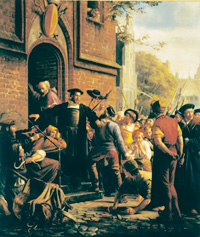
Bishop of Roskilde during
Reformation.
Joachim Ronnow, the last Bishop of Roskilde was imprisoned within his own castle in 1436. It is said he haunts Dragsholm’s tower where his captivity began.

Ejler Brokenhuus, a nobleman known as the “mad squire” was also imprisoned in the castle’s tower room. He was chained to one wall. It is not known if he became mad before or after his imprisonment.

Today, Dragsholm hosts two restaurants, conference rooms and a hotel.

Visitors to the castle report hearing moaning as well as Catholic chanting coming from this haunted tower room.

Mary, Queen of Scots third husband James Hepburn, the 4th Earl of Bothwell, was captured in Norway in 1573. King Frederick ll of Denmark had him imprisoned at Dragsholm.

Earl of Bothwell--James Hepburn
One report states he was given only enough food and water to keep him alive. He then was chained to a pillar and left. Before he died in 1578, he went mad.

Witnesses state they have seen the Earl of Bothwell riding into the castle courtyard in his carriage. Several reports state people have heard his horses’ hooves hitting the cobbled yard late at night.

One female ghost that haunts Dragsholm is nicknamed the White Lady. It is believed she was Celine, a daughter of the noble Bovles family. She fell in love with a commoner that worked at the castle. She then became pregnant.

When her father discovered her secret he ordered servants place her in one dungeon, chained to a wall, they then bricked her in while she was still alive.

This story is believed confirmed because in the 1930s workmen at Dragsholm repairing the plumbing found a skeleton enclosed in a small space, wearing a white dress.

The White Lady‘s apparition has been seen at night wandering about the castle. Not surprising, it is stated that she is looking for her lost love. Other witnesses have reported hearing her moan.

Dragsholm Castle today.
Another ghost seen is that of a young “fair maiden.” She worked at the castle and finding herself with a painful toothache she approached the castle’s noble owner. He had a poultice made which helped.

She unfortunately died after this but it is believed her ghost lingers because she is still grateful for her master’s help. She is seen at night--on a regular basis.

Many believe she is a protective spirit--still watching over Dragsholm out of gratitude.

The White Lady, the Earl of Bothwell and the Grey Lady are said to be the most active of all the ghosts at Dragsholm Castle.

Tuesday, January 20, 2015

The Dr. Mudd House

Dr. Samuel Mudd
Dr. Samuel Alexander Mudd was a farmer and practicing physician during the Civil War. He was a Confederate sympathizer and member of the Confederate underground.

He lived in Waldorf near Bryantown, Maryland with his wife and children. His farm was 30 miles south of Washington, D.C.

He was accused and convicted of being a part of John Wilkes Booth’s conspiracy to assassinate Abraham Lincoln.

Dr. Mudd met Booth three times in 1864--twice in Bryantown and once in Washington-- before Booth murdered Lincoln. At his trial, the doctor stated Booth was just a casual acquaintance.

After Booth shot Lincoln he broke his left leg as he leaped from Lincoln’s box to the stage at Ford’s Theatre.

Needing a doctor’s assistance, Booth and David Herold showed up at Dr. Mudd’s house at 4:00 a.m.

Mudd Farmhouse
The doctor stated at his military trial that he did not recognize Booth. He told the tribunal that when Booth and Herold arrived they gave the names of “Tyson” and “Henston.”

Dr. Mudd set and splintered Booth’s broken leg.

He stated he did not know about the assassination until he went to Bryantown to do an errand for his wife--Booth was still recovering in an upstairs bedroom of his home at the time.

Booth and Herold stayed at the doctor’s home for approximately 12 hours, paid him $12 for his services and then headed into the nearby Zekiah Swamp.

Shortly after this Dr. Mudd was arrested and charged with conspiracy for harboring Booth and Herold as they escaped.

Mudd was tried with 6 other men and 1 woman--Mary Surratt whose story I share here.

He was found guilty and sentenced to life imprisonment. He missed the death penalty by 1 vote.

Fort Jefferson prison
He was imprisoned at Ft. Jefferson in the Dry Tortugas located 70 miles from Key West, Florida.

In the summer of 1867, Yellow Fever broke out. The prison physician died. Dr. Mudd took over--he came down with the fever himself but recovered.

Because of his efforts all the decommissioned officers and soldiers signed a petition on his behalf.

President Andrew Johnson pardoned him in February of 1869. He returned home and continued his medical practice.

He died of pneumonia in January of 1883 after walking through the cold and snow to attend to a patient.

Dr. Mudd had 9 children and his descendants for many years worked tirelessly to clear his name. Historians today still debate whether he was innocent or guilty.

One compelling argument that he was guilty can be read here.

The results of an impressive “mock trial” that found him innocent can be read in the New York Times here.

Haunted Farmhouse

Today the Mudd farmhouse is run as a private museum. Several witnesses claim the house is haunted.

One author, Mike Ricksecker who wrote about this haunting in his book Haunted Maryland captured some interesting photos.

Danny Fluhart president of the Dr. Samuel A. Mudd Society told Ricksecker that no one is supposed to touch the bed that Booth stayed in on the 2nd floor.

Despite this rule, the staff is often frustrated to find they have to re-straighten it because the bed is mussed when they return to the museum in the morning. A distinct human-shaped impression is always discovered.

Bed Booth stayed in.
Click to enlarge
Ricksecker was in the home with Fluhart one Monday, when the museum was closed, they discovered the bed in this state and were able to take pictures.

The following video has staff and a Civil War reenactor talking about their encounters with a variety of paranormal activity at the farm. This video begins and ends with one group’s EVP sessions at this old farmhouse.

Friday, December 6, 2013

Baltimore’s Haunted Fort McHenry


This Maryland fort designed by French architect Jean Foncin in a 5-stared shape was completed in 1798. It was named after George Washington’s Secretary of War, James McHenry.

It is located on Locus Point Peninsula, which juts out into the opening of Baltimore Harbor. This fort is best known for the role it played in the War of 1812.

Bombardment of Fort McHenry
during War of 1812

The British bombarded the fort for 25 hours in 1814 for the control of Baltimore Port. It was during this struggle that the sight of the American flag * “still standing” moved a young lawyer --who had come to the fort to negotiate the release of a political prisoner of war-- to write a poem entitled, The Defense of Fort McHenry.

This young lawyer was Francis Scott Key and the poem he wrote was re-named and became America’s National Anthem--The Star Spangled Banner.

The 15-Star Flag that
inspired Key to write
his poe
During this British attack 4 people died at the fort--including the only black soldier to fight at McHenry. His ghost is still seen at the fort today. He is spotted carrying a rifle on his shoulder and pacing back and forth--as if he is still on duty.

During the Civil War, Fort McHenry was used as a prison for Confederate soldiers and for Confederate sympathizers. During World War l it was used as a hospital for returning wounded soldiers.

Workers and visitors state that because of the fort's dark history it has an oppressive atmosphere. People often report “a sense of dread,” “the feeling of being watched” and “the sensation of movement” when no one else is nearby.

Shadow figures are seen and people often smell gunpowder. Others report hearing crying, or the sound of drums playing in the distance. One dark entity seen by workers in the interior halls of the fort has frightened and even attacked people over the years.

A docent who works in one of the fort’s prison cells tells my favorite McHenry ghost story. For a long time he felt that he was not alone in this cell. For comfort he named this ghost--George. He feels his unusual friend might be one former Major of Baltimore--George William Brown.

Brown, a “political prisoner” was imprisoned at Fort McHenry during the Civil War. This docent sometimes would talk to George and he always said, “Goodnight George” before he left at the end of the day.

One day he forgot to bid his ghostly friend goodbye. As he went to exit the cell the door slammed shut. When he tried to open it, it was ripped from his hands forcefully and slammed shut again.

Unseen hands pushed this docent away from the cell door. Afraid but keeping his wits he realized his mistake. He loudly announced, “Goodnight George.” The cell door opened slowly and he was allowed to exit.

* Mary Pickersgill with the help of her daughter, two nieces and two African-American servants sewed this flag.