Saturday, January 23, 2016

Amelia Dyer: Britain’s Baby Butcher, Part ll

“ A many years ago
When I was young and charming
As some of you may know
I practiced baby-farming.”

 --Buttercup from Gilbert and Sullivan’s HMS Pinafore, 1878

Bristol in 1850s.
Amelia Dyer was born in 1837, during the Victorian era, in Pyle March—a tiny village just east of Bristol. She was the youngest of five children.

Her father, Samuel Hobley was a shoe marker, so the family had means. He paid for Amelia to go to school in a time when only a quarter of children had this privilege.

Amelia loved literature and wrote poems, but at an early age, her world was shaken. Her mother, Sarah Weymouth Hobley became mentally ill after suffering from typhus fever.

Young Amelia watched her mother’s seizures and outbursts until her death in 1848. Her slow, horrific death had a long-lasting effect on Amelia—she was sometimes called upon to provide care for a mother that was slowly losing her mind.

This early trauma skewed Amelia’s emotional responses for the rest of her life.

After her mother’s death Amelia was sent to live with an aunt and started an apprenticeship with a corset maker, a job she did until her father’s death in 1859.

Two years later, at the age or 24, Amelia broke off all ties with her family and moved to Bristol where she married George Thomas who at the age of 59 was 35 years her senior.

After her marriage, Amelia trained as a nurse and midwife at Bristol Royal Infirmary. In this era, nurses were not prepared to be caring or merciful; instead, they were expected to be strong and “emotionless” with their patients.

Amelia was a natural. However, when she became pregnant, she was no longer allowed to work.

Bristol Royal Infirmary
At this time, Ellen Dane was a boarder in Amelia’s home. Dane was a midwife who was a baby farmer on the “shady side.” Amelia observed that it was a lucrative profession if done right.

Dane provided housing for women who became pregnant out of wedlock—she offered them a place to hide from societies’ eyes, which condemned them for immorality.

Baby farming.
She would then take a once-off fee from these women and either adopt out or kill their babies through malnutrition. Amelia being a midwife, felt this business was ideal, despite the risk. She thought it would be an easy way to make money.

Her husband George died in 1869 leaving her with a child to support. She made two cold decisions that changed the course of her life forever.

Dane under suspicion by the police fled to America and Amelia took over her business.

Amelia, like Dane, provided a place for unwed mothers when they began to show. Once they had their babies she then firmly took control.

Amelia plying her trade.
Her education and charm lulled these women into trusting her.

She like Dane demanded an upfront, once-off fee of  £5-10 to have the babies supposedly adopted out, which cut down on the number of mothers returning to check on their children.

She did this not for the child’s welfare but to secure more profit.

She began to advertise her services in newspapers.

Two advertisements Amelia placed in newspapers.
Amelia like many baby farmers subjected her charges to persistent underfeeding—for the fees she received rarely paid for ongoing food. This resulted in these babies starving to death.

Godfrey's Cordial
A common practice at the time was to use an over the counter medicine known as Godfrey’s Cordial, also known as Mother’s Friend. This syrup was given to children and infants in the late 18th and early 19th centuries as a cure-all—that helped with colic, jaundice, and diarrhea.

It also helped with excessive crying. And hungry babies cried a lot, which made them difficult to handle. So Amelia like other farmers used this laudanum syrup that contained harmful opiates--to quiet the babies down.

Basically, it put them into a dull state where they felt no hunger. Many babies died from overdoses, but most died of starvation because this syrup was not a form of nourishment.

Coroners of the time noted in reports these deaths were due to “debility from birth,” “lack of breast milk,” or “starvation.”

Amelia quickly became used to making a tidy profit.

Ironically, Amelia became addicted to this laudanum syrup herself—which exasperated her mood swings and put her in deep depressions even when she was not on the opiate.

The other cold decision Amelia made at the time was to farm out her own daughter, Ellen Thomas. She didn’t want a child in her way as she traveled around to adopt babies and to avoid the authorities.

In Part lll of Amelia Dyer: Britain’s Baby Butcher this cold-hearted woman becomes even more prolific and the authorities miss their first opportunity.

Amelia Dyer: Britain’s Baby Butcher, Part l

An idyllic view of a baby farm.
It was January of 1896 when a barmaid named Evelina Marmon gave birth to a daughter she named Doris. Her baby was born out of wedlock.

The 25-year old Evelina was a God-fearing farmer’s daughter who had gone astray. She left her family’s farm for the excitement of the city only to find she had to work as a barmaid in the saloon at the Plough House—an old coaching inn—to survive.

Evelina was a buxom blonde with a quick wit. She was popular among the male customers, one of which got her pregnant and then deserted her. She lost work while she gave birth.

Evelina knew she could not bring up a baby on her own. Desperate she had to find a place for Doris.

She placed an ad in the “Miscellaneous” section of the Bristol Times & Mirror newspaper.

“Wanted, respectable woman to take young child.”

By chance, next to her ad was an advertisement that read:

“Married couple with no family would adopt healthy child, nice country home, Terms, £10.”


Marmon answered the ad, which was placed by a “Mrs. Harding.”

This was one of the aliases used by a woman, Amelia Dyer who was a baby farmer.

In Victorian England, women who gave birth to illegitimate children had few choices. Society condemned women who had babies out of wedlock stigmatizing them for life.

Abortions were illegal and the few women who had back alley abortions most often died of hemorrhaging. Birth control was frowned upon and not easy to come by.

With the passage of the 1834 Poor Law Amendment Act fathers of illegitimate children were not obliged to pay for their upbringing, there was a clause in this act passed by Parliament that stated women who had babies out of wedlock were immoral. Read more here.

Orphanages would not accept illegitimate children and there were no social service programs or welfare available during most of the Victorian era.

Finding abandoned and dead babies and children in train stations, church steps, and in the street was common.

One out of every twelve women in England at the time were forced to become prostitutes to survive.

Children born in normal circumstances had only a 50-50 chance to live to the age of 5—the outlook for illegitimate children was even worse.

A simple solution was presented when baby farming began. During the Victorian era, there were 2,000 of these farms in London alone but they could be found all over Britain and around the world.

Baby farms took babies and cared for them for a fee, on a weekly, monthly or yearly basis. They fostered these children or in many cases for a higher one-time fee of £5-10 the mother’s used these farms to “get rid of their babies” by arranging to have them adopted out.

Often these mothers were happy to dispose of their infants—not asking too many questions.

Other mothers who did care, often found their efforts blocked when they tried to check on their children after placing them in a farm’s care. They felt they could not report this suspicious activity to the police—for their own discretions might be discovered.

Unfortunately, many of these farms could not be associated with the word “care.”

Amelia Dyer
aka Mrs. Harding.
When Eveline Marmon approached “Mrs. Harding” she wanted to negotiate a weekly fee for the care of Doris—she hoped to reclaim her daughter in the future.

But Mrs. Harding insisted on a substantial one-time or one-off fee to be given up-front. Eveline desperate and running out of time reluctantly agreed to the £10 price. However, when she met Mrs. Harding at Cheltenham station she had second thoughts.

This woman was much older than she expected, she was heavy-set and 57 years old. In her advertisement, she had indicated that she and her husband could not have children and were looking to raise a family.

But as Eveline observed, Mrs. Harding appeared to be a caring and affectionate woman who covered Doris with her shawl. Eveline gave Mrs. Harding a box filled with: “clothes, nappies, chemises, petticoats, frocks, nightgowns and a powder box.”

She also handed over the one-off fee. Still nervous, she accompanied her baby and Mrs. Harding to the Cheltenham station and then on to Gloucester where she took a tearful departure from Doris.

When she returned home Eveline confided in friends that she was “a broken woman.” Days later she received a letter from Mrs. Harding that reassured her that all was well with Doris.

Eveline wrote back but never received a reply.

Mrs. Harding when she parted from Eveline told her she was headed for Reading—but she lied. Instead, she went to a flat in London where her daughter Mary Ann aka Polly was staying.

What she did next is something she had been doing for almost 30 years—it had nothing to do with the care of Doris—but was instead for money and perverse pleasure.

In Part ll of Amelia Dyer: Britain’s Baby Butcher become acquainted with the UK's most prolific serial killer.

Wednesday, January 20, 2016

Cherry Hills Murder

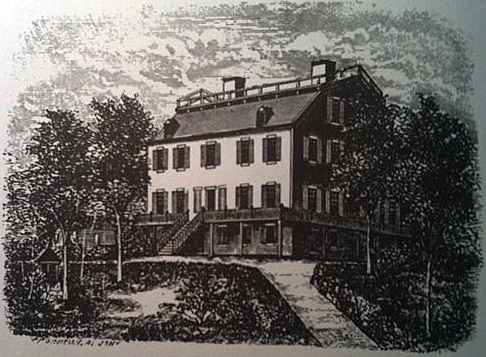
Cherry Hill Manor.
Cherry Hills, built in 1787, is a beautiful manor home that overlooks the Hudson River near Albany, New York. It belonged to the Van Rensselaer family for generations. Today it is a beloved landmark and museum.

This home however in 1827 gained notoriety for a sensationalized murder that was the result of a love triangle. 

At this time the house was occupied by members of the Rensselaer and Lansing families both scions of Albany society.

Elsie Lancing Whipple, the niece of Catherine Van Rensselaer, lived at home with her husband, John Whipple who she had eloped with at the age of 14.

Her family at first did not like Whipple, who was 9 years older than Elsie, but he quickly proved himself to be an asset. He managed the 900-acre Cherry Hill farm astutely and had doubled his young bride’s personal inheritance, so he was eventually accepted into the aristocratic family.

However, Elsie quickly became disenchanted with her husband for he was domineering and controlling. She, like many of the women in the family, was high-strung, hysterical, and often threw screaming fits.

A man by the name of John Orton, known to most at the farm as Doctor, because he could read and write, worked at the farm as an itinerant worker who did odd jobs. He lived in the home’s basement.

Orton’s real name was Jesse Strang. He was a drifter who had left his wife in 4 children in Fishkill, New York in 1825. He had faked his own death because he felt his wife had been unfaithful.

He first noticed Elsie Whipple in a tavern in Albany where he was working. He noted the young girl was, “sprightly, playful and giddy” and he was immediately attracted to her.

Soon after, Strang came to Cherry Hills to work. It wasn’t long before Elsie and Jesse were exchanging love letters via the family servants. The two managed to begin an illicit affair.

Elsie decided she could not live without Jesse and the two talked about fleeing together to Canada in their letters. But a lack of money stopped them. So Elsie came to the conclusion they best kill her husband—who controlled her money.

In the spring of 1827, she first had Jesse buy poison, and she placed this arsenic in a tonic that John took every day. But after several days he only suffered a stomachache. Frustrated at this failed attempt, Elsie now suggested Jesse should shoot her husband.

They both began to spread the rumor that men were out to kill her husband over a business deal. Strang told several people he had seen strange men lurking around the house.

On the evening of May 7, 1827, Jesse removed his coat and boots and climbed up on a shed attached to the back of the home with a rifle, he had bought recently.

Elsie had removed the curtains in John Whipple’s room. Jesse shot through the window, a bullet hit Whipple in the side and he died shortly after.


John Whipple's gravestone.
Jessie then buried the rifle in a nearby ravine and rushed to a store in town to establish an alibi. But the coroner became suspicious when he told the story of strangers at the farm repeatedly.

Jesse Stang's
Confession.
He was arrested and confessed to the crime—telling the police where he hid the rifle. He felt that Elsie’s family influence would ensure the authorities would go easy on him—so he told the police that she had masterminded the crime.

But when his lawyer told him this would not make a difference, he recanted his confession. Elsie was arrested two weeks later, and they were tried in separate trials.

Jesse's trial, on July 25, 1827 garnered a frenzy of interest—it had to be moved to a larger venue, the state Capital, to accommodate the crowd.

The merchants that he had bought the poison and rifle from testified and household servants told the court about the love letters and the rumors he had tried to spread about strangers at the farm. Yet others testified to the fact that Elsie and Jesse had been seen together.

But the evidence that sealed his fate was his own confession. The jury deliberated for 15 minutes and found him guilty. He was sentenced to hang.

Five days later, on July 30th Elsie was tried. Jesse was not allowed to testify. The jury, without leaving their seats, found her not guilty of conspiring to kill her husband.

Albany’s elite society had closed ranks and refused to condemn one of their own.

Elsie remarried a man by the name of Nathanial Freeman in Brunswick, New Jersey and when her second husband died she moved to Onondaga, New York where she died in 1832.

A crowd of 40,000 people watched Jesse Strang’s hang on August 24, 1827. It did not go well. The fall did not break his neck, and he swung for an hour before suffocating.

This was the last public hanging in Albany.


Cherry Hill today.
Shortly after John Whipple’s murder people began to report seeing a male ghost at Cherry Hill.

This male figure is seen often on the lower floor or the terrace. Today, nearby residents often state they have seen this apparition.

It is still hotly debated as to whether this ghost is John Whipple the victim or Jesse Strang the murderer.

The complete text of Jesse Strang’s confession is located here.

Monday, January 18, 2016

A Deadly Game of Hide and Seek

This classic ghost story has been immortalized in film, short stories, and in a famous song and poem.

It is known under various names. The Lost Bride, Bride and Go Seek and in England as The Mistletoe Bough or The Mistletoe Bride.

This story was first published in 1809 in Germany in an article entitled The Melancholy Occurrence, which tells the tale of a bride who goes missing on her wedding day.

Samuel Rogers’ poem entitled Ginevra, published in 1823, also tells the moving story of how a bride disappears on her wedding day only to be found years later.

“Full fifty years were past, and all was forgot . . .
The mouldering chest was noticed . . .
‘Why not remove it from its lurking place . . .’
It burst, it fell; and lo, a skeleton . . .”

The full text of this poem can be found here.

Roger’s poem inspired Thomas Bayly to write the lyrics for a ballad song entitled, The Mistletoe Bough, music composed by Sir Henry Bishop, in the 1830s. Here is a part of this song.

“They sought her that night, and they sought her next day,
And they sought her in vain while a week passed away . . .
At length, an old chest, that had long lain hid,
Was found in the castle—
They raised the lid,
And a skeleton form lay mouldering there
In the bridal wreath of that lady fair!”

The entire song lyrics can be read here. A popular version of this ballad is shared below.

By 1859, this song in England was so beloved it was shared in most households at Christmastime. Many knew the heart-wrenching lyrics “by heart.”

This story was retold in two short stories: The Old Oak Chest by Susan E. Wallace in 1887 and The Romance of Certain Old Clothes by Henry James in 1868.

The story was also made into a silent film in 1904 by Percy Stow; this short film has since been restored and is below. Two other movies based upon this story were made in 1923 and 1926.

Percy Stow film
This story has been told for over 2 centuries now. Various versions of this myth have circulated in America. A simplified version was retold in the early 1970s.

Alfred Hitchcock produced his own version of this story in 1948 in his film entitled Rope. In his film the main character, Brandon Shaw hides the body of a murdered son in a chest.

However, most versions of this story are similar so here is the English version -- The Mistletoe Bough.

A young bride was married to Lord Lovell at Christmastime. After the ceremony, she suggested they play a game of Hide and Seek, which the younger members of the wedding party could enjoy as well.

The young bride was picked as the first person to hide. No one suspected as she went off this would be the last they would see of her.

Her husband, father and the wedding guests searched and searched, but she was not found. The wedding guests eventually had to leave, many assured the family as they parted that surely the bride must have just fallen asleep in her hiding place.

The groom, father and the servants continued to search late into the night and the next day but their efforts were unrewarded for the young bride was not found.

The days turned to weeks and the weeks turned to months then years, but the bride’s disappearance remained a mystery. Lord Lovell grew old, and the story was now legendary.

The family home was eventually sold, and several years later the home’s attic was emptied. Amongst the old paintings and furniture, there was an old oak chest that appeared to be locked.

The lid was pried open and inside was a skeleton dressed in a wedding gown-- it was holding a withered wedding bouquet. At last, the bride was found.

Chest opened.

Bramshill House
Many stately homes * in England over the years have claimed to be the location for this chest. They include: Bramshill House and Marwell House both in Hampshire. Castle Horneck in Cornwall, Basildon Grotto in Berskhire, Minster Lovell Hall in Oxfordshire, Exton Hall in Rutland, Brockdish Hall in Norfolk and Bawdrip Rectory in Somerset.

* Some of these homes lay in ruins today.

A number of these homes also lay claim to the ghost of the unfortunate bride that is said to haunt their grounds. She is seen wearing her wedding gown.

I share more recent sightings in my post--Branshill's Entombed Bride.

Here is a recording of the song, The Mistletoe Bough.


The following is the restored silent version of the 1904 film version of this story. It is short.