Showing posts with label hanged. Show all posts

Friday, July 22, 2016

Southern California’s Convict Lake

Sportsmen state the fish do not bite when the ghosts are near. . .

A mile and a half up in the High Sierra Mountains in California sits a Lake named after escaped convicts.

Nevada State Penitentiary at Carson City
Convict Lake was named after a group of six convicts that escaped from the Nevada State Penitentiary in September of 1871. 

Twenty-nine men convicted of stagecoach and train robberies escaped this prison in the Nevada desert and headed west. They crossed the border into California.

This group of convicts split up and headed into the High Sierras, which was not a wise decision, for the first snowfalls in late September were already hitting these mountains.

Convict Lake
Six men from this group headed south toward the lake that is now named after them. They found themselves without shelter or supplies.

Along the trail, they encountered a local mailman, William Poor. Poor immediately recognized them from the wanted posters in his office. The convicts seeing the fear in his eyes killed him in cold blood.

When word about this murder reached the locals, they became enraged and formed a posse. 

On September 24th they found the convicts’ hideout near the lake. A bloody gun battle ensued. Deputy Sheriff Robert Morrison was killed. 

When the fight was over three men were taken into custody, the other three escaped further into the mountains and died of exposure. 

Two of the men captured were hanged. The third man who testified against the other two convicts was returned to prison. He was stabbed and killed by fellow prisoners for being a snitch.

Ever since three ghosts have been seen near this lake. Two wear nooses around their necks, the third has a knife sticking out of his back. It is believed he was the one who was the informer.

All three ghosts are seen covered in snow with icicles hanging from their eyebrows. Witnesses state these men have “lifeless” eyes.

These three ghosts are seen near Convict Lake year-round, but they are seen more often in the fall months. 

The locals and fishermen state that the trout in this lake do not bite when these ghosts are seen.

Witnesses state they present a gruesome sight.

Wednesday, January 20, 2016

Cherry Hills Murder

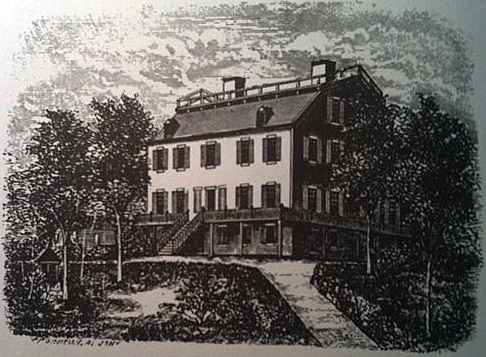
Cherry Hill Manor.
Cherry Hills, built in 1787, is a beautiful manor home that overlooks the Hudson River near Albany, New York. It belonged to the Van Rensselaer family for generations. Today it is a beloved landmark and museum.

This home however in 1827 gained notoriety for a sensationalized murder that was the result of a love triangle. 

At this time the house was occupied by members of the Rensselaer and Lansing families both scions of Albany society.

Elsie Lancing Whipple, the niece of Catherine Van Rensselaer, lived at home with her husband, John Whipple who she had eloped with at the age of 14.

Her family at first did not like Whipple, who was 9 years older than Elsie, but he quickly proved himself to be an asset. He managed the 900-acre Cherry Hill farm astutely and had doubled his young bride’s personal inheritance, so he was eventually accepted into the aristocratic family.

However, Elsie quickly became disenchanted with her husband for he was domineering and controlling. She, like many of the women in the family, was high-strung, hysterical, and often threw screaming fits.

A man by the name of John Orton, known to most at the farm as Doctor, because he could read and write, worked at the farm as an itinerant worker who did odd jobs. He lived in the home’s basement.

Orton’s real name was Jesse Strang. He was a drifter who had left his wife in 4 children in Fishkill, New York in 1825. He had faked his own death because he felt his wife had been unfaithful.

He first noticed Elsie Whipple in a tavern in Albany where he was working. He noted the young girl was, “sprightly, playful and giddy” and he was immediately attracted to her.

Soon after, Strang came to Cherry Hills to work. It wasn’t long before Elsie and Jesse were exchanging love letters via the family servants. The two managed to begin an illicit affair.

Elsie decided she could not live without Jesse and the two talked about fleeing together to Canada in their letters. But a lack of money stopped them. So Elsie came to the conclusion they best kill her husband—who controlled her money.

In the spring of 1827, she first had Jesse buy poison, and she placed this arsenic in a tonic that John took every day. But after several days he only suffered a stomachache. Frustrated at this failed attempt, Elsie now suggested Jesse should shoot her husband.

They both began to spread the rumor that men were out to kill her husband over a business deal. Strang told several people he had seen strange men lurking around the house.

On the evening of May 7, 1827, Jesse removed his coat and boots and climbed up on a shed attached to the back of the home with a rifle, he had bought recently.

Elsie had removed the curtains in John Whipple’s room. Jesse shot through the window, a bullet hit Whipple in the side and he died shortly after.


John Whipple's gravestone.
Jessie then buried the rifle in a nearby ravine and rushed to a store in town to establish an alibi. But the coroner became suspicious when he told the story of strangers at the farm repeatedly.

Jesse Stang's
Confession.
He was arrested and confessed to the crime—telling the police where he hid the rifle. He felt that Elsie’s family influence would ensure the authorities would go easy on him—so he told the police that she had masterminded the crime.

But when his lawyer told him this would not make a difference, he recanted his confession. Elsie was arrested two weeks later, and they were tried in separate trials.

Jesse's trial, on July 25, 1827 garnered a frenzy of interest—it had to be moved to a larger venue, the state Capital, to accommodate the crowd.

The merchants that he had bought the poison and rifle from testified and household servants told the court about the love letters and the rumors he had tried to spread about strangers at the farm. Yet others testified to the fact that Elsie and Jesse had been seen together.

But the evidence that sealed his fate was his own confession. The jury deliberated for 15 minutes and found him guilty. He was sentenced to hang.

Five days later, on July 30th Elsie was tried. Jesse was not allowed to testify. The jury, without leaving their seats, found her not guilty of conspiring to kill her husband.

Albany’s elite society had closed ranks and refused to condemn one of their own.

Elsie remarried a man by the name of Nathanial Freeman in Brunswick, New Jersey and when her second husband died she moved to Onondaga, New York where she died in 1832.

A crowd of 40,000 people watched Jesse Strang’s hang on August 24, 1827. It did not go well. The fall did not break his neck, and he swung for an hour before suffocating.

This was the last public hanging in Albany.


Cherry Hill today.
Shortly after John Whipple’s murder people began to report seeing a male ghost at Cherry Hill.

This male figure is seen often on the lower floor or the terrace. Today, nearby residents often state they have seen this apparition.

It is still hotly debated as to whether this ghost is John Whipple the victim or Jesse Strang the murderer.

The complete text of Jesse Strang’s confession is located here.

Thursday, August 13, 2015

The Hanging of Florence Lassandro


Florence Lassandro

Born Flumena Costanzo in Cosenza, Italy Florence immigrated with her family to Southern Alberta, Canada at the age of nine.

At the age of 15 her parents arranged a marriage for Florence. She married Charles Lassandro in October of 1915. Their marriage was not a happy one.

Charles moved Florence to the United States in order to make his fortune but ended up with huge gambling debts. The couple moved back to Alberta.

Charles hit up his former boss for a job.

Emil Picariello known as “The Emperor Pic” manufactured ice cream and owned the Alberta Hotel in Blairmore. However, these legitimate businesses where just a cover for his criminal activities.

Prohibition was in effect in Alberta and PIcariello was a successful bootlegger. He ran liquor from British Columbia into Alberta and Montana. Charles became involved in his rum running operation and so did Florence.


Picariello’s son Steve was also involved in this shady business and it is speculated that Florence was in love with him. Florence, who viewed Emil as a father figure and fed up with her irresponsible husband, ended up living with the Picariello family.

In September of 1921 the police spotted Steve Picariello making a rum run. They chased him and gunfire was exchanged. Steve was injured and then escaped to Michel, B.C.

Constable Lawson's home.
When Emil heard what had happened to Steve, he and Florence approached Constable Lawson at his home in Coleman. An argument ensued and gunshots were fired. Lawson’s nine-year old daughter Pearl, watched as her father was fatally wounded.

Both Emil and Florence where arrested for the murder of the constable. During the trial no evidence was presented that showed which one had actually shot Lawson. The jury was told they could convict both, which they did.

A public outcry arose over the fact there had been no proof or witnesses presented against Florence and appeals where submitted but nothing came of these.

One account mentions that Florence remained silent through her trial supposedly because Emil had asked her to take the blame—“for they would never hang a woman.”

During the trial Florence was dubbed, “The Mobster Princess.”

Both Emil and Florence were sentenced to hang. After the trial Florence’s pleas that she was innocent fell on deaf ears. She was hanged on the gallows at Fort Saskatchewan Penitentiary in Alberta in 1923 at the age of 23.

Fort Saskatchewan was used for a Northwest Mounted Police outpost—29 people were hanged here—Florence was the last woman to be hanged in Alberta.

People still wonder if Florence was just a victim of circumstance or was she a hardened criminal.

Fort Saskatchewan
Today several buildings that made up this fort still stand—including the courthouse where Florence was convicted. They are run as a museum today.

Many have experienced strange activity in these buildings. Unexplained voices and noises are heard on a regular basis. Apparitions are felt and seen in the buildings and around the grounds.

One ghost that lingers is believed to be Florence Lassandro.

One noted encounter with her ghost was during a Fright Night Halloween event and sleepover the fort hosted for young people.

Darlene Briere a member of Fort Saskatchewan Historical Society and a Special Event Coordinator for the fort took this group of young people outside after the event.

During this time she noticed a thick fog roll in to the area. Thinking it was strange she took several pictures with her digital camera.

Later when she downloaded them to her computer she saw a female standing amidst the fog. She became convinced it was Florence.

Later that same evening she went to check on the children whom were bedded down in the museum’s courthouse. As she walked by an adjoining room she spotted a curtain moving strangely.

She entered this room and saw this curtain move again—it then fell off its rod. It landed and outlined the shape of a body kneeling on the floor. She bravely approached this figure and pulled off the curtain shrouding the figure.

Before her was a young woman who looked just like Florence. *

* Excerpts from the television show Creepy Canada.

Side note: A popular Canadian Opera based on Florence’s or Flumena’s life and death has been performed in Canada since 2003. 

Thursday, March 5, 2015

New Hampshire’s South Street Cemetery


This South Street Cemetery located near downtown Portsmouth is haunted. One reason for this is because it was used as a hanging ground in the 1700s.

South Street is enormous and actually consists of five cemeteries that were eventually combined. 

South Street Cemetery

“South Street” is not the cemeteries’ official name but most call it this--because it stands at the intersection of South Street and Sagamore Avenue.

Near the north side, of the entrance to this cemetery, is where the gallows stood. In this area is where many visitors and investigators claim they get “creepy” or “eerie” feelings.

It was here in 1739 that Penelope Henry and Sarah Simpson were “turned off the cart.” This means they were positioned on a cart beneath the gallows--the cart was then pulled away leaving them hanging.

The man responsible for their deaths was High Sheriff Thomas Packer. In New Hampshire’s history, only three women have been executed by hanging--Packer was accountable for all three of these executions.

The most well known of these three was a 25-year old school teacher, Ruth Blay. Becoming pregnant out of wedlock, Blay concealed her condition. Her baby was stillborn.

She wrapped her dead baby in a cloak and buried it beneath loose floorboards, in the schoolhouse. Several of her students, including 5-year old Betsy Pettengill, saw her do this.

Packer's Falls
Blay's trial was rushed. She was found guilty and sentenced to hang--which many considered too harsh a punishment. After the trial, it was discovered her baby was stillborn.

Portsmouth residents defended their favorite schoolteacher and requested that a reprieve be granted.

However, on the day of her execution, December 30, 1768, Packer had other plans. Knowing a pardon might be on the way, he moved Blay’s execution up by one hour, before noon, so he would not be late for dinner.

An angry mob discovering this stood in the street, as Ruth Blay dressed in silk was taken by cart to the gallows. She did not go quietly--all heard her shrieks.

Packer hastily positioned her beneath the gallows and ignoring the shouting crowd, looped the noose around her neck. With his brisk command, the horses were driven away--leaving Blay's body swinging.

Her last view was of the open sea--today at this spot the view is blocked.

Ruth Blay is buried at the bottom of Gallows Hill. 
Packer left quickly as not to be late for his meal. Within minutes of Blay’s death, a rider with an urgent letter arrived. It was a pardon from New Hampshire’s Royal Governor, for Blay.

Outraged, the mob marched to the sheriff’s house. They hung an effigy of Packer with a sign that read:

“Am I to love my dinner
This woman for to hang?
Come draw away the cart, my boys--
Don’t stop to say amen.
Draw away, draw away the cart.”

Ruth Blay was buried in an unmarked grave, 300 feet north of the pond, that sits at the center of South Street Cemetery. It is near her grave where investigators capture the most anomalies in their photographs.

It is here, where most cameras malfunction. When investigators leave the area, they find their cameras work fine. Strange glowing lights--described as different than orbs--are also seen near Blay’s grave.

It is also believed that Blay and her baby, haunt the old schoolhouse located at 94 Main South Hampton, New Hampshire.

Thomas Packer hanged all three women for the same reason--records show that they were convicted of “ feloniously concealing the death of an infant bastard child.”

Just 25 years after Ruth Blay’s execution, American lawmakers ruled that Concealment should no longer be punishable by death.

Packer died in office, on June 22, 1771.

Sunday, January 18, 2015

Bill Sketoe’s Hole

This ghost story takes place in the Wiregrass area of Alabama near the town of Newton.  It has endured for 150 years because many believe it is true.


No one has ever seen the ghost of William “Bill” Sketoe but the locals are firmly convinced he haunts the area where he was hanged.

Bill Sketoe was a Methodist minister whose family was originally from Spain. He grew up in the town of Newton.

In 1864 he was fighting in his 3rd year for the Confederacy when he received word his wife Sarah, who was home taking care of their eight children, had taken ill.

He hired a “substitute” to take his place at the front so he could return home and tend to his wife. After he returned, it is said Sarah significantly improved.

As Sketoe’s visit turned from weeks into months it is said the Captain of the Dale County Home Guard -- a man by the name of Joseph Breare became convinced Sketoe was a deserter.

He and five of his men ambushed Sketoe on December 3, 1864, in an isolated area outside Newton near the old Choctawhatchee River bridge. 


What is left of the original wooden
bridge can be seen in the center front of this photo.
Click to enlarge.
They beat him up--made him crawl through the sand-- and then placed him in a buggy with a noose around his neck that was attached to the limb of a Post Oak tree.

Breare asked if he had any last words, and Sketoe asked if he could pray. But when he began to pray for the men in front of him, the captain became infuriated and whipped the buggy’s horse.

What these militiamen did not take into account was Sketoe was a tall, large man. The branch of the tree bent under his weight, and he was able to touch the ground with his toes.

George Echols, one of Breare’s men home because he was wounded, took his crutch, and dug a hole beneath Sketoe’s feet. Sketoe then strangled, and the deed was done.

Click to enlarge


After the hanging the hole that Echol’s dug remained. It was dug out of the soft sand near the riverbank, but it didn’t fill in.

It kept its original dimensions--30 inches wide and 8 inches deep. People felt a simple gust of wind should have filled it in, but the hole remained.


For the next 125 years, people tried to fill this hole in. Dirt, trash, and sand were placed in it, but when people returned, sometimes within the hour, the hole was empty.
In 1979 a new highway
bridge was built over the spot
where the hanging took place. 


Two men while a new highway bridge was being built even camped over the spot. They filled it with dirt, one also placed his bedroll over it only to find the next morning the hole was empty.

It always kept its original dimensions--30 inches wide, 8 inches deep.

So who or what was keeping this hole cleared out? The locals immediately came to believe it was the ghost of Bill Sketoe. They felt he haunted the area where he died because he was hanged unjustly.

For years, people came to see this hole, and paranormal groups investigated the area. The citizens of Newton erected a monument to Bill Sketoe by the hole.

Local historians reported that the 6 men of the Home Guard responsible for the hanging of Sketoe all met mysterious deaths.

Captain Breare while riding his horse, on a clear day, struck the limb of a Post Oak tree--the same kind that Sketoe was hanged from--and fell off his horse and died.

Another man was struck by lightning and died. George Echols who had dug the hole with his crutch died in the swamp from an unknown cause.

Another man while riding his mule was thrown off and died. Witnesses to this event reported the mule ran off as if terrified by something. The last two men also died of mysterious causes.

People began to believe Sketoe’s ghost played a hand in these deaths.

Most of the legend shared above was first published in Kathryn Tucker Windham's book, 13 Alabama Ghosts and Jeffrey. I share another story from her book here.

The legend of why Bill Sketoe was hanged has several gaping holes. 

Historian David Williams in his book entitled, Rich Man’s War: Castle, Class, and Confederate Defeat in the Lower Chattahoochee Valley presents another reason Sketoe was hanged.

First, there is no record that William Sketoe ever served in any Confederate or state military unit.

The legend's claim that he arranged a substitute to take his place at the front is highly unlikely because the Confederates repealed the Substitution Laws in early 1864.

Williams’s book indicates the reason for Sketoe’s hanging is more complicated.

During the Civil War Dale County was a wild place. The surrounding forests harbored numerous deserters and Unionists. They frequently emerged to terrorize the locals.

The residents in the area formed Home Guards to defend themselves.

Newton Home Guard
Joseph Breare, a Newton lawyer,  had served in the Alabama infantry and was captured at Gettysburg. He later formed the Newton Home Guard known locally as the Buttermilk Rangers. 

He and his men resolved to hunt down and punish all deserters.

Breare became convinced that Sketoe was helping John Ward, the leader of a local band of deserters and pro-Union guerillas.

Even though Sketoe was never charged or tried and there was no hard evidence of his
Sketoe's grave.
connection with Ward, Breare hanged him anyway.

It seems Sketoe’s life was still taken unjustly. So the reason for the haunting stands firm.

In 1990, flooding covered the area where Sketoe was hanged with tons of rocks. The hole is no longer visible.

Sunday, November 30, 2014

A Blacksmith’s Ghost

Solomon Fenner lived in the village of Laceby in Lincolnshire England in 1710.

Fenner had briefly served in King William and Queen Mary’s army when he returned to his home to work as the village blacksmith--a trade he had apprenticed in as a youth.

He was not wealthy, but he made a comfortable living. He was known in Laceby as a pious man who attended church each Sunday. He gave what he could to the parish poor.

Solomon unmarried and in his 30s became enamored with a young woman, Rebecca Petitt who lived in the neighboring market town of Caistor.

Rebecca was widely admired for her long red hair and lovely green eyes. Her beauty plus the fact she was witty had guaranteed she had plenty of suitors. Rebecca’s father William Petitt had rejected all offers of marriage for he had plans to make a more advantageous match.

Petitt was a greedy man who owned several shops in Caistor. His goal was to accept a son-in-law who would also benefit him financially.

Laceby

Solomon Fenner showed up at the Petitt’s doorstep one Sunday afternoon to ask William for his daughter’s hand in marriage.

William not only rejected his offer, he had his servants throw Fenner out onto the street.

Over the next week, Solomon usually a calm man let this rejection fester. Bitterness overtook him, and he snapped.

He knew Petitt’s habit every Saturday was to visit a friend in Cabourne a hamlet that lay between Caistor and Laceby. Petitt would return home late at night after an afternoon of gambling and drinking.

The next Saturday Solomon seeing “red” lay in wait in the shadows. When Solomon spotted Petitt staggering down the Lincolnshire road, he leaped out and bludgeoned him to death with his hammer.

Solomon calmed down and looked down at his bloodied hands, he realized it was too late.

He ran to a nearby farmhouse and woke the inhabitants. He tearfully confessed what he had done. They detained him and sent for the authorities in Caistor.

They discovered Petitt’s bloody and battered body and knew Solomon Fenner was telling the truth.

Hanged and
Gibbeted
The night before Solomon was hanged, he expressed fear for his immortal soul. His body was gibbeted on a hill that overlooked Cabourne--and the scene of the crime.

Since a legend states that Solomon Fenner has not found rest.

According to Lincolnshire folklore, the ghost of Solomon Fenner approaches travelers who walk between Cabourne and Caistor late at night.

He is described as tall and robust as he steps out of the shadows wearing dirty clothes and carrying a bloodstained hammer in his hand. His eyes are red from weeping.

What his ghost does next remind one of The Rime of the Ancient Mariner   for his spirit then confronts these travelers.

He reassures them that they have nothing to fear for he will not harm them. He then tells them the story of his crime. He reminds them that all life is sacred.

It seems his punishment for taking a human life is to spend eternity telling others his crime.

Wednesday, September 17, 2014

The Ghost of Captain Joshua Huddy


The British hanged this American Captain during the Revolutionary War for a murder he did not commit.

Sandy Hook in New Jersey was an important location for both the Americans and the British troops during the colonists struggle for independence.

It was here the colonists could observe British ship movements to and from New York City, which was occupied by the enemy.

The British needed to protect Sandy Hook Lighthouse against the rebels that were trying to destroy it--in hopes of causing an increase in British shipwrecks.


Sandy Hook Lighthouse
British Naval squadrons frequently stopped at Sandy Hook Bay to take shelter and top off their casks with the clear waters from a spring located at the Highlands.

Joshua Huddy was the son of a prominent Monmouth County family. He was leading an attack against British troops, stationed at Sandy Hook when he was captured.

Captain Huddy being
taken to prison.

The British tired of constant harassment by American patrols, and American spies were looking for an excuse to use a rebel as an example. Captain Huddy was chosen.

They accused Captain Huddy of killing Philip White, a British soldier. It was a trumped-up charge, for they knew White had actually been shot after Huddy had been taken as a prisoner.

They hanged Huddy from a tall tree atop the Highlands on April 12, 1782--his last view was of Sandy Hook and the bay.

A public outcry arose on both sides of the Atlantic when this dishonest treachery by the British commanders became known.

Captain Huddy quickly became an American martyr, because he had valiantly served his country, and he was “most foully murdered by the British occupiers.”

More than a martyr was created that April in 1782, for the restless spirit of this wronged Captain, still roams Sandy Hook.

It is said, Captain Huddy still watches for British warships approaching.

His spirit is known to check the living he encounters on his nightly patrols, to determine if they are patriotic Americans.

His ghost is seen wearing a Revolutionary War officer uniform. He wanders the shores of Sandy Hook.

He approaches people who observe him, but at the last moment, turns away, and then mysteriously disappears.

It is said that he disappears once he has heard the voices of those he meets. This is why it is believed that he is checking for British accents.

Some believe his ghost appears because he is seeking revenge for his unjust hanging.

After Hurricane Sandy's devastation to the area--the Monmouth County Park at Sandy Hook was reopened in the summer of 2013. So far, there have been no new reports about this ghost.

Monday, July 7, 2014

Thirteen Days


Here is a ghost folktale from the 1900s West Virginia oil fields.

The son of a young farmer was pitching hay one day when he fell on his pitchfork and was killed. A worker from a nearby oil derrick discovered the body.

He had just pulled the pitchfork out of the young man’s chest and was standing over him when four farmers came along and saw him.

These men were tipsy, for they had stopped after work for a drink. They became angry because they knew the boy’s father. They accused the oil worker of murdering the young farmer.

Irrationally, they decided to dispense justice immediately. One of the men got a rope and threw it over a limb of a tree while the other three dragged the protesting oil worker over to the tree.

They slipped the rope around his neck and asked him if he had any last words. He spat in their faces and announced that he would see all of them in hell. The oil worker threatened they would all die similarly within thirteen days.

The farmers hanged him and then assigned one man in the group, to bury the body. This man remained behind to place the body in a wagon.

He started for the woods. He drove his wagon along a road that was above a steep embankment.

His horses became spooked, and the wagon turned over, flipping him out. He fell twenty feet where his neck landed between two branches killing him instantly.

When his body was discovered, it was deemed an accident. The remains of the oil worker were not found.

At the scene, witnesses stated they saw a dark figure standing in the woods near the accident.

Three days later, the body of the second of the four men was found hanging from a hay mow in his barn. It appeared he had slipped on the clean floor and had fallen onto a rope used to haul things up to the loft.


Again, witnesses stated that they saw a dark form standing near the barn.

The two remaining men started to suspect the oil worker’s prediction was coming true--they wondered who would be next.

Nine days later, the third man was found hanging by the neck between two steel crosspieces on an oil derrick.

Several oil workers saw a a strange dark figure in the woods near the derrick, after the body was found hanging.

The next night, which was the thirteenth day, the fourth man was found hanging from a rafter in his kitchen-- an apparent suicide.

The man’s wife saw a dark form lurking around their farm for several days after her husband took his own life. He then stopped appearing.

Did the ghost of the innocent oil worker help his prediction come true?