Showing posts with label New York. Show all posts

Wednesday, August 14, 2019

The Hanging of Rose Butler


The land where Washington Square Park is located in New York’s Greenwich Village was used for over a hundred years as a burial site.

It was initially used as an Indian burial ground.

Then after the Revolutionary War it was a potter’s field for criminals that were hanged in New York in the 1700s.

A Vault full of bones found
beneath the park.
There are an additional 20,000 souls buried in a mass grave, lost to a yellow fever epidemic that lasted from 1791 to 1821.

As New York’s wealthier citizens moved into the area, this extensive graveyard was covered over for a military parade ground.

It was at this point that the shallow graves of the potter’s field began to surface. As a result, several bones of the deceased poor were crushed underfoot.

The military parade ground at what was to become the park.

This stark history, plus the disturbance of these graves—point to this ground being haunted. After this location became a park in 1828, people began to note unexplained activity.

Today, the buildings that surround Washington Square, house the various NYU departments. The young people that flock to this park often do not know, about the morbid history of their favorite hangout.

Many bodies lie beneath the famous fountain and arch at this park.

Hangman's Elm
Most of NYUs students have never heard of Rose Butler, even though some have encountered her ghost. On windy nights, she is seen swinging from a large tree in the park’s northwest corner known as the “Hangman’s Elm.”

She is described as a shadow dangling in the tree that appears to disappear when witnesses move closer, to get a better view. Others have noticed this dangling figure from the various windows that overlook the park.

Some have seen her apparition walking through the park. Cold spots accompany her, even on hot summer days. Most disturbing is the witnesses who claim they felt her walk right through them.

Rose Butler was a house slave owned by the Morris family. At age sixteen, the family accused her of stealing. Previous owners had also caught her stealing.

Rose resentful, was also angered at the fact many blacks that were “free” lived near the Morris household.*

She hatched a plan to kill the family. She tried to burn down their house. She set it ablaze and tied their only exit shut.

But she only managed to burn part of the staircase, the family escaped unharmed.

Rose was arrested and tried for arson.

Arson was a heinous crime at the time—for there were not firefighters, and many perished in house fires.

Butler was condemned to death by hanging. This was a harsh penalty—for a woman. The case went all the way to the New York Supreme Court, but they upheld the ruling.

Some state this was because New York was in transition at the time. Slavery was on the decline, and there was a lot of tension between slaveholders and non-slaveholders.


At the age of nineteen, in 1799, Rose Butler was the last criminal hanged in what would become Washington Square Park. She was buried in the nearby potter’s field.

Some feel her grave was one of the many desecrated—hence the haunting.

*   She should have been free, slavery was an abomination, but some because of this sentiment, claim she was innocent--the fire was just an accident. But my research reflected otherwise.

But another question remains--

Since Rose didn't succeed, should she have been hanged? 

Thursday, May 2, 2019

A Ghost at The Frederic Remington Art Museum


The Frederic Remington
Art Museum
This art museum is located in Ogdensburg, in northern New York. It is haunted by two notable ghosts, my favorite spirit in residence is a lady by the name of Elena (Ameriga) Vespucci.


It was said she was won in a card game . . .

George Parish
George Parish, the nephew of one of Ogdensburg’s leading citizens, Daniel Parish won a usual prize in a poker game from John van Buren, the son of President James van Buren.

Van Buren had lost $5000 in this game, so he wagered Ameriga his female companion and Parish accepted this bet and won.

Elena Vespucci
Elena Vespucci was born in Italy in 1804. She was a direct descendant of the Italian explorer Amerigo Vespucci—America’s namesake.

She was a headstrong child, so her parents sent her to live in a convent, Le Signore della Quiete in Florence for 14 years. She received an excellent education.

Lady Companions
At the age of 17, her parents introduced her to the court of the Grand Duke of Tuscany. She took her older sister’s name, Ameriga and lived in the palace as a demoiselle de compagnie, a lady’s companion to the Grand Duchess.

Ameriga inspired by the French Revolution and bored joined a secret society, connected to the Mazzini Italian Nationalist movement committed to gaining back Italy’s independence. In 1832, she took up arms disguised as a man.

She was wounded, and her identity was discovered. While recovering she refused to give the names of her, “comrades-in-arms” for two years, so she was banished from Italy.

She was an heiress but impoverished. Her family embarrassed by her conduct disowned her. She had married when she was young, but her husband died in one of Italy’s many revolutions.

Prince Ferdinand
She then became a mistress to a series of lovers. While in Paris she was the mistress of Prince Ferdinand, the son of King Louis Philippe.

In 1938, noble friends provided her with references as she left for North America. She traveled from Washington D.C. to New York then on to Boston.

Ameriga’s spirited personality and her dark-haired beauty captured the eye of several notable Americans, including Senators Benton and Webster.

In 1841, she applied for American citizenship, hoping to gain an entrance into American society, however, it was denied when Prince de Joinville a brother of Prince Ferdinand recognized her.

She was then obliged to return to her former way of life to survive, after several lovers she attached herself to John van Buren where she found herself placed as a wager in a poker game.

When George Parish won her, she met the love of her life at age 37.

The mansion as it looked when
George Parish owned it.
She became Parish’s mistress and the two moved into his mansion, which later became The Frederic Remington Art Museum.

Ameriga Vespucci 
The ladies of Ogdensburg shunned her for living in sin. But these were the best years of her life.

Sadly, George left the mansion in 1860, having inherited the title of Baron of Senftenburg in Bohemia, leaving “Madam Ameriga” as she was known, behind.

George returned, after settling his estate in Austrian only to send Ameriga to Paris where he arranged to give her a modest house and income. This broke her heart.

Ameriga threw a goodbye party for the neighborhood children. Their mothers attended only because they were curious and wanted to see inside the mansion.

She lived with her sister until her death in 1866. George, after taking a second mistress, an American widow, died in Venice on his honeymoon in 1881.

So did Ameriga Vespucci’s spirit travel back to the home in New York where she loved and lived happily with Parish?

Quite a few people believe this. One notable encounter with Ameriga’s ghost happened when a local psychic medium, Freda Gladle and her friend, Donna Wright visited the mansion in 2015.

They communicated with a female ghost who told them firmly, “I was not won in a poker game.”

Instead, this spirit told them she had lost money during this game and then had quit having no money left to bet.

Examples of Remington's work.
The mansion today is the Frederic Remington Art Museum, his widow lived in this house from 1915 until 1918. This museum displays several of Remington’s Western sculptures and oil paintings.

Remington’s ghost is seen at the museum as well as several other spirits. I will share their stories in a future post.

References include St. Lawrence County Historical Association publication, The Quarterlyand Walter Kellogg’s book Parish’s Fancy which can be bought on Amazon.

Monday, May 2, 2016

Mad Anthony: Spectral Midnight Rider

Even though ghosts are seen during the day the most dramatic sightings often are witnessed at night. Specifically, at midnight known as the witching hour.

Mad Anthony Wayne
This ghost story takes place at the witching hour in both upstate New York and Pennsylvania. After midnight one must gather their courage in these two states for many have reported seeing a spectral horse and its owner.

This ghost is Major General Mad Anthony Wayne and his horse Nancy. They are seen charging across shadowed hills and isolated roads.

Wayne was a hero during the American Revolutionary War. He got the nickname “Mad Anthony” because he took dangerous risks that exhibited a restless and daring courage.

Wayne with Nancy
His partner in this heroism was his horse Nancy. In one spot where he is seen, Storm King Pass, in 1779 he raced across the Hudson River in New York on Nancy’s back in order to warn a group of American troops that British soldiers were fast approaching.

This scene is still witnessed at midnight. People state Wayne and Nancy show no signs of fear.

In more dramatic witness accounts of this sighting it is said that white-hot orange sparks are seen flashing from Nancy’s hooves while Wayne’s dark cloak billows out behind him.

In a long standing legend it is stated Wayne’s ghost and Nancy are also seen along a road that runs between Radnor and Erie, Pennsylvania. The cause for this haunting is said to be the fact the old general is looking for some of his bones.

Old Fort on Presque Isle
These sightings occur on Presque Isle as well as at the old Wayne blockhouse in Erie.

Hooves are also heard pounding on Contestoga Road into Lancaster, along the Susquehanna River, then up the west bank to the Alleghenies all the way to the shores of Lake Erie.

It was along this route that Wayne’s remains journeyed in a wagon. The general was buried at the Old Fort on Presque Isle originally.

St. David's Episcopal churchyard.
But after his death his son, Isaac arranged to have his body dug up in 1809. He wanted his father’s remains buried at the old St. David Episcopal churchyard in Radnor—Wayne was a lifelong member of this church.

The box brought to carry his body was too small for all of Wayne’s bones so a surgeon made the decision to leave part of the bones buried at the fort. The rest were placed in this box and carried in a wagon across what was then still a wilderness.

The road to Radnor was rough and bumpy. It is said several of the bones fell out of the box and were left where they lay.

Waynes grave in Radnor.
What remained of Wayne’s body at the end of this journey was then reinterred at Old St. David’s churchyard.

The legend states that since Wayne’s body was disturbed and several of his bones were lost he still haunts this route looking for his missing bones.


His ghost is seen most often at midnight on New Years Day—this was Wayne’s birthday. Witnesses state they hear Mad Anthony whistling for Nancy his faithful horse and then her hooves are heard pounding across the rough landscape.

Tuesday, February 16, 2016

Seneca Hill Ghost

In the spring of 1898, William Cooper returned to his home in Fulton village late one night after drinking. 

He and his young wife argued over their farm property. Cooper picked up his gun and shot at his wife.

His wife now terrified, grabbed their young daughter, and ran panic-stricken to a neighbor’s farm. 

Cooper tracked her down and cruelly shot the neighbors, Charles Smedley and his wife but failed to kill his wife.

He then committed suicide.

This tragedy was reported in the New York Times on June 25, 1898.

Some believe this tragedy is the reason why for over a century multiple witnesses have seen a frightened female apparition running in the vicinity of Seneca Hill near Oswego, New York.

Seneca Hill is a small community that sits between Oswego and Fulton.

Witnesses state this ghost appears terrified as they watched her fleeing with a girl around the age of 6 in tow.

They describe her and the little girl as barefoot, both wearing white 19th-century nightgowns. Others state she wears a white cap—possibly a nightcap. 

What they have seen fits the tragic Cooper scene for his wife and daughter were terrified as they fled for their lives.

One male witness states as he was driving along this road, a barefoot woman, came out of nowhere and stopped right in front of his car. She was wearing a nightgown, and she appeared to be in a panic.

He watched as this woman ran up on the porch of a nearby house, she then vanished right through the door. He asked his wife, who sat next to him if she had seen that? She stated she had not.

Sightings of this frightened woman most often occur in July, October, and November. Many occur during November.

Railroad tracks.
Her ghost has been seen along Kingdom road and Dutch Ridge road. Her apparition has also been spotted on Route 481, along the railroad tracks, Route 57, along the shore and Route 45 near Minetto.

These sightings are so prolific that people who have never seen this ghost believe in her.

Sunday, February 7, 2016

Stambovsky v. Ackley: Notoriety Backfires, Part ll

Ackley home.
In 1989, Jeffrey Stambovsky, a Manhattan transplant bought Helen Ackley’s house for $650,000.

Stambovsky not aware of the home’s reputation for being haunted moved in with his wife. He first heard the news from a neighbor. Stambovsky then professed he did not believe in ghosts.

But despite his disbelief, he was disturbed that Helen and the realtor had not mentioned this information. He felt the notoriety of a haunting could potentially affect the home’s value.

Later, when his pregnant wife heard the news, Jeffrey decided for her comfort they should not have to stay in a place that made her nervous. Nor should they be expected to put their life savings into the home.

He filed a lawsuit against Helen and Ellis Realty, for “fraudulent misrepresentation.” He lost his first suit in a lower court, it sided with Helen Ackley citing caveat emptor, or buyers beware.

Stambovsky then appealed his case to the appellate division of the New York Supreme Court in 1991, in front of a panel of 5 judges. In a narrow 3 to 2 decision Jeffrey won.

Whimsically, Justice Israel Rubin, who wrote the decision declared, “That Helen Ackley had promised the Stambovsky’s that the property would be vacant when they took possession, which was obviously not true.”

The court based the decision on the fact that buyers beware did not apply in this case, for how does one inspect a house for ghosts. They also cited the fact that Helen had deliberately publicized her home as being haunted, so she owed the buyer no less.

Helen Ackley at age 77. She
has since passed away.
They did not find fraud on Helen’s part, but considering the history of her published comments, she could not deny the property was haunted—so as a matter of law, the house was haunted.

Excerpt of dissent.
Stambovshy was allowed out of his contract and his down payment of $32,000 was returned.

The next buyer of this LaVeta Place home on the Hudson River sold it later for $900,000, a fair market value. None of the three subsequent owners of the house have experienced paranormal activity.

The Stambovsky v. Ackley court decision is considered historic, because of its impact on New York and several other states laws, when it comes to a property that is stigmatized.

It varies from state to state but most, including New York, now have statutes on their books that the seller "does not" have to disclose ghostly activity to prospective buyers.

The one failsafe to this is if the prospective buyer asks, then the seller does have to tell the truth about a possible haunting.

In Part l of Stambovsky v. Ackley: Notoriety Backfires, the hauntings the Ackley family experienced over many years are described.

Stambovsky v. Ackley: Notoriety Backfires, Part l


Stambovsky v. Ackley is an historic court case where a house in Nyack, New York was declared legally haunted.

When Helen and George Ackley with their seven children moved into their stately Victorian home--several entities watched them.

The Ackley’s felt this 2-story, 5,000 square foot, 18-room home, with a full attic and basement, would be ideal for raising their family.

They had only one initial concern. The house had been abandoned for seven years, so there was a lot of work to be done.

Ackley's home.
The family soon discovered their new home was already occupied. As Helen looked out one bay window at the Hudson River, a plumber, doing work for them, mentioned that before they moved in, he had heard footsteps on the floor above him.

He said they would stop mid-swing, defying gravity.

Then a neighbor mentioned that one set of French doors would burst open without cause. George was told that people had heard disembodied “voices” in the house.

One day as Helen painted the living room, she spotted a ghost watching her. It looked on with approval, so Helen took this to mean it liked the color she had chosen.

The family discovered the house was occupied by a poltergeist as well. Items were moved or would disappear.

Helen’s oldest daughter, Cynthia frequently felt her bed shake on school days. This would occur just before her alarm was set to ring. Over spring break, she informed the ghost that she didn’t have to rise early the next morning. The bed didn’t shake.

Helen Ackley
As the years passed, Helen and other family members saw three distinct ghosts. One was a young woman who wore a red cloak. She was seen descending the stairs.

An elderly man was often seen levitating four feet off the floor. He was spotted most often in the home’s living room. Helen stated this man with his “cheerful” continence and “apple cheeks.” reminded her of Santa.

The third ghost was a sailor, that wore a powdered wig. Helen came to the conclusion that all three of these spirits were from the Revolutionary War period.

The Ackley’s home gained notoriety when Helen wrote an article in 1977, about this activity for Reader’s Digest entitled, My Haunted House on the Hudson.

This article is no longer available online but one quote from it states--

“The ghosts have been, gracious, thoughtful—only occasionally frightening—and thoroughly entertaining. Our ghosts have continued to delight us . . .”

In the 1980s, two local newspapers, the Nyack News and Views published articles Helen wrote about the ghosts.

As the family grew up, the house turned into a compound, the older children’s spouses moved in.

Various family members received gifts that would appear, given to them by the ghosts. Sometimes these gifts would then just disappear.

Helen was given a set of small silver sugar tongs, that then disappeared. The grandchildren all received baby rings, and a daughter-in-law was given coins.

Cynthia’s husband, Mark Kavanagh who later wrote an article, The Ghost of Nyack was alone in the house one Christmas. As he put various toys together, he heard a muffled conversation in the dining room.    

When he went to investigate the voices stopped, but once he left the room, they continued. After, he felt he was being watched.

One night as he lay on his side, he heard his bedroom door open. He heard the floorboards creak as someone approached the bed. He felt a weight as if someone sat down by his feet. Then something pressed against his body.

When he turned, he saw, “a womanly figure in a soft dress in the moonlight.” Within minutes this figure got up and walked out.


After George died, Helen decided to sell the house. This decision would involve her in a sensational law case that landed in front of New York’s Supreme Court.

In Part ll of Stambovsky v. Ackley: Notoriety Backfires, this case is described.

Wednesday, January 20, 2016

Cherry Hills Murder

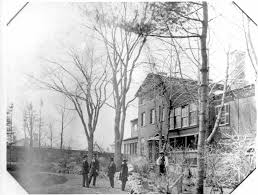
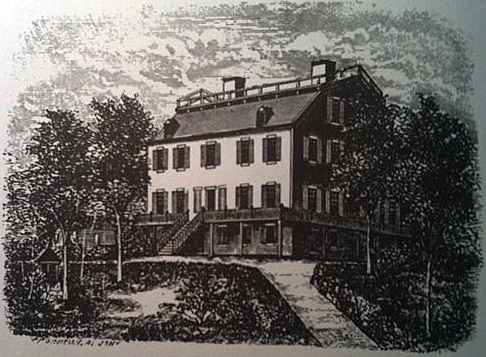
Cherry Hill Manor.
Cherry Hills, built in 1787, is a beautiful manor home that overlooks the Hudson River near Albany, New York. It belonged to the Van Rensselaer family for generations. Today it is a beloved landmark and museum.

This home however in 1827 gained notoriety for a sensationalized murder that was the result of a love triangle. 

At this time the house was occupied by members of the Rensselaer and Lansing families both scions of Albany society.

Elsie Lancing Whipple, the niece of Catherine Van Rensselaer, lived at home with her husband, John Whipple who she had eloped with at the age of 14.

Her family at first did not like Whipple, who was 9 years older than Elsie, but he quickly proved himself to be an asset. He managed the 900-acre Cherry Hill farm astutely and had doubled his young bride’s personal inheritance, so he was eventually accepted into the aristocratic family.

However, Elsie quickly became disenchanted with her husband for he was domineering and controlling. She, like many of the women in the family, was high-strung, hysterical, and often threw screaming fits.

A man by the name of John Orton, known to most at the farm as Doctor, because he could read and write, worked at the farm as an itinerant worker who did odd jobs. He lived in the home’s basement.

Orton’s real name was Jesse Strang. He was a drifter who had left his wife in 4 children in Fishkill, New York in 1825. He had faked his own death because he felt his wife had been unfaithful.

He first noticed Elsie Whipple in a tavern in Albany where he was working. He noted the young girl was, “sprightly, playful and giddy” and he was immediately attracted to her.

Soon after, Strang came to Cherry Hills to work. It wasn’t long before Elsie and Jesse were exchanging love letters via the family servants. The two managed to begin an illicit affair.

Elsie decided she could not live without Jesse and the two talked about fleeing together to Canada in their letters. But a lack of money stopped them. So Elsie came to the conclusion they best kill her husband—who controlled her money.

In the spring of 1827, she first had Jesse buy poison, and she placed this arsenic in a tonic that John took every day. But after several days he only suffered a stomachache. Frustrated at this failed attempt, Elsie now suggested Jesse should shoot her husband.

They both began to spread the rumor that men were out to kill her husband over a business deal. Strang told several people he had seen strange men lurking around the house.

On the evening of May 7, 1827, Jesse removed his coat and boots and climbed up on a shed attached to the back of the home with a rifle, he had bought recently.

Elsie had removed the curtains in John Whipple’s room. Jesse shot through the window, a bullet hit Whipple in the side and he died shortly after.


John Whipple's gravestone.
Jessie then buried the rifle in a nearby ravine and rushed to a store in town to establish an alibi. But the coroner became suspicious when he told the story of strangers at the farm repeatedly.

Jesse Stang's
Confession.
He was arrested and confessed to the crime—telling the police where he hid the rifle. He felt that Elsie’s family influence would ensure the authorities would go easy on him—so he told the police that she had masterminded the crime.

But when his lawyer told him this would not make a difference, he recanted his confession. Elsie was arrested two weeks later, and they were tried in separate trials.

Jesse's trial, on July 25, 1827 garnered a frenzy of interest—it had to be moved to a larger venue, the state Capital, to accommodate the crowd.

The merchants that he had bought the poison and rifle from testified and household servants told the court about the love letters and the rumors he had tried to spread about strangers at the farm. Yet others testified to the fact that Elsie and Jesse had been seen together.

But the evidence that sealed his fate was his own confession. The jury deliberated for 15 minutes and found him guilty. He was sentenced to hang.

Five days later, on July 30th Elsie was tried. Jesse was not allowed to testify. The jury, without leaving their seats, found her not guilty of conspiring to kill her husband.

Albany’s elite society had closed ranks and refused to condemn one of their own.

Elsie remarried a man by the name of Nathanial Freeman in Brunswick, New Jersey and when her second husband died she moved to Onondaga, New York where she died in 1832.

A crowd of 40,000 people watched Jesse Strang’s hang on August 24, 1827. It did not go well. The fall did not break his neck, and he swung for an hour before suffocating.

This was the last public hanging in Albany.


Cherry Hill today.
Shortly after John Whipple’s murder people began to report seeing a male ghost at Cherry Hill.

This male figure is seen often on the lower floor or the terrace. Today, nearby residents often state they have seen this apparition.

It is still hotly debated as to whether this ghost is John Whipple the victim or Jesse Strang the murderer.

The complete text of Jesse Strang’s confession is located here.