Showing posts with label Albany. Show all posts

Wednesday, January 20, 2016

Cherry Hills Murder

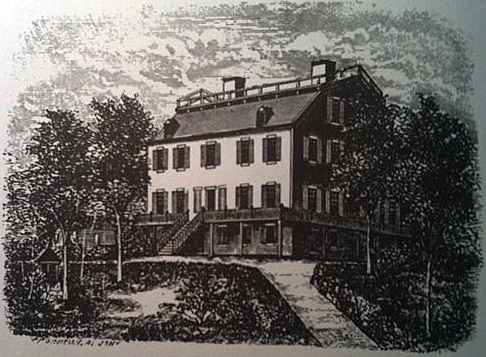
Cherry Hill Manor.
Cherry Hills, built in 1787, is a beautiful manor home that overlooks the Hudson River near Albany, New York. It belonged to the Van Rensselaer family for generations. Today it is a beloved landmark and museum.

This home however in 1827 gained notoriety for a sensationalized murder that was the result of a love triangle. 

At this time the house was occupied by members of the Rensselaer and Lansing families both scions of Albany society.

Elsie Lancing Whipple, the niece of Catherine Van Rensselaer, lived at home with her husband, John Whipple who she had eloped with at the age of 14.

Her family at first did not like Whipple, who was 9 years older than Elsie, but he quickly proved himself to be an asset. He managed the 900-acre Cherry Hill farm astutely and had doubled his young bride’s personal inheritance, so he was eventually accepted into the aristocratic family.

However, Elsie quickly became disenchanted with her husband for he was domineering and controlling. She, like many of the women in the family, was high-strung, hysterical, and often threw screaming fits.

A man by the name of John Orton, known to most at the farm as Doctor, because he could read and write, worked at the farm as an itinerant worker who did odd jobs. He lived in the home’s basement.

Orton’s real name was Jesse Strang. He was a drifter who had left his wife in 4 children in Fishkill, New York in 1825. He had faked his own death because he felt his wife had been unfaithful.

He first noticed Elsie Whipple in a tavern in Albany where he was working. He noted the young girl was, “sprightly, playful and giddy” and he was immediately attracted to her.

Soon after, Strang came to Cherry Hills to work. It wasn’t long before Elsie and Jesse were exchanging love letters via the family servants. The two managed to begin an illicit affair.

Elsie decided she could not live without Jesse and the two talked about fleeing together to Canada in their letters. But a lack of money stopped them. So Elsie came to the conclusion they best kill her husband—who controlled her money.

In the spring of 1827, she first had Jesse buy poison, and she placed this arsenic in a tonic that John took every day. But after several days he only suffered a stomachache. Frustrated at this failed attempt, Elsie now suggested Jesse should shoot her husband.

They both began to spread the rumor that men were out to kill her husband over a business deal. Strang told several people he had seen strange men lurking around the house.

On the evening of May 7, 1827, Jesse removed his coat and boots and climbed up on a shed attached to the back of the home with a rifle, he had bought recently.

Elsie had removed the curtains in John Whipple’s room. Jesse shot through the window, a bullet hit Whipple in the side and he died shortly after.


John Whipple's gravestone.
Jessie then buried the rifle in a nearby ravine and rushed to a store in town to establish an alibi. But the coroner became suspicious when he told the story of strangers at the farm repeatedly.

Jesse Stang's
Confession.
He was arrested and confessed to the crime—telling the police where he hid the rifle. He felt that Elsie’s family influence would ensure the authorities would go easy on him—so he told the police that she had masterminded the crime.

But when his lawyer told him this would not make a difference, he recanted his confession. Elsie was arrested two weeks later, and they were tried in separate trials.

Jesse's trial, on July 25, 1827 garnered a frenzy of interest—it had to be moved to a larger venue, the state Capital, to accommodate the crowd.

The merchants that he had bought the poison and rifle from testified and household servants told the court about the love letters and the rumors he had tried to spread about strangers at the farm. Yet others testified to the fact that Elsie and Jesse had been seen together.

But the evidence that sealed his fate was his own confession. The jury deliberated for 15 minutes and found him guilty. He was sentenced to hang.

Five days later, on July 30th Elsie was tried. Jesse was not allowed to testify. The jury, without leaving their seats, found her not guilty of conspiring to kill her husband.

Albany’s elite society had closed ranks and refused to condemn one of their own.

Elsie remarried a man by the name of Nathanial Freeman in Brunswick, New Jersey and when her second husband died she moved to Onondaga, New York where she died in 1832.

A crowd of 40,000 people watched Jesse Strang’s hang on August 24, 1827. It did not go well. The fall did not break his neck, and he swung for an hour before suffocating.

This was the last public hanging in Albany.


Cherry Hill today.
Shortly after John Whipple’s murder people began to report seeing a male ghost at Cherry Hill.

This male figure is seen often on the lower floor or the terrace. Today, nearby residents often state they have seen this apparition.

It is still hotly debated as to whether this ghost is John Whipple the victim or Jesse Strang the murderer.

The complete text of Jesse Strang’s confession is located here.

Friday, June 19, 2015

The Haunted Satin Dress and Abe Lincoln

This is the strange tale of a bloodstained dress, Lincoln’s ghost and a young couple that witnessed his assassination who afterward experienced their own tragedy.

Major Henry Rathbone was the son of a successful Albany businessman who made his fortune from making and selling stoves. His fiancé, Clara Harris was the daughter of a U.S. Senator, Ira Harris.

Clara Harris and Major Henry Rathbone
Rathbone and Harris were invited to join Lincoln’s party at Ford’s Theatre the night he was shot by Booth. This young couple had seats in Lincoln’s box.

The Major jumped up and tried to detain the assassin, but Booth pulled a knife out and deeply slashed Rathbone’s arm, he then escaped by jumping to the stage.

The white satin dress Clara wore was splashed with Lincoln’s and her fiancé’s blood. Rathbone and Harris, after this horrific night, traveled back to Albany and were married. They had three children.

Some believe after they witnessed Lincoln’s assassination, it tainted their lives. Clara could not wear the stained dress again, but just getting rid of it didn’t feel right to her.

Henry standing at left, Clara sitting
next to him.
Unfortunately, every time she saw it, bad memories of that terrible night flooded back. The shot that rang out, the splashed blood, her fiancé’s valiant attempt to catch the murderer, the flash of Booth’s knife as it sank into Henry’s arm, her voice that demanded water for the president.

Even when the couple was preparing to sell their Albany home, Clara could not get rid of the gown. Her solution was to have the closet the dress was in sealed off with bricks.

Henry’s life, after the assassination, was one filled with a dark depression, which eventually manifested into mental illness. The Rathbones in 1882 moved to Hanover, Germany, in a quest to seek aid for Henry’s sad illness.

Before dawn on Christmas Eve morning in 1883, a pale, thin Henry who now complained of constant headaches came into his wife’s bedroom, fully dressed.

Henry and Clara
He told Clara he wanted to be with their children. She reminded him of the early hour. Members of the household awakened, hearing their voices, entered the bedroom to discover Clara dead and Henry lying on the floor with multiple stab wounds.

In an eerie repeat of the assassination they had witnessed eighteen years earlier, Henry had taken a revolver and shot his wife and then stabbed himself six times.

Rathbone lived and was committed to a German asylum for the hopelessly insane. He lived in constant fear the other inmates were conspiring against him. Henry died in this institution in 1911. He was buried next to Clara, who was 28 when he murdered her. *

Back in Albany, at the Rathbone’s former house, with the bricked-up closet, witnesses reported a variety of strange happenings.

A shot was heard ringing out on the anniversary of Lincoln’s assassination, people claimed to see the ghost of Abe, and a sobbing woman was seen wearing blood-soaked attire.

These rumors were so prevalent in Albany that in 1929, Mary Raymond Shipman Andrews wrote a story called The White Satin Dress based upon this haunting.

Louis C, Jones, who wrote Things That Go Bump in the Night, grew up in Albany. He remembers one story that was often told.


A family who were descendants of the family who occupied the house, after the Rathbone’s moved, hosted a houseguest who experienced this haunting.

This guest, related to the then Governor of Massachusetts was pondering a political problem while at home. A bill that had been passed in his state was causing a heated controversy.

Having trouble falling asleep, he worried whether he should take the side that would be politically expedient for his career, or do what he considered to be the right thing.

He finally fell asleep to be awoken abruptly. There was someone in the room with him. He raised himself up on one elbow and saw the figure of Lincoln standing in the moonlight.

Lincoln appeared to be calm and had an understanding smile upon his lips-- he then just vanished. The governor switched on the light, and a book of Lincoln’s speeches fell to the floor.

As he picked it up and saw these words, “Hew honesty to the line; let the Lord take care of the chips.” The governor stuck to his guns and supported the bill. He was re-elected and went on to serve his state with more courage than before.

The family that lived in the house was skeptical about what he saw, but during a renovation of the bedroom, that he stayed in, they found the tiny closet that had been closed off. In it was the dress with Lincoln’s bloodstains. They sealed it back up.

*  In 1952, following German cemetery policy regarding graves long unvisited, the remains of the Rathbone’s were dug up and disposed of. This might be why Clara Rathbone’s ghost also haunts her old home in Albany.

Henry Riggs Rathbone
The Rathbone’s oldest son, Henry Riggs Rathbone was 13 years old when his mom died. Clara’s brother then raised him and his younger brother and sister. He grew up to be a U.S. congressman. He proposed Ford’s theatre be turned into a museum--which it was.


In 1910, just one year before his father’s death, Representative Rathbone broke down the bricks that enclosed his mother’s white satin dress, which had been worn 45 years earlier. He burned it--saying it had cursed his family.

Tuesday, November 11, 2014

The Hayden Family Curse

William Henry Hayden known as “Will” moved his family to Albany, Vermont in the early 1800s. He borrowed money from his mother-in-law Mercie Dale who was a widow and financially well off.

Mercie moved with the family, and her money helped the family settle into this new community. Will never paid this loan back, and several years later he found himself in severe financial trouble. He once again approached Mercie and requested additional money.

She refused and now uncomfortable moved away from the family. In the following months, she was struck by an ongoing illness. Now suspicious, she accused Will of poisoning her.

In 1809, as she lay dying in the presence of her daughter Silence she uttered an ominous curse in which she declared the Hayden name would die and pass into oblivion.

“The Hayden name shall die in the third generation and the last to bear the name shall die in poverty.”

Mercie bitterly announced she refused to be buried in the Hayden family cemetery she instead requested to be interred in a neighbors’ family plot.

Life went on, and the curse was forgotten.


Will Hayden’s daughters all got married and supplied the couple with several grandchildren. But the family’s luck and fortunes quickly took a turn for the worse.

Of the couple’s four sons all but one died young. The one that survived Henry was named after his father. He slowly started to show signs of erratic behavior.

Will and his wife Azabah became estranged after Will lost most of the family fortune. He later also lost his eyesight.

Will at one point fled to Canada to avoid his creditors. He died later in New York penniless.

Will’s son Henry Jr. built an extravagantly furnished home for his family in 1854 after his father's death. *

Henry Hayden Jr. mansion
The Henry Hayden Jr. family quickly became the envy of the neighborhood. The family would take regular pleasure rides down South Albany Road in handsome horse-drawn carriages.

Henry's family lived comfortably with many servants to fulfill all their needs. Their annual New Year’s party held in the new mansions 3rd story ballroom with its “spring suspended floor” was always a big success.


Hayden Family plot

As Henry Jr. continued to grow unstable, his mother cut him out of the will. He had one daughter named Mamie. He died in 1910 of a cerebral hemorrhage.

Henry Jr. body was carried in a horse-drawn hearse that passed his old home on the way to the cemetery. The curtains in the windows were shut in tribute, but by this time his mansion had been empty for 20 years because he could no longer afford to live in it.

Many now recalled Mercie’s curse and most believed it had taken its toll on the Hayden family.

The only Hayden left alive was Henry Jr.’s daughter Armenia or as she was known, Mamie. All that was left of her inheritance was an unsavory family reputation and a large number of unpaid bills.

Ill and humiliated she moved to Waterville, Maine where she died alone in poverty in February of 1927.

She was the last victim of Merice Dale’s curse.

* This 160-year-old Greek revival style mansion located on Route 14 is on the National Register of Historic Places.

A family from Canada purchased the old Hayden mansion for $25,000.

Rumors started to spread that the underground tunnels that Henry Jr. had once used to smuggle illegal Chinese immigrants to supply his farmland with cheap labor were now being used for a large bootlegging operation.

This new family held dances once more in the 3rd-floor ballroom. They enjoyed the social status this brought. In 1922 they sold the mansion.

Most of the subsequent owners did not have the money to maintain the old mansion. The estate was eventually sold piece by piece other parts burnt down.

The mansion abandoned for years spiraled into disrepair.

Stories began to circulate that the old mansion located on the outskirts of town was haunted.

People passing by reported seeing strange lights. Others mentioned hearing music coming from the 3rd-floor ballroom. They stated this room was brightly lit at the time they heard this music.

Some believe that the ghosts of the Chinese immigrants that Henry smuggled into the country remain. These workers were often buried in unmarked graves near the family’s farm.