Showing posts with label spirit. Show all posts

Thursday, August 27, 2015

The Good Spirit: Grey Robe


The stories about Grey Robe and why the Navajo’s believe in him were highlighted in the May 1969 edition of Frontier Times in an article written by John R. Winslowe.

In Robert F. Turpin’s 2014 book, Old West Ghost Legends he includes a chapter on stories that have been told about encounters with Grey Robe.


In more recent times Navajos have referred to Grey Robe as a “good spirit.” But traditionally, he was never referred to as what other cultures call a ghost.

Instead, the Navajo considered him merely a mysterious entity or benefactor that saved many Native American lives.

All the sightings of him occurred in the Red Valley near Tuba City in Arizona.

Descriptions of Grey Robe state he glides instead of walking, his facial features are rarely seen and some accounts state his form when seen was surrounded by a grey mist or fog.

He is seen wearing a grey robe tied at the waist with a cord—hence his name. Witnesses state he never talks he points or gestures instead.

This entity was first seen in the early 1800s and reports of encounters continued into the late 1940s.

He is credited with saving lost children, an isolated crippled woman who had fallen and a boy that broke his leg on a remote ridge.

It also is stated Grey Robe warned many people of impending dangers—such as washed-out roads and flood waters heading their way.

It is said he led a sheepherder to water during a drought, so he would not lose his flock.

Black Hat’s Encounter

One Navajo named Black Hat, who was new to the Red Valley in north-central Arizona, had never heard the stories about the mysterious Grey Robe when he encountered him.

He was traveling through the valley when his horse slowed down and perked up his ears. He saw a grey figure up ahead, standing near the trail he traveled.


The figure was wrapped in a robe, and a grey mist or grey smoke seemed to surround him. Black Hat stopped his horse and asked, “Who are you?”

The shadowy figure did not speak but instead motioned for him to follow him. Black Hat noticed the figure made no sound as he moved through the sagebrush—his body appeared to float instead of walk.

Several hundred yards further down the trail, the figure stopped and turned toward Black Hat. It then pointed toward a rocky ridge in the distance.

As Black Hat turned back he saw the figure slowly fade away. He realized this encounter had not scared him, but instead, he felt a feeling of serene kindness settle over him.

Black Hat headed to the rocky ridge where he found an unconscious Indian boy. He saw that the boy’s leg was broken in several places.

He gathered dry brush and made a signal fire. It wasn’t long before a party of Navajos rode in. They lived nearby and had seen the light.

It was discovered later that the boy had been thrown from his pony when a rattlesnake frightened it.

If Black Hat had not found the boy, he would have died. The other Indians asked him how he had happened upon the boy since the ridge was quite a distance from the trail he traveled.

Black Hat hesitated and then told then about the grey figure. The others seemed not to be surprised by his description—especially the part where he stated the figure wore a grey robe and was faceless.

The elder of the group nodded and said. “It was Grey Robe.” He then told Black Hat about the friendly spirit that helps the Navajo people.

This legend is not lost today, for the Navajos remember the stories about Grey Robe fondly.

Thursday, August 20, 2015

Rescue In A Vast Ocean


The spirits of departed relatives sometimes return to save a loved one.

In March of 1876, a sea captain named George Hatfield was a few weeks from his home in Fox River, Nova Scotia. He was sailing north from Cuba to Boston when a bad storm hit the Atlantic Ocean.

He spent a stressful day at the helm of his ship and then gratefully retired to get so much needed rest. But as fate would have it this was not to be.

Soon after Hatfield nodded off he felt a hand on his shoulder and heard a voice state he needed to change course. But when he rolled over there was no one in his cabin.

Hatfield thought his first mate must have delivered the message and then rushed back up on deck. The captain headed up to the bridge to find out what was going on.

On deck he spotted his first mate at the wheel leading the ship through the stormy waters. Hatfield approached him and quizzed him as to why he did not want to follow the set course.

But the first mate had no idea what he was talking about. Hatfield feeling foolish concluded he must have dreamed the visitor in his cabin.

He went below and crawled back into his bunk. He fell asleep quickly but shortly after he was awakened again in the same manner.

Angry, Hatfield headed back to the deck. He demanded his first mate tell him why he wanted to change course and why he had not stayed after waking him to discuss this matter.

Noticeably puzzled, the mate replied that he had not left his post, nor had any other crewmember.

Now confused, the captain returned to his cabin. He had barely closed his eyes when someone tapped his shoulder and ordered him in a loud voice to make a specific course change.

This time as the captain looked up he saw a strange man leaving his cabin. Hatfield jumped up and hurried up the stairs to the deck. When he reached his first mate he asked him if he had seen someone walking along the deck.

His first mate replied no. The captain then ordered him to alter the ship’s course in the way the voice had directed him. The first mate despite the captain’s erratic behavior followed his orders.

This time when Hatfield returned to his bunk he was able to go to sleep without any more interruptions.

The next morning when the captain appeared on deck he ordered his men to keep a sharp look out at the sea.

Several hours later he heard a cry and then one of his crew pointed out a battered ship that appeared to be taking on water quickly.


The captain was able to maneuver his ship close to the sinking ship. It was the American schooner D. Talbot. His crew managed to rescue everyone on board.

The ship’s captain, a man by the name of Amesbury, was particularly grateful for his wife and child were on board the doomed ship.

Later after the captain and his family were dry, Hatfield told them how he had happened to find them. He described the mysterious man that had appeared in his cabin.

Captain Amesbury’s wife interrupted Hatfield and asked him to describe what this man wore. After he did, she began to cry. Hatfield asked her what was the matter?

She told him that he had described her father—this man had died ten years earlier.

Everyone involved later agreed that her father’s spirit had returned from the grave and guided Hatfield to the exact spot in the vast Atlantic Ocean—where his help was needed.

Wednesday, July 22, 2015

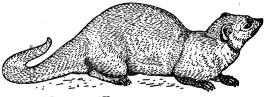
Isle of Man’s Talking Mongoose


The “creature” in the following story has been compared to a German paranormal entity called a Kobold.

The Kobold like a poltergeist is a playful little spirit that plays tricks on humans. Kobolds can be malevolent or benevolent. They take on various forms including animals.

Photo James Irving took of Gef.
Irving farmhouse: Doarish Cashen
The story of the talking mongoose circulated in1930. It centered on an isolated hilltop farm near Dalby on the The Isle of Man. The owners of this farm, James and Margaret Irving witnessed a series of bizarre incidents.

They and their daughter 13-year old Voirrey started to hear an animal scratching behind the walls of their farmhouse—known as Doarish Cashen-- in September of 1931. Eventually, these sounds evolved into what sounded like a baby crying and then into clearly spoken English.

James, Margaret, and Voirrey Irving
The entity that was talking introduced himself to the family as Gef, who claimed to be an earthbound spirit in the form of a mongoose. He told the family, he was born on June 7, 1852, in Delhi, India.

Voirrey Irving
Even though James and Margaret caught glimpses of Gef, the only person to actually see this spirit was Voirrey who described him as “a yellow rat-like creature, with a bushy tail.” Gef was friendly toward the Irving family, but he was also sometimes a nuisance to others.

When he wanted he could travel away from the farm and neighbors reported hearing odd sounds, which they believed was the Irving’s mongoose.

Gef loved to sing and knew the words to several favorite songs of the time.

He would spy on the Irving’s neighbors and return to share juicy gossip with the family.

The only proof he existed was the sounds he made, a few photos, Voirrey’s seeing him and the fact he moved or threw items around the farmhouse.

At one point he became so annoying to the family they announced they intended to move. This upset Gef so much he became more obedient.

The story about Gef eventually spread, journalists from all over flooded the Irving farm.

Harry Price, a famous paranormal investigator of the time visited the farm with a team. They found no conclusive evidence that Gef existed.

Photo Price's team took of Gef.
The family moved from the farm in 1937, later in 1947, the new owner claimed to have shot a “strange looking mongoose-like animal that he saw roaming his property.”

Some believe this was Gef, others felt Gef probably left the farmhouse along with the Irving family.

Still, others believed that Gef was just a fantasy that the Irving family made up to provide entertainment for themselves and neighbors.

Images of Gef for years were featured on beer mats in pubs across the Isle of Man.

Friday, May 22, 2015

Ankou: Collector of Souls

Stories about the Ankou also known as “The Graveyard Watcher” are found all over Europe.

The Ankou is said to guard cemeteries.

This spirit originated from an ancient tradition that whenever a new cemetery was opened, it was the custom to bury a person alive in the first grave. Whoa! This then created the Ankou ghost.

It was believed an Ankou was needed to frighten off unwanted intruders and spirits so that the dead would not be disturbed.

In Great Britain, the Ankou is said to be the origin of the phrase used by people when an involuntary shiver strikes them:

“Someone is walking over my grave.”

By the 19th century, the story about the Ankou had evolved or been whitewashed. According to Anatole Le Braz bestseller, The Legend of Death:

“The last dead of the year, in each parish*, becomes the Ankou of his parish for all the following year.”

*  Each parish in Brittany had its own Ankou.

The belief in this spirit was so strong that in a year where there were more deaths people would state, “War me te, heman zo eun Anko drouk” or “Oh, my faith, this one is a nasty Ankou.”

Ankou is described as a shadow, skeleton or tall man with long white hair. He wears a hat and wields a scythe. He either uses a cart or black coach with four black horses to collect the souls of the deceased. 

In Celtic tradition, he is a death omen. It is said his head revolves so he can see everything everywhere. He stops at the home of someone who is about to die. He either knocks or wails like a Banshee. He has a black coach and two ghostly figures on foot with him.

It is always stated he is an adult male who is selected because he was either the first or last person to die that year. He then has to collect souls for a year before he can go on to the afterlife.


Ankou atop a cart.
One of many tales told about the Ankou involves three drunken friends.

These friends were walking home one night when they came across a man in a rickety cart. Two of the friends started to shout at Ankou.

They then threw stones at Ankou. One stone broke the cart’s axle. When they saw what they had done, they ran off.

The third man felt bad about what his friends had done. He stayed to help. He found a tree branch to replace the broken axle, and he used his shoelaces to tie the branch to the cart.

The next morning his two friends were found dead. He discovered his hair had turned white. After this, he never spoke of how it happened.

Friday, November 8, 2013

Chaco Canyon’s Fajada Butte Spirit


Awhile back I wrote a post about Chaco Canyon’s history and ghosts. Recently, I learned about another ghost or spirit that resides in the canyon. The ancient Anasazi Indians saw this spirit while Chaco was still a thriving community over 700 years ago. Some state she still wanders the canyon today. A Navajo elder told one account of this spirit to his grandchild.

Indian Paintbrush
fames Fajada Butte
In my original post I talked about Fajada Butte, which the Navajos call Tse Diyil. This butte located in a remote part of Chaco is a sheer 400 foot cliff that rises above the canyon floor. Along a narrow ledge at the top is a site the Native people consider very sacred.

This spot is Sun Dagger, which is a carved stone that the ancient Anasazi astronomers, a thousand years ago, used to reveal the changing of the seasons by where the suns’ rays hit the circular carvings on the stone. This site was forgotten about once Chaco was abandoned but it was rediscovered recently in 1977.

Sun Dagger
This elder told his relative that this female spirit lives on top of Fajada Butte. The Navajos call her, She Who Dries You Out.” It is said the Anasazi Indians and Native American that came after have only caught fleeting glimpses of her. She is seen most often from a distance. Several accounts mention she is seen walking to a nearby canyon carrying a jug apparently in search of water. The few Indians who have tried to approach her state that she just fades or disappears into the environment.

The legends that surround this spirit always state that she is a very beautiful woman. In ancient times it was stated that she once descended the cliff and joined the community briefly. She then picked out one male she was attracted to and lured him back to her home on top of the butte.

But thing were not as they seem for this female spirit returned to the community the next day with her male victim tied up. It was said she was no longer young and beautiful. Instead she had become an old woman. Her victim was heard begging for water but she refused his request. Instead, she urinated into a bowl and demanded he drink it. Afterwards this man quickly grew thin and died.

Georgia O'Keeffe's
Jimson weed
There is a poisonous medicinal plant in Chaco that grows at the base of Fajada Butte that reminds me of this legend. Jimson weed known as one of the Datura plants is believed “to hold a spirit of a changing woman.” Jimson is sometimes described as a woman who can transform many times. This spirit can take the form of a maiden, a mature woman, or that of a very old woman. 

The Navajos at one time used this plant to induce "visions." They have a saying about it: "Eat a little go to sleep. Eat a little more and go have a dream. Eat some more, and don't wake up." 

Goats that have grazed on it have suffered prolonged painful deaths. The FDA has deemed it unfit for human consumption.

Canyon Jimson weed