Showing posts with label Sightings. Show all posts

Saturday, May 4, 2019

John Wayne’s Haunted Yacht


Wayne was a prolific actor in the 20th century. He starred in 142 films of which 82 were Westerns. He was a top box office draw for over 30 years. For millions of Americans, he became a symbol that represented the countries’ frontier heritage.

Wayne as cowboys and The Quiet Man.
Two of my favorite films he starred in were not Westerns, The Quiet Man in 1952 and Hellfighters in 1968.

The Wild Goose
In Wayne’s later years his favorite possession was his yacht, the Wild Goose.

I wrote a post about John Wayne’s ghost being seen at the Alamo in Texas, here, but it said his spirit appears more often on his beloved yacht.

This is not surprising since Wayne considered this yacht his home away from home. He bought this cruiser in 1962, just seventeen years before he died of cancer.

He docked the Wild Goose in Newport Beach Harbor near his home but he often sailed to Mexico, Alaska and Avalon. On these trips, he included his drinking and poker buddies—Bob Hope, Dean Martin, Sammy Davis Jr., and Jackie Gleason.

Shortly before Wayne’s death in 1979, he sold the Wild Goose to Lynn Hutchins, an attorney. Within a few months of her purchase, she began to see Wayne’s ghost.

A portrait of Wayne
that is displayed on
the Wild Goose.
Several of Wayne’s possessions remain onboard, including, portraits, furniture, and prized mementos.

She often heard his ghost rattling beer glasses, and pacing loudly across the yacht’s decks. His spirit would block doorways, and she would see his image reflected in mirrors and through portholes.

In 1983, a psychic, Patricia Hayes arranged a séance on board the ship. Wayne’s spirit told her he visited, “because it is his favorite place.” He also explained to her he knows he is dead.

John Wayne onboard the Wild Goose.
Since Hutchins’ sold the Wild Goose to Hornblower Cruises and Events in 1991, the paranormal activity has continued.

Female passengers on these charters report that bathroom doors lock mysteriously and strange noises are heard.

A captain on another ship reported he saw lights on in the Wild Goose’s stateroom late one night when she was docked and empty. The next morning the maintenance crew arrived to find the dock gate locked and all the lights off.

In one bizarre incident, the ship slipped its lines in the middle of the night. It was found the next morning across the bay, at the old dock near Wayne’s former home.

There were no signs that the pilothouse or engine room had been entered. The rope lines were intact; they had not been cut or broken.

Wild Goose
Josh Reeves the event manager and maître d’ for Hornblower Cruises states he hears the sounds of an ice machine that no longer is on the yacht. He has also seen Wayne’s image through portholes.

The companies’ chef, Said Lassia, working alone one night saw a flashing light, like a candle, in the yacht’s main salon. He left, too frightened to stay.

Hutchins’ engineer, Elser Morales, who worked on the Wild Goose for 13 years, tells the story of what happened to one former captain of the ship. This man was abruptly awakened one night as he slept in Wayne’s bedroom. Something rudely “threw him out of the bed.”

Since Morales heard this story he has never stayed on the ship alone.

Friday, April 5, 2019

The Ghost of Moonville Tunnel


Moonville Tunnel

Moonville was a small coalmining town in the 1870s and 80s. Located in Southeastern Ohio, it was a railway stop along the Marietta-Cincinnati line.

Train engineers for over a century hated traveling through this lonely section along their route. The town at its peak only had one hundred residents, and the tracks were pitch dark and narrow.

These engineers had to keep a lookout for cows and deer that strayed onto the tracks as well as fallen trees.

But what they dreaded most was a large tunnel they had to go through to reach the town.

On a cold November night in 1880 an engineer, Theodore Lawhead was heading into this tunnel’s pitch-blackness when he spotted a light . . .

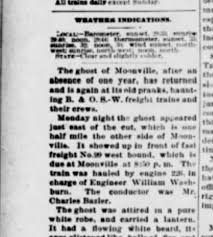
A newspaper story about the crash.
Within seconds he realized this light was headed straight for his train. The dispatcher had neglected to tell him another train was on the track. The two trains crashed head-on killing Lawhead and his fireman, Charles Krick instantly.

Today, no one would remember this tragedy except for the fact there has been a series of odd sightings for over a century in this tunnel.

In February of 1895, the Chillicothe Gazette published the following:

1895 Newspaper report about
Lawhead haunting.
“The Ghost of Moonville, after an absence of one year, has returned and is again at its odd pranks, haunting B&O S-W freight trains and their crews.

Monday night the ghost appeared just east of the cut, which is one-half mile the other side of Moonville. It showed up in front of fast freight No. 99 westbound, which is due at Moonville at 8:50 p.m. 

The Train was hauled by engine 226, in the charge of Engineer William Washburn. The conductor was Mr. Charles Bazler.

The ghost was attired in a pure white robe, and a carried a lantern. It had a flowing white beard, it eyes glistened like balls of fire, and surrounding it was a halo of twinkling stars. As the train approached the lantern was swung across the tracks . . .”

Since there have been countless sightings of this ghost at the end of this tunnel.

Witnesses today report seeing this apparition as well as a lantern swinging back and forth. Many have also felt a chill surround them at the end of this tunnel.

Photos have captured this phenomenon. Foggy mists have shown up as well as a figure, walking across the tunnel, wearing an engineer’s cap.

So is Theodore Lawhead trying to prevent another accident like the one that took his life? Some believe this is why his ghost lingers.

Tunnel with signal installed.
In the 1980s many train engineers, upon entering the tunnel, and seeing this light waving frantically hit their emergency brakes—the railroad in response to this dangerous situation installed a signal.

Crews were told they were only to heed this signal light and no others.

The freight trains stopped running in this area in 1988. The tracks were removed shortly after this. Today all that is left in Moonsille is a cemetery and the large railroad tunnel.

This, however, has not stopped the sightings of Lawhead’s ghost. Hikers, horseback riders and bicyclists all use this old train bed—and the sightings continue in this old tunnel.

Thursday, March 3, 2016

Terrified Night Watchmen

Waterfront Station
Waterfront Station is an old train depot in downtown Vancouver, B.C. Canada. Located in the western historic Gastown district, this grand building reflects the golden luxury era of train travel.

The station’s elegance was featured in the American television show The X-Files. A statue located on the southeast corner of the building known as Angel of Victory was featured in one episode.

Angel of Victory
Honors soldiers killed in
World War l.
This station recently celebrated its 100-year anniversary. It was built in 1915 by the Canadian Pacific Railroad and is still a busy transportation hub for the lower mainland.


As one Canadian journalist put it a building this old cannot survive without quirks. Waterfront Station is considered Vancouver’s most haunted.

In recent years, multiple night watchmen who work in the station during graveyard shifts have seen apparitions and experienced poltergeist activity.

This activity is so pronounced it has terrified them.

A favorite encounter happened late one night. A guard spotted a woman dressed in a 1920s flapper outfit dancing solo through one corridor on the west side of the station. He also heard 1920s music. When he approached this female the music stopped abruptly and she vanished.

Another guard experienced what he characterized as “the fright of his life” while he patrolled the northwest corner of the building. He entered one empty room with only his flashlight for light.

He spotted the ghost of a “little old lady.” A bright glowing light surrounded her. He described her as having a mournful expression. As he stood rooted to the floor, this woman reached out to him.

He bolted from the room. Later he stated he had no idea how he managed this for he had been in a state of shock.

Yet another security guard inspecting the upper floor on the east side of the building experienced poltergeist activity. As he walked through one room used to store old desks something caught his attention.

He became aware he was not alone. Seeing nothing amiss he became nervous. He decided to leave. When he turned around to exit he found the desks had all been moved together silently.

They now blocked his exit path. In a panic he jumped on top of one and ran from the room.

Many other night watchmen have reported hearing the sound of phantom footsteps strike the station’s tiled floors and soft disembodied voices when they are the only ones in the building.


One sight that is often reported by the guards involves three ghosts. They state they watched three old ladies sitting on one particular station bench in the middle of the night. It appears they are waiting for a train that never arrives.

Ghostly soldiers are sometimes spotted in Waterfront. This station was heavily used during both the first and second world wars.

One stark apparition often seen appears on the north side of the station on the tracks outside.

This was just one of a series of
stamps issued in Canada recognizing
the countries most famous
ghost stories in 2015.
In 1926, a brakeman while making repairs was killed in the rail yard. He was knocked unconscious by falling debris on the tracks. Tragically, a passenger train then ran over him, decapitating his head.

Since, many have reported seeing this headless brakeman roaming the tracks--especially in rainy weather. He carries a glowing lantern in one hand.

This apparition has also been seen in other parts of Gastown. The Old Spaghetti Factory a restaurant in the area also lays claim to this ghost.

People wonder if he is still on the job or if he is just looking for his head.

Thursday, February 25, 2016

Dash: American Ghost Ship

In the early 19th century Britain and France were fighting the Napoleonic Wars. Despite President Thomas Jefferson and then-President James Madison’s efforts to keep neutral-- America found itself right in the middle of this conflict.

British impressment of Americans into service.
British and French trade restrictions disrupted American business, which had a devastating impact on our shipping industry and country.

These two country's privateers and military vessels blocked our ports and harassed American ships. The British took this a step further when they began to use impressment to steal American men and goods into their service.

President Madison’s response was to impose the economic Embargo Act of 1807. It mainly kept American ships bottled up in harbors along the East Coast.

This Embargo backfired for since it restricted our ships from trading for needed goods—it hurt the American people even more.

Also, ironically, this embargo didn’t stop the British harassment, which further damaged the American economy. The end result was President Madison declared war against Great Britain in 1812.

Privateering during the War of 1812.
During the War of 1812, the U.S. used government-licensed private armed vessels, known as privateers. These ships were not part of the American navy. Their task was to detain, seize, and take enemy vessels, their crews, and their goods. They then would bring these men into U.S. ports for prosecution.

So privateers were in part sanctioned pirate ships.

Dash
One such ship was a topsail schooner called Dash. It was built in 1813 in Freeport, Maine.

Dash was a half model or what is called a Hawk nest. This meant she had 16 guns and another ten fake “Quaker” wooden ones to fool the enemy.

She was built for speed and eventually was re-rigged with a unique sail to increase her already impressive speed.

The Dash was able to break Portland’s blockade three times in 1813, with a cargo of lumber for trade. She returned from the West Indies, having traded for coffee and sugar cane.

In September of 1814, she was commissioned as a privateer. She was re-armed with more guns and more men—mostly from Freeport. This vessel was able to capture fourteen enemy ships—all without one single injury to her crew.

In January of 1815, she left port with another privateer, the Chamberlain. She pulled ahead but ran into a heavy gale. The Chamberlain turned back but the Dash continued.

She was never heard from again. It is not known what happened to her, but some speculate that her captain underestimated her speed and ran her aground on the treacherous shoals of the Georges Banks.

Within months of the Dash’s disappearance, fishermen in Casco Bay swore they saw this ship bearing down on them through a mist. As this ship turned and headed for Freeport, they clearly saw the words “Dash—Freeport” written on her bow.

Over the years, these sightings continued, at one point they even increased. Fishermen and other boaters reported that this schooner seemed to appear out of nowhere—always in a fog.

Foggy Casco Bay
Witnesses noted that despite the fact there wasn’t any breeze this did not prevent this sailing ship from moving quickly.

As more sightings of this ship were noted, a legend began to be circulated about Dash. It states that when a descendant of one of Dash’s sixty crewmembers dies this ship returns to bear these loved ones on their final journey.

One impressive witness sighting occurred in the 1940s, during WWll. A U.S. naval ship and Coast Guard boats that were protecting Casco Bay saw an unusual sight one foggy afternoon.

A blip was noticed on their radar screens. These vessels headed for the spot. As the sirens went off and all men reported to their stations, they were surprised to see a 19th century sailing schooner.

It was cruising along the channel headed for Freeport. By the time they reached this old ship, it had disappeared.

This sighting has been written about several times and has gone down as one of the most bizarre occurrences on the East Coast during the war.

Thursday, October 22, 2015

The Jersey Devil

They say . . . in the Pinelands of southern New Jersey there is a monster that haunts-- it is known as the Leed’s Devil. This devil when seen resembles a dragon with a head like a horse, the body of a snake, a forked tail and wings like a bat.

This devil—the Jersey Devil—wrecks havoc upon farmer’s crops and livestock, it poisons water sources-- pools and creeks and when it is seen on the Jersey shore—it is considered a harbinger—for soon after ships wreck.

So beware of this monster with the flashing red eyes.

This well-known legend is rooted in New Jersey’s past. It began with a woman’s curse.

Deborah Smith emigrated from England in the 1700s to marry a man named Leeds. The couple settled in the New Jersey Pine Barrens in Galloway Township, Atlantic County.

Their life together was not a happy one. Mr. Leeds was a lazy drunk who rarely worked. Deborah put food on the table for their twelve children by sewing shirts.

When Deborah discovered that she was pregnant with her 13th child it is said she snapped. She cursed her ner’er-do-well husband and invoked the power of the devil.

It is said she wished her thirteenth child “may be the devil.” So revenge could rain down on Mr. Leeds.

She got her wish for soon after this child was born it turned into the dragon like creature described above and flew off. The legend states that her family was truly cursed for the Leed’s Devil not only killed her husband but several of her other children.

One dipiction of the Jersey Devil
Some believe the origin of this legend is actually rooted in a superstition widely believed in the 1700s. People during this time believed in witchcraft and they felt a child born with a deformity—which might have been the case with the Leed’s 13th child—was a sign God cursed the child.

Regardless, the belief in the creature known as the Jersey Devil has persisted ever since. For over 200 years, there have been numerous sightings of this flying devil.

In the 1870s a Long beach fisherman claimed he saw the Jersey Devil serenading a mermaid.

A famous sighting occurred in 1909 when a councilman, E.P. Weeden in Trenton claimed that he was awakened by the sound of flapping wings outside his bedroom window. He stated he found cloven hoof prints in the snow after this.

Soon, other residents stated they also saw similar hoof prints. Within a week thousands of residents in the area stepped forward to say they had seen the Devil. Local newspapers wrote several stories about these sightings.

It wasn’t long before sightings were also reported in Pennsylvania and Delaware.

In 1978, two teens ice-skating in Chatsworth near the Barrens claimed to smell an odor of “dead fish” and then they spotted two red eyes staring at them. They didn’t stay around to see the rest.

Many more witnesses have come forward to state they did not see the Jersey Devil but instead heard it “rampaging through the woods, or emitting blood curdling cries.”

In the 1960s, strange tracks were discovered near May’s Landing—rumors stated it must be the Jersey Devil. When loud shrieks were also heard in the area local Camden merchants offered a $10,000 reward for the capture of the creature. They stated they would build a zoo to display it.

This reward remains unclaimed.

Excerpts from Spooky Campfire Tales, by S.E. Schlosser and The New Jersey Historical Society.

Thursday, August 27, 2015

The Good Spirit: Grey Robe


The stories about Grey Robe and why the Navajo’s believe in him were highlighted in the May 1969 edition of Frontier Times in an article written by John R. Winslowe.

In Robert F. Turpin’s 2014 book, Old West Ghost Legends he includes a chapter on stories that have been told about encounters with Grey Robe.


In more recent times Navajos have referred to Grey Robe as a “good spirit.” But traditionally, he was never referred to as what other cultures call a ghost.

Instead, the Navajo considered him merely a mysterious entity or benefactor that saved many Native American lives.

All the sightings of him occurred in the Red Valley near Tuba City in Arizona.

Descriptions of Grey Robe state he glides instead of walking, his facial features are rarely seen and some accounts state his form when seen was surrounded by a grey mist or fog.

He is seen wearing a grey robe tied at the waist with a cord—hence his name. Witnesses state he never talks he points or gestures instead.

This entity was first seen in the early 1800s and reports of encounters continued into the late 1940s.

He is credited with saving lost children, an isolated crippled woman who had fallen and a boy that broke his leg on a remote ridge.

It also is stated Grey Robe warned many people of impending dangers—such as washed-out roads and flood waters heading their way.

It is said he led a sheepherder to water during a drought, so he would not lose his flock.

Black Hat’s Encounter

One Navajo named Black Hat, who was new to the Red Valley in north-central Arizona, had never heard the stories about the mysterious Grey Robe when he encountered him.

He was traveling through the valley when his horse slowed down and perked up his ears. He saw a grey figure up ahead, standing near the trail he traveled.


The figure was wrapped in a robe, and a grey mist or grey smoke seemed to surround him. Black Hat stopped his horse and asked, “Who are you?”

The shadowy figure did not speak but instead motioned for him to follow him. Black Hat noticed the figure made no sound as he moved through the sagebrush—his body appeared to float instead of walk.

Several hundred yards further down the trail, the figure stopped and turned toward Black Hat. It then pointed toward a rocky ridge in the distance.

As Black Hat turned back he saw the figure slowly fade away. He realized this encounter had not scared him, but instead, he felt a feeling of serene kindness settle over him.

Black Hat headed to the rocky ridge where he found an unconscious Indian boy. He saw that the boy’s leg was broken in several places.

He gathered dry brush and made a signal fire. It wasn’t long before a party of Navajos rode in. They lived nearby and had seen the light.

It was discovered later that the boy had been thrown from his pony when a rattlesnake frightened it.

If Black Hat had not found the boy, he would have died. The other Indians asked him how he had happened upon the boy since the ridge was quite a distance from the trail he traveled.

Black Hat hesitated and then told then about the grey figure. The others seemed not to be surprised by his description—especially the part where he stated the figure wore a grey robe and was faceless.

The elder of the group nodded and said. “It was Grey Robe.” He then told Black Hat about the friendly spirit that helps the Navajo people.

This legend is not lost today, for the Navajos remember the stories about Grey Robe fondly.

Friday, February 6, 2015

Aquia’s Blonde Beth

There are many stories about various Episcopal Churches being haunted. One site on the web mentions 20 different Episcopal churches across America that have ghosts connected to them. One of these is Aquia Episcopal Church located in Stafford, Virginia.

Aquia Episcopal Church
Aquia was built in 1757 and this churches’ architecture is one of the few true examples of a Greek cross structure from colonial times. Thomas Jefferson was one original member of this church.

Just after the Revolutionary War this church was shut down for a number of years because of lack of funds. During the Civil War, Aquia was used briefly as a field hospital and provided services for Union soldiers.

Today this church is a thriving Episcopal Church with an active membership. The structure is a designated National Historic Landmark and the church offers historical tours to the general public.

Part of this church’s interesting history is about the ghosts that are said to remain. These stories are so well known that the members of this active community church today, remind people who seek paranormal activity to please respect their church and stay away.

A Mysterious Murder

One ghost story told often about Aquia Church is said to be the result of a murder.

Vestry Tower
When the church was re-opened after the Revolutionary War the remains of a young woman were found in the Vestry Tower, Note: some accounts state this small tower was a “belfry” but it never contained a bell so it is a vestry.

It remains a mystery as to who killed this woman and why but what is known is she was left to rot in the vestry. When she was discovered all that remained was her skeleton and her blond hair.

One gruesome legend connected to this story is that this woman’s spilt dried blood remained on the vestry floor for over 100 years--despite efforts to clean it up.

Another legend states that there have been so many people who have said they encountered this ghost that many others refuse to go near this church at night.

Eyewitness Accounts

More believable are several eyewitness accounts from people who state they heard or saw the ghost of this unfortunate young woman--who in more recent years has been dubbed Blonde Beth.

A common story is that members of the church have heard footsteps running up the narrow stairs that lead to the vestry. A custodian that worked in the church stated he sometimes saw a female face floating over the churches graveyard at night.

Add caption
One man who discovered an old book about the churches history at a garage sale was so intrigued him he decided to take the tour. He had not heard the ghost stories.

As he was leaving the church’s parking lot he glanced up and saw a feminine face looking down at him from the window in the vestry. He described her face, “as transparent, with a boney nose.” He stated she was smiling at him.

In the early 1990s Aquia celebrated the rich history of the church one Sunday afternoon. One group that was invited to participate in this celebration was a troop of Civil War reenactors.

This group arrived on Saturday night, pitched their tents and built a campfire between the church and the graveyard.

A member of the church went over to talk to this group the next morning before the church service. The priest at the time was Father Kerr, he was there talking to the leader about the day’s events.

During the course of this conversation one reenactor brought up the strange sight he and several others had seen the night before. While sitting around the campfire they had seen a strange orange--reddish light flickering on and off through the vestry window.

This light continued to turn on and off throughout most of the night. The soldier jokingly told the Father, “It must have been the ghost.” He then stated it was most likely a loose bulb in a light socket that had been flickering.

To his surprise Father Kerr stated without skipping a beat, “Oh, that’s just Blond Beth. She was probably just checking you out, curious why Civil War soldiers have returned after all this time.”

The Father’s next statement shocked the group. “By the way, there are no lights or electricity in the vestry.”

Sunday, February 1, 2015

Newfoundland’s Viking Ghost Ship

At the furthest remote northern tip of Newfoundland 1000 years ago, Vikings once the nomads of the North Atlantic, established a settlement.

This area is called L’Anse aux Meadows meaning “Jellyfish Cove.”

A Norse sod longhouse recreated
at L'Anse aux Meadows
The local residents today make their living from fishing. They use small boats with hand lines to catch their fish. It is difficult backbreaking work.

In more recent years the area has also experienced an economic boom from summer tourism.

The Vikings

The Vikings were warriors just like their Gods. The term Viking is just a general name for Nordic speaking people who came from southern Scandinavia.

They were explorers that made their way west in the 11th century first to Iceland then to Greenland and finally to Newfoundland.

Fierce Viking raiders
They had 3 goals. The first was to find new victims to raid-- they attacked, plundered and departed quickly. They were successful in this endeavor for the most part because of the efficiency and speed of their ships and in part because of the sharp-iron weapons they used.

Along with these raids they were also looking for new trade partners and new places to settle.

Strange Sights

A favorite legend that is told in L'Anse aux Meadows is about how a Viking ghost ship appears every 30 years. Sightings of this ship is considered to be a good omen or harbinger.

One mid August the local fishermen were celebrating for they had experienced a “good catch.” It was the best of the season. They had returned home with their boats full.

A lone fisherman stayed late into the evening gutting the fish he had caught. Suddenly outside his shack he heard a strange noise.

It sounded like paddles hitting the water in unison. These oars were making a loud splashing sound. At first, he didn’t see anything but he then heard the sound of a horn being blown.

He moved to the door and spotted a vessel moving toward the dock. It was odd in appearance--he had never seen anything like it before.

It was a long, narrow open boat with one central mast. It had a striped sail and on either side he saw oars dipping into the water quickly.

Viking Ship
He watched confused as it came closer and closer and then just vanished. Word spread about what he had seen but no one knew where this vessel came from or where it had gone.

Several months after, the man discovered a drawing in a book that looked very similar to what he had seen. It was a drawing of a boat that had been used by the Vikings 1000 years before.

Thirty years after this initial sighting, two lazy young teens learned where an old fisherman had hidden his whiskey. One night they broke into his shed.

Just as they found his bottle they heard a loud noise coming from the water outside. They hesitated worried they were about to be discovered.

They heard the water splashing forcefully--it sounded like a large group of oars dipping into the water. They looked out a side window and saw a ship approaching.

They left immediately but once outside they stood transfixed by a strange sight. Before them was a long ship, it turned and headed toward where they stood. It then vanished.

They were so frightened by this time they left the whiskey behind as they fled the dock.

These two teens did not tell anyone what they had seen for a long time but eventually word spread about the strange ship they had seen in the harbor.

The locals realized these two young men had seen the same Viking ship on the same day as the sighting from 30 years before--August 15th. They felt the first time this ship had brought “good tidings.” Now they felt it had once more helped out--for it had saved the old fisherman’s whiskey.

This was not the last time this strange Viking ship was seen for 30 years later on August 15th the local fisherman returned with another bountiful catch.

One fisherman among this group decided to stay out in his boat a little longer--he felt he could catch even more fish. But as the sky clouded and the weather turned he decided to head for the safety of the harbor.

But his motor would not turn on. He checked the fuel and all the engine connections but everything seemed to be in order. Suddenly he heard a loud noise in the water.

It sounded like oars dipping into the water every 5 seconds. He looked in the direction of the sound and spotted a huge Viking ship bearing down on him.

This ship was on a collision course with his smaller vessel. At the last moment just when it seemed the ship would ram his boat he heard the sound of a horn blowing, it sounded like a battle call.

The Viking ship then vanished right in front of him. He stated later a strong sense of wellbeing overtook him. He went back inside his wheelhouse and the motor started immediately.


It is still a mystery why this ship appears every 30 years and on the same day but the locals don’t mind.

Here is a video that demonstrates what multiple oars sound like when they hit the water.