
In Part 1 of this post a
brief description of one battle that occurred during the War of 1812 and the hauntings it caused are shared.
 |
| View of Fort George from Old Fort Niagara on the American side of the river. |
Fort George is located near
the town of Niagara-on-the-Lake in Ontario, Canada. It was destroyed by the
Americans during a battle in 1813 but was rebuilt as a National Historical site
in more recent years.
This fort is considered one
of Canada’s most haunted and several ghost soldiers have been seen at this
location, but the most active ghost is a little girl by the name of Sara
Ann. She is a very precocious spirit.
Sara Ann’s ghost has been
seen so often over the years no one has kept count. Her youthful antics elicit
smiles as opposed to fear.
Her ghost, when seen, is
playful. She engages in games of peek-a-boo, hiding under beds and behind
pillars. She is heard giggling quietly to herself.
She is known for tugging on
visitors’ clothes. When they turn, they see her running away. She is described
as bare-footed with shoulder-length curly blonde hair.
She wears a white dress and
is often seen around the fort’s barracks. Three female visitors spotted just
her hand resting on a staircase railing in this area.
At other times she appears as
just a white cloud with a vague form.
 |
| Fort George today. |
One summer night in August a
group of tourists who were leaving spotted a little girl in the parking lot.
She was skipping around a group of guides that worked at the fort.
She appeared to be wearing a
white nightgown. Two women watched as she then faded from view. The men in this
group did not see this little girl.
But these two women who did
not know each other eerily told similar stories of what they saw. The guides
despite being closer to this apparition reported they had seen nothing.
One well-documented encounter
happened to a guide, storyteller, Kyle Upton who works at the fort. He had
heard about Sara Ann's ghost but did not believe the stories.
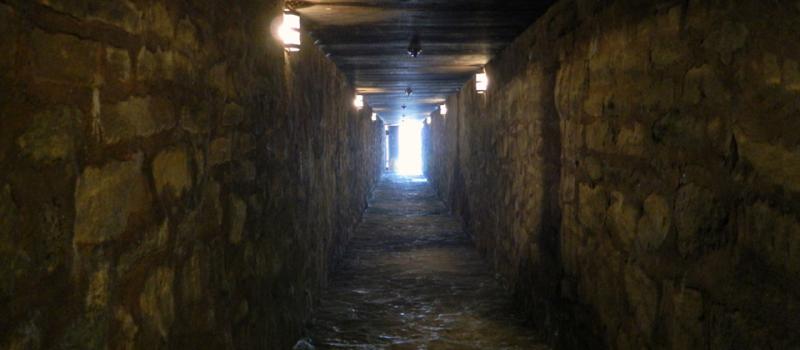 |
| The tunnel at the fort.
Upton led a group of tourists
to the entrance of a subterranean tunnel at the back of the fort one night as
storm clouds gathered, and lightning flashed.
|
When he reached the back of
this tunnel, Upton waited for his group to gather around him. This is when he
saw a form that was illuminated by a dim green-grey light.
He saw a small figure
silhouetted in this light. It was a child standing just outside the tunnel
looking in at him.
As he watched she playfully disappeared and then reappeared again. He saw her hop and skip around—then she stopped and looked to see if she was being watched.
At first, Upton thought she
was a part of his group but after he took a head count, he realized she wasn’t.
It dawned on him that this
must be the little ghost he had heard so many stories about.
Upton had trouble
concentrating on his presentation for Sara Ann distracted him. Every time the
lightning flashed at the entrance all he saw was the white wall of the nearby
blockhouse, but when the lightning stopped, he would see her once more.
When the group exited the
tunnel the little girl was gone.
 |
| St. Mark's Cemetery |
It is believed that Sara Ann
was the daughter of Hannah and Thomas Tracey. She died at age seven in 1840. Her
grave and tombstone are located at St. Mark’s Cemetery.
Her father was a sergeant
major with the King’s Dragoon Guards at Fort George. No one knows how she died
or why her spirit lingers at this fort.
In Part l of Sara Ann and Fort George other ghosts seen at the fort are described.
In Part l of Sara Ann and Fort George other ghosts seen at the fort are described.


