Showing posts with label Ontario. Show all posts

Monday, December 7, 2015

Sara Ann and Fort George, Part ll

In Part 1 of this post a brief description of one battle that occurred during the War of 1812 and the hauntings it caused are shared.
View of Fort George from Old
Fort Niagara on the American side
of the river.

Fort George is located near the town of Niagara-on-the-Lake in Ontario, Canada. It was destroyed by the Americans during a battle in 1813 but was rebuilt as a National Historical site in more recent years.

This fort is considered one of Canada’s most haunted and several ghost soldiers have been seen at this location, but the most active ghost is a little girl by the name of Sara Ann. She is a very precocious spirit.

Sara Ann’s ghost has been seen so often over the years no one has kept count. Her youthful antics elicit smiles as opposed to fear.

Her ghost, when seen, is playful. She engages in games of peek-a-boo, hiding under beds and behind pillars. She is heard giggling quietly to herself.

She is known for tugging on visitors’ clothes. When they turn, they see her running away. She is described as bare-footed with shoulder-length curly blonde hair.

She wears a white dress and is often seen around the fort’s barracks. Three female visitors spotted just her hand resting on a staircase railing in this area.

At other times she appears as just a white cloud with a vague form.

Fort George today.
One summer night in August a group of tourists who were leaving spotted a little girl in the parking lot. She was skipping around a group of guides that worked at the fort.

She appeared to be wearing a white nightgown. Two women watched as she then faded from view. The men in this group did not see this little girl.

But these two women who did not know each other eerily told similar stories of what they saw. The guides despite being closer to this apparition reported they had seen nothing.

One well-documented encounter happened to a guide, storyteller, Kyle Upton who works at the fort. He had heard about Sara Ann's ghost but did not believe the stories.
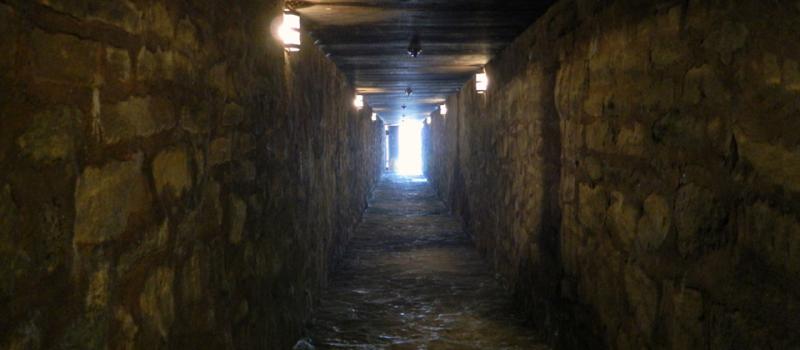
The tunnel at the fort.


Upton led a group of tourists to the entrance of a subterranean tunnel at the back of the fort one night as storm clouds gathered, and lightning flashed.
When he reached the back of this tunnel, Upton waited for his group to gather around him. This is when he saw a form that was illuminated by a dim green-grey light.

He saw a small figure silhouetted in this light. It was a child standing just outside the tunnel looking in at him.

As he watched she playfully disappeared and then reappeared again. He saw her hop and skip around—then she stopped and looked to see if she was being watched.

At first, Upton thought she was a part of his group but after he took a head count, he realized she wasn’t.

It dawned on him that this must be the little ghost he had heard so many stories about.

Upton had trouble concentrating on his presentation for Sara Ann distracted him. Every time the lightning flashed at the entrance all he saw was the white wall of the nearby blockhouse, but when the lightning stopped, he would see her once more.

When the group exited the tunnel the little girl was gone.

St. Mark's Cemetery
It is believed that Sara Ann was the daughter of Hannah and Thomas Tracey. She died at age seven in 1840. Her grave and tombstone are located at St. Mark’s Cemetery.

Her father was a sergeant major with the King’s Dragoon Guards at Fort George. No one knows how she died or why her spirit lingers at this fort.

In Part l of Sara Ann and Fort George other ghosts seen at the fort are described.

Sara Ann and Fort George, Part l

Americans landing at Fort George.
This story is about a young ghost that haunts Fort George located at Niagara-on-the-Lake * in Ontario, Canada.

The Americans destroyed this fort during the War of 1812.

America began this war with Canada after being provoked. The British Royal Navy had taken to forcefully “press-ganging” American sailors into service with their fleet. The British were undermanned at the time because of the Napoleonic Wars, which were raging across Europe.

The British were also trying to prevent the U.S. from trading with France.

Also, the British were arming Native American tribes that were standing in the way of American expansion. During this time, American extended from the Mississippi basin to the Great Lakes.

In one battle in the spring of 1813, an American fleet appeared at the mouth of the Niagara River. These warships bombarded Niagara-on-the-Lake with cannonballs. Two days later they sent hundreds of rowboats ashore at Lake Ontario close to Fort George.

The Canadians and British were outnumbered 10 to l so they could not hold back the Americans. They were forced to retreat, and U.S. troops took control of the town.

American Patriots who were loyal to King George lll during the Revolutionary War, populated Niagara-on-the-Lake, so its residents held a robust anti-American sentiment already.

Many of these Patriots lost their property and were ostracized after the Revolutionary War so most of them then headed north to the Niagara region.

Fort George played a vital role as the Americans attacked Niagara-on-the-Lake, but it was ultimately destroyed during the fighting.

A depiction of Fort George
in 1812.
The U.S. hoped this conquest would help them gain control of Upper Canada but their defeat at the Battle of Stoney Creek, later that June, halted their ambitions.

When winter arrived the Americans finding themselves vulnerable to attack had no choice but to retreat back to the American side of the Niagara River.

But before they did this, on December 10, 1813, they burned Niagara-on-the-Lake to the ground. Which left the residents out in the freezing cold.

Part of Fort George today.
Within a decade this town was rebuilt and is today a thriving tourist area. Fort George was restored in more recent years and is today a National Historical site that offers tours.

It contains several buildings including barracks, officer’s quarters, and craftsmen shops. Many witnesses feel this fort’s Palisades and earthen parapets are haunted.

In fact, the fort is considered one of Canada’s most haunted.

There have been many sightings of ethereal soldiers standing guard along the parapets. Witnesses have heard drum rolls across the grounds, and phantom gunfire is also heard rumbling.

But by far the fort’s most active ghost is not a soldier but rather a young girl who was the daughter of one of the families that lived at Fort George.

*  The town of Niagara-on-the-Lake has had many names over the past 200 years. It was first named Butlersburg, then New Niagara, West Niagara, Lenox and then Newark. It wasn’t until the late 19th century it was called Niagara-on-the-Lake.


In Part ll of Sara Ann and Fort George sightings of this young ghost is shared.

Tuesday, June 17, 2014

Ontario, Canada: Oromocto Spring


In the Waterloo Region of Ontario, Canada two early aboriginal Indian tribes lived in what is today known as Homer Watson Park * in Doon. Doon is just southeast of the city of Kitchener.

Winter on the Grand River
This area including Cressman’s Woods is on the banks of the very picturesque Grand River.

A young maiden named Nashwaaksis was a member of the Attiwandron tribe. She was in love with a warrior, Oromocto who was a member of a neighboring tribe--the Petuns.

Because these lovers were from two different tribes they had to keep their love a secret--they could not meet openly.

When Nashwaaksis heard that enemies of the Petuns, the warring Iroquois where going to attack she walked on foot from Doon to a site near Elmira where her lover’s tribe was camped for the season.

Nashwaaksis motive was to save her lover, she also knew her “reconnaissance mission” to warn would be of service but would also allow her cover so she could meet with Oromocto out in the open.

Tragically, the last time these two lovers met they stumbled upon the encroaching Iroquois near Doon.

Oromocto fought gallantly but was quickly killed in the battle. Nashwaaksis was inconsolable. It is said she was not able to recover-- she died of grief.


The Attiwandron tribe claimed both bodies and honored these two young people for their valiant effort.

The legend states as the tribe did a spring gushed forth from the earth on the spot where Oromocto was killed and where later Nashwaaksis was found dead.

The Attiwandrons took this spring as a great sign. They believed the water from this it was “as clear as the beautiful character of Nashwaaksis… and as cold as the heart of the Iroquois.”

They named this it Oromocto Spring after the brave young warrior.

Since this time many visitors that walk the area nearby state that Nashwaaaksis can still be heard crying for her lost love.

There have been many sightings of the young aboriginal woman. She is seen wondering and crying as she walks along the banks of the Grand River. It appears she is looking for someone.

Other accounts mention that her crying can be heard on the blowing wind--a low, soft mournful sob. Yet another more fanciful account states her grief can be heard in the water itself--as it babbles over the stones and rocks.

This legend that has endured, it first appeared in a local newspaper in 1917. Some state that at this point it was used to promote the “new park” and to boost the local WWl war effort.

Skeptics state it was invented just for this purpose. They have not succeeded in convincing witnesses to this phenomenon.

Regardless, it is a great story.

* The area renamed for Homer Watson a Canadian painter who was born in Doon was originally known as Attiwandron Park and was then named Cressman’s Woods.

Here is a nice video that shows the park and mentions how Homer Watson saved the area from logging. It is still pristine today because of his efforts.

Saturday, October 12, 2013

Canada’s Screaming Tunnel


This tunnel is located in Ontario in the north-west outskirts of Niagara Falls. The Grand Trunk Railroad built it in the early 1900s --the project was never completed. 

The legend that tells how this tunnel got its name dates back to when it was first built. At one time south of this tunnel on the top of Sand Plant Hill stood a large farmhouse. Today this area is an open field. 

A large family lived in this house but tragedy struck one night. Even since, the following legend has been passed from one generation to the next.

This family’s home caught fire. The parents at first were relieved that everyone had escaped until they realized their youngest daughter was not with them. 

They watched as the hot flames took their home. Horrified, they saw a small figure flee through a barn door her arms crossed over her face engulfed in flames. Her hair and nightgown were smoldering. As the cold night air touched her it fanned these flames and she screamed as more flames burst around her.


Before they could reach her she ran down the hill in the direction of the drainage tunnel below the railroad tracks. They heard more of her terrified screams then all was silent. 

They found her collapsed on the ground in the tunnel. It appeared as if she had tried to roll in order to extinguish the flames but now she was still, her eyes staring blankly upward. They broke down realizing it was too late she was dead.

This version of the story is the one most often told. Another one states that the young girl was from a family whose parents were going through a painful divorce. Her father became mentally unbalanced when he was informed his wife had been granted sole custody of children. 

It is said he dragged his youngest daughter into the tunnel and set her on fire in an attempt to gain revenge. Yet another more modern tale told states that the girl was raped and murdered in the tunnel then her attacker set her body on fire to cover any evidence.


Many who have walked through this tunnel state it has a very negative atmosphere. Even on the sunniest of days it remains dark and damp. 

Many witnesses over the years have stated they heard a young girl’s screams. 

Regardless of which tale is told they all end with the same warning. If a person enters this tunnel today and lights a stick match the flame will frighten the spirit that remains. It is said she then will blow out the match and scream in terror.


If this story was considered a true haunting and not a legend my first reaction would be to leave this poor spirit alone. Even though it is just a legend it doesn’t stop trespassers in the area. The above newspaper article addresses this issue.

Thursday, February 9, 2012

Canada’s Blue Light Tunnel


For over a hundred years the Blue Light Tunnel in Ontario, Canada has been haunted by ghosts. 

This tunnel was constructed in the mid 1870s as a part of the 3rd Welland Canal. It was first named the Merritton Tunnel because it was near Merritton, which is now is a part of St. Catharines. 

It was also at one point called The Great Western Railway Tunnel because it provided passage for the Great Western Railway under the 3rd Canal. This tunnel was in use until the First World War when a swing bridge replaced it.

The tunnel is haunted because of a series of accidents that happened near it and a graveyard that is covered in water close by.  

In the early 20th century two trains collided head on one hundred yards from the tunnel entrance. The accident happened on a sharp curve where the two engineers could not see each other. These two men escaped this accident with only broken limbs but both their fireman died as a result of this wreck. 

It is said the ghostly spirits of these two still linger in the tunnel. Sightings of wispy fog and mists near the tunnel entrance are cited as proof of this claim.

The first fireman who worked on the express train was discovered at the scene of the accident dead. His body was found crashed between the boiler and the tentler. 

When the rescuers tried to recover his body his limbs broke away from the rest of his body because his mid section was wedged so tightly. 

The second fireman who worked on the mogul train was smashed into the boiler of the train, and received burns over 90 percent of his body; he was taken to St. Catharines Hospital where he died five hours after the accident.

Another source of the ghostly activity in the tunnel is attributed to a series of accidents that happened nearby as the Welland canal was being constructed. 

One freak accident that occurred at Lock 6 in August 6, 1928 took the lives of eight men, just two years later on this same date eight more men were killed in another accident. It was believed that the ghosts of the tunnel cursed the area and this is why these two accidents happened.

The belief in this curse and haunting was reinforced by the fact that over 107 lives were lost during the time the canal was being constructed. 

In the preceding years the pump house that brings water to locks 4, 5, 6, and 7 and is close to the Blue Light Tunnel experienced its own disasters. 

Some of these accidents were not even recorded in the local paper because it was feared if they were reported it would become known The Welland Ship Canal was indeed haunted by ghosts.

Yet another source of the Blue Light Tunnel hauntings comes from a pond near the tunnel. 

In the early 1800s a churchyard and cemetery was established in the Thorold township. By the early 20th century this area had fallen into ruins. 

In the 1920s with the construction of the 4th Welland Canal it was decided that the area where the St. Peter cemetery was located would be used for a “canal pondage.” In other words they intended to flood the area with water.

Of the 913 graves that were in the area when this decision was made only 250 were claimed by relatives, the rest it was decided would just be left in place. So 663 graves remain under the pondage area near the Blue Light Tunnel. Many of these lost souls are said to still haunt the tunnel today.

Many believe because of so much tragedy the Blue Light Tunnel has acted as a magnet for all who died in the area around it. 

Because of the documented activity in the tunnel many are even afraid to enter it. Footsteps, whispered conversations, and old-fashioned music have been recorded in the tunnel. 

In recent years an area near the tunnel was used as a teen party spot. In 2011 the Blue Light Tunnel was closed to the public. In the past a cinder block wall that was constructed at the entrance to keep people out was vandalized. 

Officials state they want to keep people out of this very old tunnel because it is located under a stream therefore it is unsafe—if a wall were to collapse water could rush in. 

Some feel this is not the only reason the Blue Light Tunnel is off limits.