Showing posts with label St. Valentine's Day Massacre. Show all posts

Sunday, April 3, 2016

Al Capone and Jimmy’s Ghost

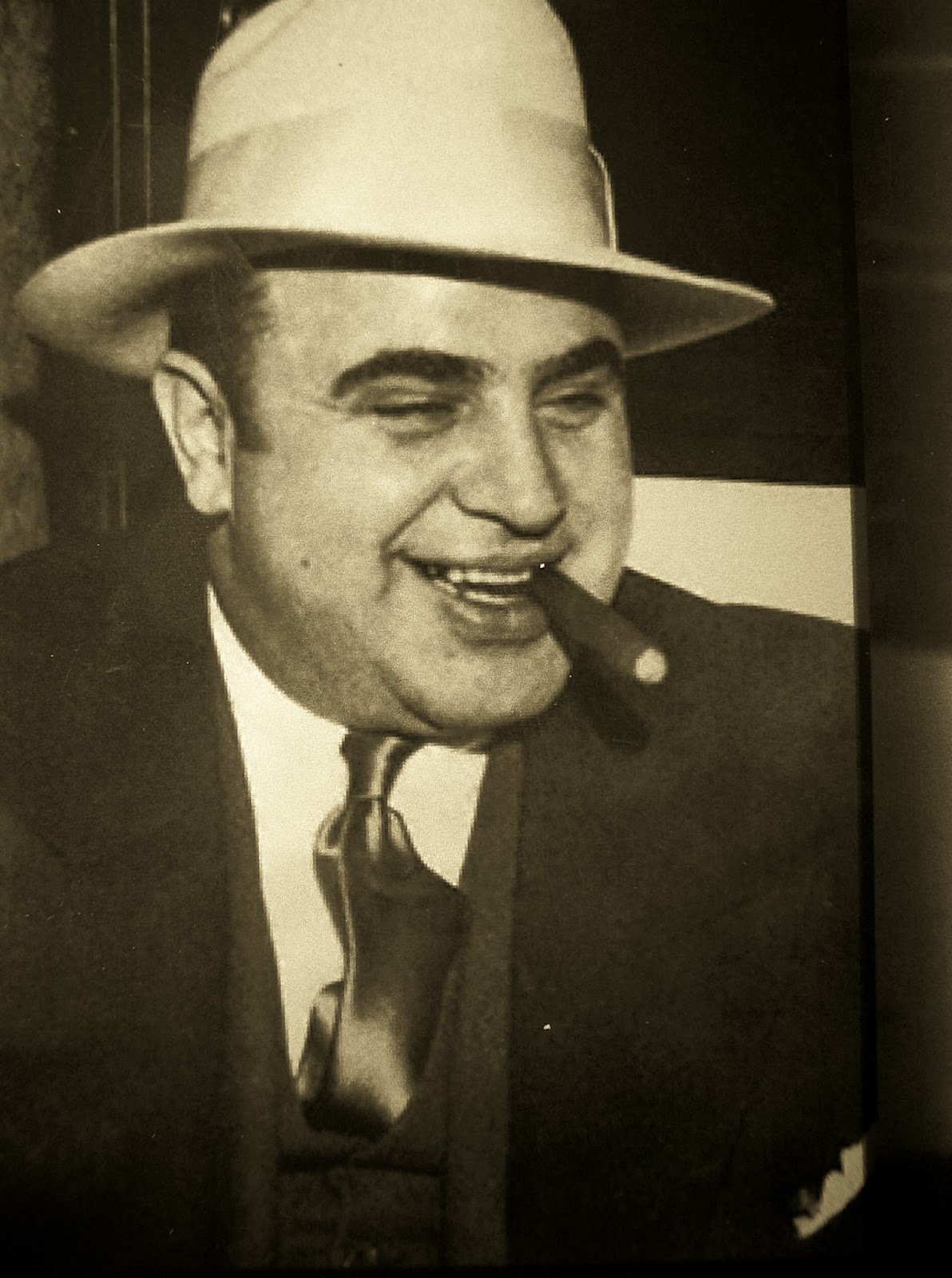
Al Capone 
Al Capone was one of America’s most notorious gangsters. He ran a multi-million dollar operation out of Chicago, Illinois.


He dominated organized crime in Chicago for almost a decade in the 1920s. At the height of his power, Capone employed over 1,000 gunmen and half the cops in the city were on his payroll.

Yet, by the end of his life, he was a shell of his former self. He had been reduced to living in a state of constant fear. He believed that the ghost of one of his many victims had come back to haunt him—others point to mental illness as the cause for this deterioration.

Alphonse Capone was born in Brooklyn, he was the son of Italian immigrants. He moved to Chicago to be a friend’s bodyguard. This friend, Johnny Torrio was head of a crime syndicate that supplied alcohol during the Prohibition Era.

By the age of 26, Capone had become a prominent crime boss in Chicago. He used bribery and intimidation to influence local political elections and violence and murder to ensure his illegal businesses thrived.

The notorious Saint Valentine’s Day slaughter in 1929 was ordered by Capone to get rid of a rival Irish bootlegging gang—known as the North Side Gang.

Capone was conveniently in Florida at the time so he and the men he sent to do these murders were never accused of this crime.

In May of 1929, Capone was convicted on a lesser charge—carrying a weapon on a trip to Philadelphia. He was sentenced to a prison term at Eastern State Penitentiary.

His cell reflected his power and influence. He had a comfortable bed as opposed to a cement slab. Oil paintings hung on the wall, a state of the art radio sat against one wall along with other elegant furnishings.

Capone's cell at Eastern State
But Capone’s stay was not to be comfortable. It was not long before this tough guy’s piercing screams were heard every night. He was also heard begging for “Jimmy to let him alone.”

Jimmy's body is one on
right against the wall.
Jimmy was James Clark or his real name—Albert Kachellek. He was second in command of the North Side Gang run by George Moran. He was shot down with six others in cold blood during the Saint Valentine’s Day Massacre. Capone believed Jimmy’s ghost was haunting him to exact revenge.

After six months, Capone was released. Members of his gang believed this ghost continued to torment their boss.

It wasn’t long before Capone was convicted on tax evasion and was sent to Atlanta US Penitentiary and then Alcatraz for a combined 11 years. Jimmy’s ghost followed him into these prisons. In fact, this ghost terrorized him until his death in 1947.

After six and half years in Alcatraz, Capone was released only to be put in a mental hospital in Baltimore. He was held there for three more years.

Some believe that Capone's problem was just mental illness and not a ghost. At the age of twenty, he had worked in a brothel as a bouncer. He contracted syphilis, he never had this disease treated.

It eventually turned into an case of neurosyphilis, which led to Capone having dementia.

It should be noted here that Capone claimed to see Jimmy’s ghost way before he lost his mind.

Capone's gravesite
By 1946, one physician who examined Capone said he had the mental capacity of a 12-year old. If Capone was actually tormented by Jimmy’s ghost will never be known, but despite his life of crime, he was and is considered a celebrity.

Even today, people leave offerings of booze, cigars, and flowers on his grave at Carmel Cemetery in Hillside, Illinois.

Friday, February 15, 2013

The Haunting of Al Capone


At the height of the Prohibition era an incident of gangland violence stands out above all the rest—the St. Valentine’s Day Massacre. These murders that took place in February of 1929 where especially brutal—even for the time. This bloody violence in Chicago resulted in two distinct hauntings. One at the location where the murders took place and one that plagued the man responsible, Al Capone at the end of his life.

Bugs Moran
In the 1920s violent gang shootings in Chicago were not uncommon as warring fractions battled for control of the cities various lucrative bootlegging, speakeasy, gambling and prostitution operations. Alphonse Capone, a rising gangster who ruled Chicago’s south side and George “Bugs” Moran who controlled the north side where two of the most powerful gangland leaders in 1929. Capone, ever ambitious, decided to hit Moran where it hurt so he could eliminate his only competition.

Moran operated out of a garage, S-M-C Cartage Company on North Clark Street. Capone who had this garage under surveillance for weeks arranged for a man, who Moran trusted, to call and tell him to expect a shipment of bootlegged whiskey on the morning of February 14. On this date, seven of Moran’s men where inside the garage as what appeared to be a police car drove up. Five men, three in uniforms and two in plains clothes got out of this car and entered the garage. Ironically, Moran who was late that morning spotted this “police” car and he and one of his men ducked inside a nearby coffee shop.

Meanwhile, in the garage the fake cops had informed  Moran’s men that they were there for a raid. They ordered these seven to stand facing a wall and to place their hands above their heads. These men thinking they were caught did as they were told. Capone’s thugs then pulled out Thompson machine guns and shotguns and brutally shot them in the head, chest and stomach, killing them.

The bullets they used had been brushed with garlic—a superstition that it was said ensured death. These fake officers then led out their two buddies dressed in plain clothes at gunpoint in order to make it look like they had made arrests. They got in their car and drove off unchallenged. A passerby discovered the slaughtered men inside when he heard a German shepherd owned by one of the murdered men, crying pitifully inside. One man was found barely alive—he had fourteen bullets in him. He was rushed to the hospital where he refused to say who had shot him. He died shortly afterward.

At the time of the massacre Capone was in Florida. Both he and Moran accused each other of the killings. The identities of Capone’s five hit men have never been definitely established. No charges were ever filed against Capone for this massacre. This violence did succeed in breaking apart Moran’s north side operations. But ironically Capone was never to reap the rewards of this power grab for these brutal murders caused a major public outcry. Federal agents headed by Elliot Ness—the Untouchables—were brought in to crack down on crime in Chicago.

The bloodstained garage where the massacre occurred was torn down in 1967 for an urban renewal project. Before the building was torn down countless witnesses heard screams, sobbing, and moaning sounds coming from inside. Today what remains of the site is a grassy area with five trees. It is said that dogs that pass by the area whine, bark and snarl at something unseen.

Capone and one of his men were arrested in Philadelphia in 1929. They were charged with carrying concealed weapons. Capone was sentenced to one year in prison. When he was released he returned to Chicago but he found the city now was much less tolerant of crime. In 1934 he was nabbed for tax evasion and sent to Alcatraz prison. Finding himself beaten by guards and evading threats on his life from fellow prisoners he spent most of his time in isolation. It is said he played a banjo his wife sent him and wept for all that he had lost.

Suffering from the advanced stages of syphilis his guards reported that they heard him pleading with someone in his cell. It appears that the ghost of James Clark, one of the men killed in the St. Valentine's Day Massacre was haunting him. He claimed that Clark would not let him alone. He was often found in his cell babbling and crying about this ghost that tormented him. At the time he was released one of his mobster compatriots stated Capone was, “nuttier than a fruitcake”. In 1947 Capone died of a brain hemorrhage caused by syphilis.