Showing posts with label Chicago. Show all posts

Thursday, May 9, 2019

The Ghosts at Lincoln Park Zoo


I have written other posts, here, here, and here about what happens when cemeteries are moved but some bodies are left behind.

This disruption often results in very active hauntings.

Entrance to Lincoln Park Zoo
The Lincoln Park Zoo, located in Chicago, Illinois is a prime example of graves being disturbed.

In 1837, Chicago’s City Cemetery contained thousands of victims of several cholera outbreaks. As the city expanded health concerns arose that these bodies were being buried near the cities’ main water supply—Lake Michigan.

View from Lincoln Park Zoo.
When this cemetery was closed in 1866, it is estimated that it contained 30,000 graves. Chicago officials decided to move these bodies outside the city limits.

Families of the deceased were informed, in 1869, that they needed to make other arrangements for their dead relatives. The city then undertook the removal of those who did not have a family.

People fled to the park during
the fire.
It is said the 1871 Chicago Fire hindered this work. This fire destroyed many of the grave markers, which meant bodies were left behind.

When this land where the old cemetery was located was given to the Chicago Park Commissioner, one exaggerated rumor declared that there were still 10,000 unmarked graves in the park.

Conservatory at Lincoln Park.
Lincoln park today is a large recreation area that encompasses 1,208 acres. It hosts, formal gardens, a conservatory, nature and history museums, playgrounds, tennis and basketball courts, boating facilities, beaches, hiking paths and trails, including an 18-mile bike path along the lakefront, a golf course, bird refuge and the zoo.

A skeleton uncovered at
the Lincoln Park Zoo.
During construction in the park, bodies are sometimes dug up. Lincoln Park Zoo was built in the 1870s directly over the old cemetery site. It is in this southern area of the park where most of the paranormal activity occurs.

In 1962, one of the lost bodies was discovered. The zoo was constructing a new barn when they dug up a skeleton. Since this body could not be identified the zoo director, for legal reasons, had it placed back where it was found, then the barn was built over this grave.

Witnesses report seeing ghosts wearing Victorian clothes throughout the park, they appear out of nowhere and then they quickly disappear.

The Lion House at the zoo.
One lady from this period is observed near the Lion House. She is seen walking around, apparently oblivious to the modern day visitors that pass by.

This same ghost is often spotted in a Ladies Room near this exhibit. Many women have been unnerved when they spot her reflection in the mirror only to turn around and discover she is not there.

There are many reports of lights flickering, and doors slamming all without cause.

The Couch crypt is the only
visible grave at the zoo.
EVP’s have been recorded with mysterious voices, both male and female. Several groups have received clear one-word responses to their questions.

Thousands of photographs are taken of the animals at this zoo, every year, but many visitors discover anomalies in these pictures they did not expect.

They find they have captured, strange fogs, streaks, orbs, lights, and faces without bodies. Several have revealed full-bodied apparitions that were not in the area when the pictures were taken.

There are also areas around the zoo, which appear to randomly become infused with negative energy. When people who are sensitive hit these spots they become nauseated.

Suicide Bridge
Another part of the park’s history is pointed to as a further reason for these hauntings. A 42-foot bridge stood in this park from 1894 until 1919.

It was built to give visitors a view of the surrounding area. But it was torn down once it was nicknamed, “Suicide Bridge.” For it was here hundreds of people either hung themselves or jumped to their deaths.

Sunday, April 3, 2016

Al Capone and Jimmy’s Ghost

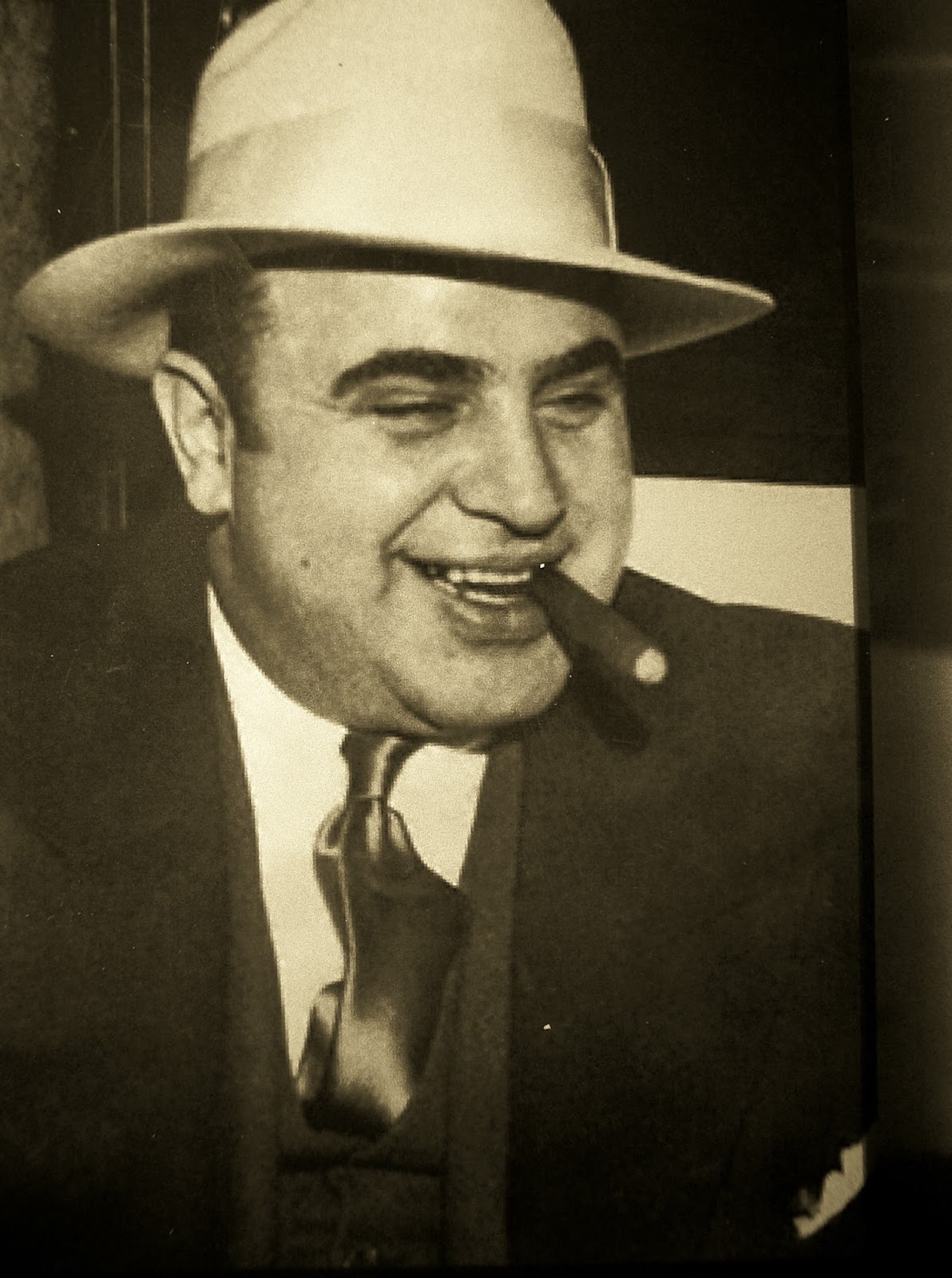
Al Capone 
Al Capone was one of America’s most notorious gangsters. He ran a multi-million dollar operation out of Chicago, Illinois.


He dominated organized crime in Chicago for almost a decade in the 1920s. At the height of his power, Capone employed over 1,000 gunmen and half the cops in the city were on his payroll.

Yet, by the end of his life, he was a shell of his former self. He had been reduced to living in a state of constant fear. He believed that the ghost of one of his many victims had come back to haunt him—others point to mental illness as the cause for this deterioration.

Alphonse Capone was born in Brooklyn, he was the son of Italian immigrants. He moved to Chicago to be a friend’s bodyguard. This friend, Johnny Torrio was head of a crime syndicate that supplied alcohol during the Prohibition Era.

By the age of 26, Capone had become a prominent crime boss in Chicago. He used bribery and intimidation to influence local political elections and violence and murder to ensure his illegal businesses thrived.

The notorious Saint Valentine’s Day slaughter in 1929 was ordered by Capone to get rid of a rival Irish bootlegging gang—known as the North Side Gang.

Capone was conveniently in Florida at the time so he and the men he sent to do these murders were never accused of this crime.

In May of 1929, Capone was convicted on a lesser charge—carrying a weapon on a trip to Philadelphia. He was sentenced to a prison term at Eastern State Penitentiary.

His cell reflected his power and influence. He had a comfortable bed as opposed to a cement slab. Oil paintings hung on the wall, a state of the art radio sat against one wall along with other elegant furnishings.

Capone's cell at Eastern State
But Capone’s stay was not to be comfortable. It was not long before this tough guy’s piercing screams were heard every night. He was also heard begging for “Jimmy to let him alone.”

Jimmy's body is one on
right against the wall.
Jimmy was James Clark or his real name—Albert Kachellek. He was second in command of the North Side Gang run by George Moran. He was shot down with six others in cold blood during the Saint Valentine’s Day Massacre. Capone believed Jimmy’s ghost was haunting him to exact revenge.

After six months, Capone was released. Members of his gang believed this ghost continued to torment their boss.

It wasn’t long before Capone was convicted on tax evasion and was sent to Atlanta US Penitentiary and then Alcatraz for a combined 11 years. Jimmy’s ghost followed him into these prisons. In fact, this ghost terrorized him until his death in 1947.

After six and half years in Alcatraz, Capone was released only to be put in a mental hospital in Baltimore. He was held there for three more years.

Some believe that Capone's problem was just mental illness and not a ghost. At the age of twenty, he had worked in a brothel as a bouncer. He contracted syphilis, he never had this disease treated.

It eventually turned into an case of neurosyphilis, which led to Capone having dementia.

It should be noted here that Capone claimed to see Jimmy’s ghost way before he lost his mind.

Capone's gravesite
By 1946, one physician who examined Capone said he had the mental capacity of a 12-year old. If Capone was actually tormented by Jimmy’s ghost will never be known, but despite his life of crime, he was and is considered a celebrity.

Even today, people leave offerings of booze, cigars, and flowers on his grave at Carmel Cemetery in Hillside, Illinois.

Tuesday, September 8, 2015

The Eastland Tragedy and Harpo Studios, Part ll


Today a memorial plaque marks the spot where the Eastland tragedy on the Chicago River, between Clark and LaSalle Streets occurred. In Part 1 of this post, a description of how this tragedy unfolded is shared.

Clark Street Bridge
Photo: Nathan Holth
To this day, witnesses claim to hear moans and blood-curling screams from the Clark Street Bridge.

Over 3,000 employees of the Western Electric Company boarded the steamship, The Eastland, on July 23, 1915, to travel to Michigan City, Indiana, for a company-sponsored picnic.

Shortly after leaving the dock at Clark Street, the Eastland steamship, which was top-heavy, fell onto its port side. Over 800 passengers were trapped and drowned within a short period.


Survivors standing on the side of Eastland steamship.
The deceased victims were taken to the 2nd Regiment Armory, which had been turned into a makeshift morgue, to handle the large number of corpses.

Oprah Winfrey bought this armory located on Chicago’s West Loop, in the 1980s. She had the 4-building 3 and half-acre space renovated into studio space.

From 1990 until 2011, she filmed the Oprah Winfrey Show at Harpo Studios. In 2014 she sold the property but leased it for another 2 years for productions connected to her OWN cable channel.

Harpo Studios
During the time her talk show was filmed, she and her staff and crew, came to believe that several of the victims of the 1915 Eastland tragedy haunted the studios. *

* Today she does not speak about this haunting.

At one time this ghostly activity inspired her to produce an entire show about the haunting.

It is said that she would not go into the studio alone at night. She and her employees experienced unexplained sounds throughout the buildings.

They heard mournful relatives crying as they collected their dead relatives, as well as giggling children running up and down the hallways. Whispers and footsteps were heard. Old-time music and glasses clinking together were also heard.

Doors would suddenly open and close, and small items were moved about. 

A shadow figure dubbed “The Grey Lady” was often seen moving throughout the studio. Her image was captured on a security camera. She is seen wearing early 20th century clothing, with a big hat.

One restroom was always kept locked because so many people heard disembodied crying behind its door.

Several witnesses also claim there is an angry male spirit upstairs.

Note: This studio was demolished recently.

In Part l of The Eastland Tragedy and Harpo Studios, one of America’s worst maritime disasters is recounted.

The Eastland Tragedy and Harpo Studios, Part l


The Eastland tragedy claimed three times the lives the Chicago Fire did, but it never received the same notoriety.

This tragedy that occurred in 1915, is one of America’s worst maritime accidents. It took 844 lives, including more than 20 entire families.

On July 24, 1915, the Chicago based company, Western Electric Company chartered four ships to take 8,000 employees to their annual company picnic in Michigan City, Indiana.

The Eastland
One of these ships was the steamship The Eastland, which had a reputation for being easily unbalanced. On more than one occasion, it had nearly capsized on Lake Michigan.

3,200 employees of Western Electric boarded this ship on that morning in July for “a day of fun on the company’s dime.”

Unfortunately, The Eastland was only supposed to carry, at most, 2,500 passengers. After the Titanic disaster in 1912, more lifeboats and life preservers were placed on the upper deck of the Eastland, making it top-heavy.

The steamship began to list immediately after it left the dock. This was because most of the passengers where on the upper deck, so they could see the city as they left the port—the ship was now unbalanced.

As the Eastland capsized to its port side, water rushed in through its windows and doors. Mass chaos among the passengers and crew ensued.

Witnesses watched in horror as people were pulled out of portholes. As “Mothers screamed for their children.” By-passers jumped into the river to help passengers to shore.

Many of the female passengers drowned, weighted down by their long dresses that were drenched.

Many people were trapped in cabins with no way out. The people who managed to escape, found themselves struggling to keep above the waterline, as many others landed on top of them.

One witness described the scene “as a moving sea of bodies.”


On the port side.
Chicago History Museum
In just 15 minutes the Eastland was resting on its side in no more than 20 feet of water—entombing hundreds of people inside. Rescuers worked into the night looking for survivors and recovering bodies.

There were so many deceased laid out on the dock, the authorities could not prevent thieves from rummaging through the pockets of the dead.

Local merchants lent their wagons to help move the deceased from the scene. The corpses were taken to the 2nd Regiment Armory, on West Washington Avenue, its gym was set up as a makeshift morgue.

2nd Regiment Armory
Blocks of ice were placed next to the deceased until family members could identify their loved ones.

In the 1980s, this property, including the old armory, was bought by Oprah Winfrey and renovated, and reopened as Harpo Studios.

Winfrey and her staff came to believe the ghosts of people who perished in the Eastland tragedy, haunted the four buildings that made up this studio.

In Part ll of The Eastland Tragedy and Harpo Studios the haunting activity that has been observed in Harpo Studios are shared.

Wednesday, March 25, 2015

Inez Clarke: A Real Haunting or Myth?

Stories about cemetery statues coming to life are a popular ghost sub-genre.

One of the most beloved of these tales involves a statue of a pretty six-year-old girl wearing a frilly dress and sitting in a rustic log chair. Her name was Inez Clarke, and the figure that marks her grave is enclosed in a glass box.

Inscribed below this case:

Click to enlarge
Daughter of
J.N. and M.C. Clarke
Born Sep. 20, 1873
Died Aug. 1, 1880

This impressive sculpture is located at Graceland Cemetery outside Chicago, Illinois.

Inez was buried at Graceland in 1880. According to one legend, she died when her parents forced her outdoors into a thunderstorm as punishment.

When she was struck by a thunderbolt and killed her parents now guilt-ridden told others that she died of tuberculosis.

A subtler story told is that Inez was on a picnic with her parents when a sudden storm moved in. She was hit by a thunderbolt and killed instantly. Her parents inconsolable had a lovely statue made and placed at her grave in remembrance of their daughter.

Shortly after her burial, it is said Inez was not able to rest in peace. Rumors began that she haunted her gravesite. Her ghost was seen near her statue and also seen meandering throughout the cemetery.

Credible witnesses state they saw a little girl dressed in an old-fashioned dress playing next to the glass-encased statue. Others report they heard crying or moaning coming from this plot.


Children most often see her ghost. They state they run and play with her.

One cemetery night watchman quit his job after spotting the case empty during a violent thunderstorm. He was scared the stories about Inez’ ghost were true.

After this, rumors spread that the statue would come to life during storms.

This entire story was supposedly debunked in 1910 when staff contacted the Clarke family which they thought was connected to Inez. This family knew about the old tales but denied the connection.

Soon after it was discovered that there was no one by the name of Inez Clarke in the local US Census in the late 19th century.

It was also discovered that Inez’ grave was actually the burial plot for an eight-year-old boy named Amos Briggs.

Then an explanation was given as to why this statue was above his grave. It was stated a Scottish sculptor offered it to the cemetery. Graceland accepted it but did not put much thought into where they placed it.

Grandparents buried at left.
But this old explanation does not explain the inscription below Inez’s statue.

Recently, new research points to the fact Inez is buried here. She was the daughter of Mary Clarke who had her during her first marriage. So Inez’ real last name was “Briggs.”

Inez went to live with her grandparents after her parents divorced. The name “Inez Briggs”--seven years old--does appear in the 1880 Chicago Census report. Inez was living with her grandparents at the time of her death--the cause was diphtheria.

Her grandparents most likely had the statue made. More proof that this is the real story is her grandparents, David and Jenny Rothrock are buried right next to her grave at Graceland. 

Below is a copy of the 1880 Chicago Census that shows Inez living with her grandparents.
Click to enlarge

Monday, November 17, 2014

Christmas Tree Ghost Ship


From 1898 to 1912, Herman Schuenemann was the Captain of the wooden schooner Rouse Simmons. 

Captain Schuenemann was considered as much a part of Chicago’s Christmas as Santa Claus, because his ship was better known as the “Christmas Tree Ship.”

Every November he would set sail on Lake Michigan from Thompson with a full cargo of spruces, pines, and balsams piled high.

As Schuenemann reached his destination-- he would steer the Rouse Simmons down the Chicago River and up to the Clark Street Bridge, were thousands of waving Chicagoans would wait in anticipation.

Once the ship had docked, people swarmed onboard to choose a Christmas tree. They cost 50 cents to a dollar.


“Chicago’s Yuletide season began when the Christmas Tree Ship arrived with evergreens lashed to her masts and rigging… Her skipper would welcome throngs of Chicagoans aboard as soon as the ship’s moorings were secure. Whole families would hurry to the dock to get the pick of the crop. Many wandered on deck to watch the Captain’s daughter, Elsie, weave pine branches into wreaths, which were also for sale.”

         --Reminiscences of Phil Sanders when he was a boy.

Herman Schuenemann, and his brother August before him-- from 1876-to 1898-- always made sure no one left without a tree. Both brothers gave away hundreds of trees to needy families, churches, and orphanages.

August was carrying a load of trees to Chicago when his ship went down in 1898, in one of Lake Michigan’s fierce November gales. His brother, Herman, made another trip just two weeks later determined Chicago would have its Christmas trees that year.

Unfortunately, fourteen years later Herman would suffer the same fate.

Bad Omens

Lake sailors, as well as ocean sailors, are a superstitious lot--they have to be. Generations of “old salts” pass down what a sailor needs to be aware of--this includes everything that happens on and around their ships.

Captain Herman Schuenemann
in the middle with two crew members.
Captain Schuenemann was a competent, and cautious sailor but for some reason he ignored a significant number of ominous warnings in November of 1912.

He was planning to sail from Thompson, Michigan, on a Friday with a large cargo of trees despite severe storm warnings. His crew was nervous, for there was an apparent storm brewing, and the captain wanted to start their journey on a Friday.

Sailors considered it extremely unlucky to begin a voyage on a Friday. In the 1800s, the British Navy was so annoyed by this superstition they purposefully launched a new ship called HMS Friday on a Friday.

Needless to say this ship and its crew was never seen again.

Captain Charles Nelson, Herman’s partner, who had been a lake captain for 50 years tried to persuade Herman to delay, but he could not convince him. Herman didn’t want to take the risk of being iced into the harbor, and having his ship dashed against the docks by gale-force winds.

Schuenemann then ignored several more bad omens. Just before the schooner left the harbor, several sailors watched in horror as droves of rats fled the ship. This is believed to be a sign a vessel is in imminent danger.

Three crew members afraid left the Rouse Simmons, forfeiting their pay. This left just 13 crewmembers on the ship. Sailing with thirteen crewmembers was considered to be as dangerous as starting a voyage on a Friday.

Ships at the time nailed a horseshoe to the side of their vessels for good luck. Just as on land, it is considered bad luck if these horseshoes are hung upside down--all the luck will run out.

As the Rouse Simmons set sail, the horseshoe that was hung on its side was loosened by strong winds. It was now hanging upside down on a single nail.

The Storm

Captain Schuenemann left the harbor on November 22nd and sailed right into the now infamous Big Storm of 1912.

The temperature immediately dropped from 40 degrees to below freezing.  Rain turned to snow and ice, which coated the ships’ rigging, sails and spars--and the Christmas trees that were on deck.

The next day witnesses in Kewaunee, Wisconsin, saw the Rouse Simmons pass by flying her distress signals. They wondered why the ship with its tattered sails did not just stop but instead sailed into a blinding snowstorm.

“The Two Rivers Life Saving Crew was informed of the ships’ distress signals and set out in search of the schooner but it was never found.”

                   --From an article in the Chronicle of Two Rivers

Wreck of Rouse Simmons
This mystery was not solved until 1971 when the wreck of the Rouse Simmons was found at the bottom of Lake Michigan.

Its wheel was missing so the experts concluded that the enormous ship's cargo of Christmas trees had basically turned into ice blocks on deck, which then slid into the wheel leaving the captain unable to control the ships’ course.

Phantom Bells and a Ghost Ship

One popular sailor superstition is that when a ship’s bells are heard ringing of their own accord, as in a storm, this foretells death.

In the days after the Rouse Simmons was lost, several people near Two Rivers, Wisconsin reported hearing phantom bells and phantom cries in the wind.


A ghost ship has also been seen over the years. It is often spotted on Christmas Eve, and Christmas Day, gliding in the waters near Two Rivers. People have watched as it just vanishes into a mist.

Excerpts from Haunted Christmas by Mary Beth Crain

Monday, October 20, 2014

Victim Tells All

This is the true case of a female ghost returning in order to reveal the person that murdered her.

This story first appeared in a book, Houses of Horror by Richard Winer. It was then showcased in an episode of the television show Unsolved Mysteries in April of 1990.

In 1977, Allen Showery an African American hospital orderly was called in for questioning by the Chicago police. He knew what it was about.

The Victim

Born in the Philippines in 1929, Teresita Basa was a quiet and unassuming respiratory therapist at Edgewater Hospital in Chicago, Illinois. In February of 1977 the fire department was called to her apartment.

Teresita Basa
In the blaze her nude body was found under a burning mattress with a butcher knife buried in her chest.

The police pursued several leads but none panned out.

A Vision

In 1977, Remy Chua another respiratory therapist at the hospital also from the Philippines saw a disturbing sight in the Edgewater employee lounge. She saw the ghost of Teresita in this area.

Chua who had not known Teresita very well then started to have strange visions and dreams.

In these visions and dreams Teresita implored Chua to go to the police and tell them what had happened.

Chua started to take on mannerisms and habits that were not her own. At one point her coworkers heard her singing a song. Later she denied singing this song stating she didn’t even know it.

As things worsened Chua collapsed on her bed one night. Teresita’s voice taking over informed Joe--Remy’s husband a doctor--that Showery had killed her. When Joe asked for proof so others would believe him she listed jewelry that her murderer had stolen from her home.

The couple reluctantly approached the Chicago police who at first were skeptical. Detective Joe Stachula felt the Chua’s had given them enough information to implicate Allan Showery.

Confession and Conviction

As relatives identified jewelry found in Showery’s home as belonging to Teresita--he broke down and confessed to the crime.

He had been invited to Teresita’s home to fix her TV. He killed her and took her jewelry to give to his girlfriend.

Showery was convicted of murder in 1979. He was only given a 14-year sentence for this cold-blooded crime.

Allan Showery
Remaining Mystery

Remy has never had another experience like this one.

She and her husband and others involved in this case have not been able to explain what happened to her in 1977.

Footnote: The Edgewater Hospital building today is abandoned and many believe it is haunted.

Here is the Unsolved Mysteries 11-minute story about this case. At the time of this production the names of the couple were changed.

Thursday, February 27, 2014

The Unseen Guardian Angel


It was the early 1930s in Chicago during the Great Depression. A doctor told this story to his brother…

Dr. Brown late one night was awakened from a sound sleep by the phone ringing. He groggily groped for the receiver trying to find his glasses on the nightstand.

A husky voice on the other end pleaded, “Is this Dr. Brown?”

The doctor reassured the caller that he had reached the right number. The male voice became more desperate, “Can you come quickly? It is a matter of life and death.”

Again the doctor reassured the caller, “Yes, of course, where do you live?” The voice mumbled a number and street as the doctor found his pencil and pad of paper, he asked the man to repeat it. “It is 17 Alan Street, please hurry.”

State Street Chicago 1930s.
Since it was the middle of the night, the doctor drove across town quickly, not having to fight the regular traffic. He drove into a neighborhood that was in a poorer section, that was run down. He knew many who would not venture into this area even in the middle of the day.

He found the street and then the house number, but oddly no lights were on at the address. He hesitated, then grabbed his bag and walked up to the front door. He rang the bell and waited, no answer, so he rang once more. He tried a third time--still no response.

As he turned to leave he heard a gruff voice, “Who’s there?”

It’s Dr. Brown, someone called for medical assistance.”

“Nobody here called you. You best leave.”

The doctor retraced his steps to the car looking to see if he might have read the number wrong. He had written the number “17.” He looked around, but none of the homes on the block had lights on. He headed home wondering if it had just been someone’s idea of a prank.

He did not receive a follow-up call that night or the next day, so he soon forgot about the incident. Several weeks later he received a call from the hospital requesting he come to the emergency ward immediately.

A nurse at the reception area told him that a patient who had been involved in a severe accident had begged the staff to call him. She told him the man did not have much longer to live.

She escorted him into a large ward where a man heavily bandaged lay in a corner bed. Dr. Brown glanced at his chart, but he did not recognize his name.

The man looked up at him, “Dr. Brown, you don’t know me, but I have to talk to you. I need to beg your forgiveness.”

Puzzled, the doctor moved to the side of the bed and nodded to the nurse to leave. The dying man continued.

“Several weeks ago I called you late one night.” He hesitated and then continued, “My family, …I have been out of work for months, there was no money, I couldn’t feed my children…”

As his voice faded, the doctor leaned forward to hear his words. “I need your forgiveness.”

More confused, the doctor shook his head no and stated, “You don’t…”

The man gripped his hand stopping him, “Yes, I do. You see that night I had planned to kill you. I was going to take your money and instruments.”

Horrified, the doctor managed to reply, “But you didn’t kill me.”

“I intended to, but when I saw the big powerful young man standing at your side I was afraid. So I sent you away. Can you forgive me?”

“Yes, of course.” Dr. Brown replied in a daze. The man’s grip loosened and fell from the doctor's hand. He had held it the whole time. He took one last gasping breath and died.


As Dr. Brown recounted this story to his brother he paused, "I suspected it was just a prank. I came close to death and didn't even know it. I didn't know that my guardian angel had saved my life that night." He shook his head in wonder, "he only appeared to my assailant."

Monday, December 30, 2013

Can Animals Return as Ghosts?


“If having a soul means being able to feel love and loyalty and gratitude, then animals are better off than a lot of humans. You’ve nothing to worry about there.”

Alf Wright
aka
James Herriot
The above quote is a response given by the late British author, and veterinarian James Herriot, when he addressed the question of whether or not animals have souls, and could experience an afterlife.

His response was received with appreciation from people all over the world. Herriot was one of the first well-known animal lovers to address this topic.

If you believe the above, then the possibility exists that some animals do indeed return in ghostly form.

A popular post on this blog is about “Ghost Cats” and the intriguing video my group caught of a “possible” ghost cat. I received many positive responses to this post through email and in person.

This topic is close to many people’s hearts.

Numerous witnesses over the years have seen what they feel are deceased pets come back to visit.

A good book about this topic is Ghostly Animals of America written by Patricia Edwards Clyne.


Many people have seen the ghosts of animals over the years--not all of them former pets. The following story is an unusual one.

There is a busy intersection in Cook County in a suburb of Chicago. Until recently, this intersection did not have a traffic light. The speed limit in the area is 45 mph, but cars often drive through this intersection going 50 mph plus.

Drivers especially at night, have trouble seeing this intersection because there is a rise, which blocks their view until they actually cross it.

A riding stable is located near this intersection. This stable has extensive wooded riding paths, and one of these paths crosses this intersection.

Unfortunately, because of this dangerous intersection, more than one rider has been injured or killed at dusk or at night, when a car has hit them while they crossed this road. Several horses have been killed in these accidents, as well.

Drivers along this road have reported seeing a strange phenomenon. They see what appears to be a “smoke grey silhouette of a horse and rider.” Neither figure has distinguishable features. They are most often seen right in the middle of the road.

This strange duo is seen at night, crossing the intersection. Some have reported that they saw this horse and rider appear in front of their cars suddenly, but as they slowed down, this “silhouette” just faded away.

Other grisly reports state that drivers have actually seen one of these accidents, reenacted in this intersection. These accounts include witnesses seeing a rider being thrown from their saddle, and then just disappear. Others state they actually saw a fallen horse dragged by a car until it came to a complete stop. 

Friday, May 10, 2013

Edwin Becker’s Story: True Haunting


In the 1970s when it was still very much taboo to talk about ghosts, one families story of living in a haunted house in the inner city of Chicago, Illinois was aired on NBC news. 

A news reporter Carole Simpson interviewed a young family named Becker who claimed that the house they lived in was haunted by several ghosts. 

Simpson’s interview was televised in the Becker’s living room and was the first exorcism to be broadcast live. This exorcism was performed by a medium, Joseph DeLouise, who had been one of only a handful who had responded to the Becker’s pleas for help. The Rev. William Deri-Davies also attends.

I have placed the original video of this NBC news story below. This broadcast in the early 1970s is very unique, considering the term “paranormal” was not used very often at that time.

Ten years later, Edwin Becker wrote about what he and his family had experienced in this house. Several publishers were interested in his book, but they all wanted him to spice up or embellish what had happened. 

To Becker’s credit, he refused to do this. Which makes his story more compelling in my eyes. Instead, Becker chose to self-publish his book entitled, True Haunting. His eBook is available on Nook and Kindle, etc. It is a well-written account of a terrifying haunting.

Edward Becker, his wife, and their infant daughter, in 1970, moved into a two-story house that had been converted into apartments. Little did he know that his life and his families were about to become as he put it “a living nightmare.” 

Becker, not a believer in ghosts, knew the house had a sorted history. Five people, all related, had died in the home. 

Two died on each floor and one in the basement. Two of the deaths were known to be suicides, and one other was suspected to be a murder. All five people who died in the house were considered, “mental deviates” --to use a term from that time.

The most recent death in the home had occurred just before the Becker family moved in. A man by the name of “Ben” who had the seedy hobby of making his own pornographic materials had been found dead. 

The house was put on the market for a low price. Edwin Becker logically felt that fresh paint and a new carpet would wipe out the initial oppressive sense or feel he got when he first walked through the empty building. 

He stated later that his arrogance was to cost him dearly. 

Immediately after the Becker family moved in, unnatural things began to occur. For the ghosts in the house wanted their presence to be known. 

Room doors and cabinet doors slammed violently shut. Footsteps were heard at the back of the house both day and night. Horrifying screams were heard throughout the house. 

The phone would rise up, hover in mid-air for several minutes, and then crash down. The kitchen mixer affixed to a wall would fling itself across the room. 

Keys to the various doors in the home were found misplaced. Several when found were bent and twisted out of shape. 

Unseen hands picked up the families’ pet cat, held it out of the second-floor window and then dropped it twenty feet to the pavement below.


The Becker family becoming desperate and finding most people did not believe their story, had a priest come in to bless the house. During his visit, his brass container that held his holy water shattered all over one room. 

He refused to enter the home again. 

Most of their friends professing not to believe them, ironically still refused to visit them. Becker’s best friend, a visually impaired man, told him that he sensed presences throughout the home and that he heard a variety of voices.

In the end, Edward Becker admits that he was very naive. He at first flippantly taunted and mocked these spirits as if it were a game. Later he realized this probably spurred on their resentment against him and his family. 

He admits in his book that he allowed these ghosts to figure out where he was emotionally vulnerable, and they used this information against him. He finally understood that the ghosts considered him and his family the intruders.

The following is Becker’s perception and thoughts on what happened:

“Ghosts can be seen and heard. They can appear as solid as you or me. They can propel objects and interrupt utilities. They can affect your moods and feed off of emotions. They can become hostile and violent when threatened. They can harm you, and they can’t be moved.”

This YouTube video is of the Simpson interview and the exorcism performed. The tape is old, so it skips.