Showing posts with label murders. Show all posts

Monday, July 15, 2019

Haunted Lizzie Borden House


Lizzie Borden House
The murders of Andrew and Abby Borden in 1892 are two of the most gruesome in American history.

The Borden’s lived in Fall River, Massachusetts with Andrew’s two daughters, Emma, and Lizzie from a previous marriage.

Lizzie Borden
The two were discovered “hacked to death” with an ax. Lizzie became the authorities primary murder suspect and was tried and acquitted in a two-week sensationalized trial.

No one else was ever accused, and these murders remain unsolved. But to this day many believe that Lizzie actually did murder her father and stepmother.

Much of the evidence that pointed to Lizzie being the murderess, for some reason, was ignored or even found to be inadmissible during her trial.

Lizzie did not appreciate her frugal father, and she and her sister had an open disdain for Abby—calling her “Mrs. Borden.”

Lizzie Borden House today.
The sisters just before the murders had fought with their father over money matters—they were due to inherit over seven and a half million dollars—in today’s value-- at their father’s death.

Lizzie was seen burning one of her dresses, by a friend, that she claimed to be paint-stained, just days after the murders. The suspected murder weapon, a broken hatchet, was found hidden in the home’s basement.

The police, when they questioned Lizzie after the murders, found her statements to be “inconsistent,” and she provided several changing alibis.

Andrew and Abby Borden
The day of the murders, Emma was away from the Borden house, and the family maid, Maggie was outside cleaning windows. Lizzie was home—she claimed to be in a barn in back of the house looking for fishing tackle and eating pears.

The police found this barn so hot—they felt no one could have stayed in it for twenty minutes, let alone for an hour and a half.

The Borden house is not that large, but Lizzie claimed not to hear or see anything.

There were ninety minutes between the two murders, and the police found that it was odd that a murderer would stay around for this long-- and then not to have been seen by Lizzie or the maid?

But most of this was not taken into account at the trial. When the Borden’s crushed skulls were exhibited, Lizzie fainted. The all-male jury was sympathetic—after all, how could a petite, Sunday school teacher do this?

Today the Lizzie Borden house is a museum, and a bed & breakfast. Visitors can take day tours or stay overnight. Tour guides, visitors, and paranormal teams all feel it is haunted.

Bodies of Andrew and Abby Borden found murdered.
Andrew Borden was murdered as he napped on the settee in the family parlor. Abby was killed in the family guest room upstairs—she had nineteen blows to the head.

Strange mist captured on camera
in Borden guest room.
These two rooms have a lot of activity. Most who enter this house, that has been restored to its 19th-century appearance, report feelings of overwhelming sadness.

Tour guides mention being touched by unseen hands. Many report something tugged at their clothes.

There have been reports of people seeing the apparitions of Andrew, Abby, and Lizzie in the home. Strange mists have also been observed. 

There are also reports of something unseen whispering in people's ears.

One of the strangest phenomena to happen occurs by the bed in the guest room where Abby Borden was killed.

A strange image caught in a mirror
at Lizzie Borden house.
Countless people have closed their eyes and stood on the spot where she died. They all report feeling as if someone shoved or pushed them on the back. Others feel a force coming through the floor that tries to tip them.

Witnesses also mention hearing children’s laughter in the homes attic rooms.

One folktale belief is that the spirits in the house can be “bribed” to leave the living alone.

Visitors often place a few coins on Mr. Borden’s bureau. While the young spirits respond best to small toy offerings.

The following video is a good summary of the tensions in the Borden family, as well as an explanation for why there are young spirits in the house.

Wednesday, June 19, 2019

The Violent History of Georgia O’Keeffe’s Beloved Home


Georgia O'Keeffe at Ghost Ranch
Arthur Pack, one of America’s first environmentalists, bought Ghost Ranch, 15 miles north of Abiquiu, New Mexico in 1936.

O'Keeffe's home at Ghost Ranch
Georgia O’Keeffe having visited Ghost Ranch for several summers convinced Pack to sell her, a small piece of this ranch in 1940, seven acres and a house. This became her summer home.

She bought another three acres and a crumbling adobe home (which she spent 3 years remodeling) in the village of Abiquiu where she spent her winters.

Pedernal
O’Keeffe created her Southwestern paintings while living in North Central New Mexico.

Her home at Ghost Ranch has a fascinating history.

In the 1800s the Archuleta brothers claimed 22,000 acres on the Rito del Yeso spring. This was the most reliable water source in this high arid desert.

Ghost Ranch

These brothers built cedar and adobe houses and ran horses and cattle on this ranch that became known as Rancho de Los Brujos (Ranch of the Witches).

O'Keeffe's
Ghost Ranch in Fall.
This pair began to offer “feigned hospitality” to other cattlemen that passed through the valley. But these visitors would mysteriously disappear. There were rumors of bodies in the well and men being pushed off high cliffs to their death.

The Archuleta brothers then sold the goods, horses, and cattle they stole from these victims.

These two men became prolific killers.

View from Kitchen Table
Credit: Erin Vanella
Ghost stories began to be told about the ranch. Some heard the wailing voices of the murder victims. Others spoke in whispers about ghostly apparitions.

The brothers afraid this was drawing undue attention to their criminal enterprise stated they actually started the rumors of ghosts themselves to keep people away.

Becoming greedier the Archuleta brothers grew paranoid. They even eventually became suspicious of each other.

After the younger brother sold one stolen herd, he decided to bury the gold he received in a clay pot. The older brother demanded to know where he hid this payment.

The two fought, and the older brother killed his brother. But this younger man took the secret of where the money was to his grave.

Thinking the wife of his brother must know where the gold was hidden the older brother threatened her. She wisely packed up and left with her children.

O'Keeffe's Winter Cottonwoods
The villagers seeing that the remaining brother was now alone and vulnerable took the opportunity. They rode to the ranch and hanged the older brother from a Cottonwood tree.

For years, people felt the spirit of this brother was connected to the tree he was hanged from.

This is why some feel the property is called Ghost Ranch today.

Phoebe and Arthur Pack
No one has ever found the buried gold and the Presbyterian Church has owned Ghost Ranch since Arthur Pack and his wife, Phoebe, gave it to the church in 1955.

Since this beautiful valley has been used as a retreat for people of all faiths and cultural backgrounds.

Tuesday, June 18, 2019

Murders at the "In Cold Blood" House


Clutter family farmhouse.

This year is the 60th anniversary of the brutal murders of the Clutter family in Kansas.

One of the best-selling crime books of all time is In Cold Blood by Truman Capote. This author spent six years researching this horrific crime.

Truman Capote at the Farmhouse.
A film, of the same name, was released in 1967, based upon Capote’s book. I saw this film when I was young. The scene at the end when the heartbeat stops, freaked me out--- not that I had or have any sympathy for the murderers.

Herb Clutter, his wife Bonnie and two of his four children, Nancy, 16 and Kenyon, 14 were asleep when two drifters broke into their farmhouse outside Holcomb, Kansas, in 1959, intending to rob the family.

Herb, Bonnie, Nancy and Kenyon Clutter.
These two thugs, Richard “Dick” Hickok, and Perry Edward, traveling across Kansas had heard a rumor that a wealthy wheat farmer had $10,000 stashed in his house.

But once inside the Clutter home they realized there was only fifty dollars.

The two murderers.
Enraged the two men then proceeded to shoot each family member with a shotgun. Bonnie and Nancy were killed in their beds, and Herb and Kenyon were bound and killed in the basement.

Each family member was shot point blank in the head. Mr. Clutter’s throat was slit as well.

Kansas State Prison gallows
where they were hanged.
Six weeks after these two murders, the two men were arrested when a “jailhouse snitch” told on them. They were tried and convicted, and after five years of appeals, they were both executed by hanging.

Since the Clutter family deaths, two other families have owned the farmhouse. In 2006, the house was put up for auction, but there were no takers.

Local witnesses claim the house is actively haunted. They believe the ghost present is Nancy, Herb’s youngest daughter. Her spirit is seen, after dark, wandering the home and property off Oak Avenue.

A short excerpt in Joanne Austin’s book, Weird Happenings, True Tales of Ghostly Places states something else odd happens at this farmhouse.

A bloodstain believed to be Herb Clutter’s blood remains on one basement wall. Over the years, regardless of how many times it has been scrubbed or painted over –it returns.

Photograph of the bloodstain.
The last family to own this house gave tours for a fee. But after being accused of making money off this tragedy, they stopped. The farm is private property, and trespassing is not allowed.

Saturday, May 2, 2015

Ohio’s Bloody Bridge

Often the backstories connected to ghost sightings are just legends that evolve over time to give a reason as to why a place is haunted.

The story of Ohio’s Bloody Bridge is unique in that the story told about why this bridge is haunted is true.
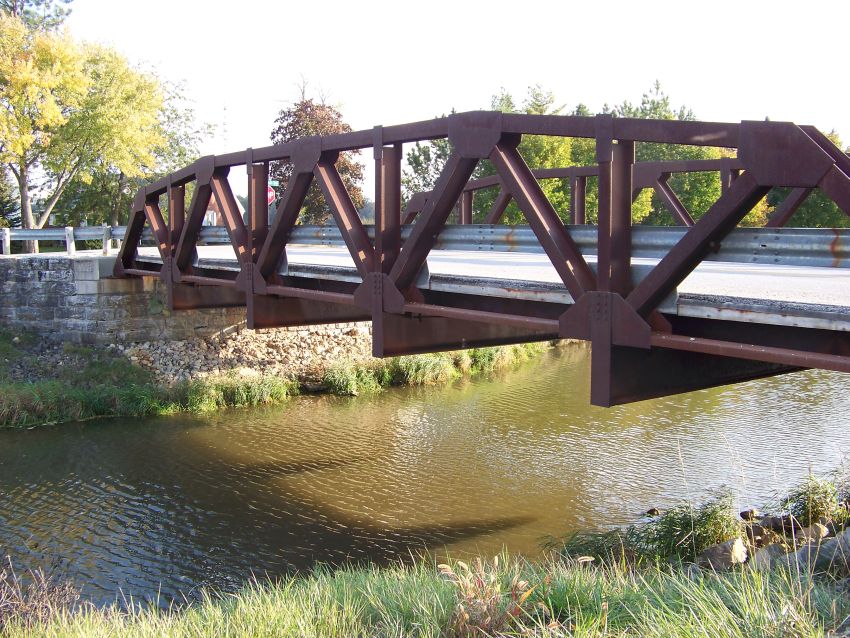
Present day Bloody Bridge
.
In the 1850s, a bridge that crosses the Miami-Erie Canal, located near Spencerville, Ohio was the site of a grisly murder.

Bill Jones and his girlfriend Minnie Warren seemed to be happy and madly in love, so it was a surprise to everyone when Minnie broke-up with Bill and began dating Jack Billings instead.

Bill now angry, and jealous plotted his revenge. One cold fall night in 1852, he waited near the bridge that crossed the canal. Jack and Minnie had attended a party that evening, and Bill knew they had to cross the canal to return home.

When Jack and Minnie’s wagon reached the middle of the bridge, Bill jumped out of the shadows with an ax in his hands. Before the couple could react, Bill lopped Jack’s head off with one fatal swing.

Minnie let out a scream and as she stood, she lost her footing and fell into the cold waters below--not knowing how to swim, she drowned.

When the townsfolk discovered the bodies, they launched a search for Bill Jones. But he was not found. Several years later, a body was found in a nearby well. Most believed this was Bill’s body. People speculated he had committed suicide or had fallen victim to an accident after the murders.

Soon after this crime, the locals started calling this bridge, “Bloody Bridge.”

Plaque and bridge.
Witnesses stated they saw the ghost of a headless man walking along the bridge after sundown. This made the bridge even more notorious, and it became a popular destination.

Other witnesses stated when they looked into the waters below the bridge at night, they saw the faces of Bill and Minnie looking back at them.

The original bridge was torn down, and a new one was placed in the original location. The story was so beloved by this time hordes of folks showed up to take a souvenir from the old bridge.

The construction of the new bridge did not impact the haunting. For people still, report seeing the figure of a headless ghost and the faces in the water.

In 1976, the Auglaize County Historical Society placed a plaque at the site, proclaiming the bridge was indeed haunted.


It reads:

“During the canal years of the 1850s, a rivalry grew between Bill Jones and Jack Billings for the love of Minnie Warren. There became hatred by Bill because Minnie chose Jack. On a fall night in 1854, returning home form a party, Minnie and Jack were surprised on the bridge by Bill, armed with an ax, With one swing, Bill severed Jack’s head. Seeing this Minnie screamed and fell into a watery grave. Bill disappeared, and when a skeleton was found years later in a nearby well, people asked was it suicide or justice.”

Excerpts from The Big Book of Ohio Ghost Stories, by James A. Willis

Thursday, October 2, 2014

Phantoms of the Lost Dutchman Mine

“The mines men find are never so rich as those lost.”

                                                 --Old saying about gold mines.

Photo: Chris C. Jones
Weavers Peak is said to be a
prominent landmark in locating the mine.
The story about the Lost Dutchman Mine in Arizona is a favorite story told about a lost mine in America.

Modern day prospectors still flock to the Superstition Mountains located 30 miles east of Phoenix in hopes of finding the rich deposits of gold it is said this mine contains.

Many people, unwaveringly hopeful, have bought what they were told was the “real treasure map” that would lead them to wealth and prosperity.

Various versions of supposed treasure maps.
Over a dozen men were killed in the 1800s in pursuit of this gold. It is stated that they may be the phantoms that still protect this treasure today.

Gold Found and Lost

After the Mexican War in 1848 the territory of Arizona was transferred to the United States. But with plans made to build a southern transcontinental railroad to Los Angeles the U.S. discovered they needed the land south of the Gila River.

James Gadsden, the U.S. Minister to Mexico facilitated the purchase of another 45,000 square miles between the Gila River and the present Mexican border.

With the onset of the Gadsden Purchase, a young Mexican man fled his home in Mexico and went into the Superstition Mountains. It is said he escaped a fathers' wrath because he had violated the virtue of this mans’ young daughter.

Superstition Mountains
Supposedly, he found a rich deposit of gold in 1852. He then returned to his village and convinced several of the men to return to the Superstition Mountains to help him remove part of the gold before the purchase of the land was complete.

This group mined a large amount of gold and happily headed home. But they didn’t get far before a band of Apaches ambushed them. All were killed except for two young boys who hid. The Apaches not caring for the gold left it where it fell.

It is said the two young boys then buried the gold and ran for their lives. Years later, these two told their cousin about the gold and the three men then returned to the Superstition Mountains to retrieve the buried gold and reopen the mine.

As they pursued this they unfortunately met up with a German or some say a Dutch prospector by the name of Jacob Walz--sometimes spelled Welz.

Greed and Murder

Jacob Walz
The three Mexican men shared their secret with Jacob Walz, and he then promptly killed them.

Walz then recruited his nephew and two friends to help with the heavy labor of digging into the mountainside to retrieve the gold. After they completed this task, Walz killed the three and buried them deep within the mine.

Several other prospectors who had the misfortune to wander near the Dutchman’s mine suffered the same fate.

When Walz returned to Phoenix, rumors about a rich mine began to circulate. Several men tried to follow Walz into the mountains, but they never returned to Phoenix. It was believed Walz killed them.

When Jacob Walz died in October of 1891 his family found a shoebox under his bed that was filled with gold nuggets. Supposedly this box also contained a map to the mine, but it was written in code, which was never deciphered, so the location of the Lost Dutchman Mine remains a mystery.

Guardian Ghosts

A well-known legend that surrounds the Lost Dutchman states that if anyone comes too close to this mine they will encounter ghosts.

Several witnesses have claimed to be frightened off by the Apache warriors who murdered the Mexican villagers.

Others state these phantoms are the ghosts of the various men murdered by Walz--most often they are said to be the three whose bodies Walz placed deep in the mine.

Jacob Walz in New York
Yet other prospectors have claimed they saw the ghost of Jacob Walz. These stories include tales of Walz drawing a gun on these unsuspecting miners.

So be forewarned modern day prospectors--if the Arizona heat or the Superstition Mountains’ rugged terrain does not get to you-- a ghost or two just might.

Saturday, May 17, 2014

New Mexico State Penitentiary Riot, Part l


Smear marks are blood.

This prison riot was the second deadliest in U.S. history. On February 2, 1980, a group of maximum-security prisoners managed to take control of the entire penitentiary, and they and many other prisoners proceeded to wreak havoc for 36 hours.

Grievances

The New Mexico Penitentiary was extremely overcrowded by the 1970s. The guards were understaffed, poorly paid and most didn’t have sufficient training. The warden had instated a “snitch system” that infuriated many of the inmates. The prison personnel was basically overwhelmed, and this system helped them maintain discipline.

Several prisoners had brought the issues of overcrowding, inmate discipline, plus the awful food and lack of educational services to the warden’s attention more than once. Their complaints were ignored.

A Ticking Time Bomb

On Friday night the riot started a small group of hard-core prisoners were drunk on prison hooch. This group should have been locked in the maximum-security block, but their cells were still being built so. Instead, they were temporarily being housed in a cellblock that was dormitory style. 

Against procedure, this dorm was unlocked.

That night one inexperienced guard was assigned to 100 prisoners in this area. As the riot began, there were only 15 guards on duty in the entire penitentiary to watch over more than 1,100 prisoners.

Riled up that their grievances were being ignored and after several hours of drinking, this small group of prisoners overpowered this guard and took his keys.

The first place they headed was the prison pharmacy to get access to the drugs. They also unlocked many other areas--letting more prisoners out to roam.

They would have been confined to just this one area of the prison but for the fact that they gained access to the prison’s control center. Against regulation, the gate to this area was unlocked. 

Ironically, new bulletproof glass had been installed in the control center in recent days, but the prisoners managed to shatter this glass with a fire extinguisher.

Smashed Control Center
They now had access to the entire penitentiary.

Cell Block 4

Warning: these stories are graphic and disturbing.

Cell Block 4
The original group joined by others had one goal--they wanted revenge. They headed for Cell Block 4. This is where the snitches were housed.

They started accessing these cells the following morning.

These prisoners were locked in individual cells for their protection. Under normal circumstances, the revenge seekers might not have gained access to them--but for one item that was left behind by outside workers the day before. The prisoners found their Acetylene or welding torches.

These cut through the bars. Forty of these prisoners did manage to cut a hole through one wall and escape out into the yard, but many others didn’t. Most of the 33 deaths that occurred during the riot took place in this Segregation unit.

They tortured these prisoners still using these torches. They hung one prisoner up and burned his gentiles and other parts of his body until he died. Another prisoner had his head torched until it exploded. Yet another prisoner was thrown over the upper tier with a rope around his neck--hanging him.

The burn marks from one tortured prisoner can still be seen in Cell Block 4 on the concrete floor. The outline of his body is still evident. This area has been steam cleaned and painted but the burnt shape always reappears.

Decapitation indents and burnt outline.
One prisoner who shouldn’t have even been at the state pen--because he was mentally ill--wasn’t a snitch but was just in protective custody. They decapitated this man and placed his head on a rolling cart for all to see. One witness reported seeing two inmates with brooms hitting his head around the floor as if it were a ball.

Injured Prisoners

Over 90 prisoners were injured. Some died of drug overdoses. Prisoners raped prisoners. Others where stabbed or beaten. Some were piled in the prison’s gym and set on fire.

Views of the penitentiary during the riot.

Many minimum-security prisoners stood at their cellblock windows or in the yard during the riot and requested help. They called out to the Natural Guardsmen that encircled the outside perimeter of the prison during most of the 36-hour uprising.

The fate of the Guards

Of the 15 guards on duty, only four managed to hide or to escape. Many prisoner groups captured eleven of these guards. Several of these men were tortured and repetitively raped.

No guards were killed, but none of them returned to their job afterward, and most will not talk about what happened--not surprisingly this horrific nightmare scarred them.

Aftermath

Early Sunday morning the riot finally ended--with all of the prisoners surrendering as the National Guard entered the prison. Not one prisoner was ever tried or convicted for the murders that took place--many were just transferred to other prisons.

This riot did impact how prisons are run in New Mexico. Under the Duran consent decree, the feds were forced to come in to provide oversight for New Mexico prisons for the next two years.

After the riot, the state pen was closed down. This site located just south of Santa Fe has a newer maximum-security prison across from Old Main where the riot took place.

Parts of Old Main today are used to store movie props, and the rest of the buildings have been used in films, but mostly they remain empty. These buildings are considered to be New Mexico’s most haunted.

In 2013, historical tours of the old prison started to be offered to the public once a month. Before this several small groups including paranormal groups were allowed access to Old Main.

In New Mexico State Penitentiary Riot, Part ll I share two stories about the hauntings in Old Main.


Books about riot: Politics of a Prison Riot, by Adolph Saenz, The Hate Factory by Georgette Hirliman, The Devil's Butcher Shop, by Roger Morris.