Showing posts with label Ohio. Show all posts

Saturday, July 20, 2019

Kings Island’s Playful Ghost


Visitors go to Ohio’s Kings Island amusement park to eat funnel cake and enjoy the exciting rides.

Kings Island is located in Mason just outside Cincinnati. It opened in 1972 and has been this state’s favorite amusement park since.

The Beast
The most popular ride is called “The Beast.” When this wooden rollercoaster first opened in 1979, it was the tallest, fastest and longest coaster in the world.

Even today, forty years later, The Beast is still Kings Island's most popular ride.

But some visitors, while at the park, have gotten “ a thrill” of a very different kind.

Kings Island was built on land that was used for an ammunition factory (King’s Powder) from the late 1880s until the 1940s. During this time, there was a massive explosion that killed over one hundred people.
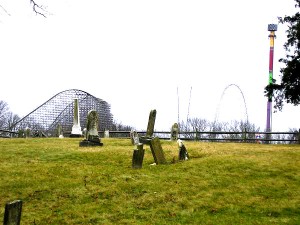
Dog Street Cemetery with
The Beast in background.
All that remains of this company is a small cemetery (Dog Street Cemetery)—that sits near the park’s exit, next to the parking lot.

This cemetery is one reason some feel the park is haunted.

One active spirit at Kings Island is a little girl. She is seen wearing a blue dress. Her ghost is spotted mostly in the park’s parking lot, skipping or playing “hide-and-seek” among the cars.

Park employees call her “Tram Girl” because of a game she likes to play with them.

As these drivers deliver their passengers at various points throughout the parking lot, this ghost likes to jump out in front of their vehicles—daring them to run over her.

One driver, in 2017, had just finished dropping off the last few passengers for the night and was headed for the main parking lot.

He was tired after a long day. So when his tram headlights illuminated a young girl, wearing a blue dress, run right in front of his vehicle, he was slow to react.

This driver did slam on his brakes, but he was sure he had hit her. But oddly he didn’t feel an impact or hear any screams.

He climbed out, but the parking lot was empty, and nothing was under the tram. After inspecting the front for damage, he was surprised there was none.

The little girl had disappeared as quickly, as she had appeared.

White Water Canyon at Kings Island.
This mischievous spirit is also seen at White Water Canyon in the park.

She is believed to be Jane Galeener, who lived with her mother, father, and younger brother on a section of the property that is now Kings Island.

Jane Galeener's gravestone in
Dog Street Cemetery.
She drowned in 1846, at the age of 5 in a lake, where White Water Canyon is located in the park today.

She is buried in Dog Street Cemetery.

Here is a video that shows how much fun The Beast is to ride.

Monday, June 17, 2019

Ohio’s Lick Road


End of Lick Road
Lick Road located in Northwest Cincinnati is haunted by the unfortunate ghost of a teenage girl.

This road is narrow and winds through dense woods, it then takes drivers down a steep hill. It runs from Kemper to the backside of the Richardson Forest Preserve.

Many will not take this route at night for it is an unsafe drive but more avoid it because of the ghost that lurks nearby.

A familiar tale told is that a young girl, named Amy and her boyfriend were parked at the end of Lick Road after their prom.

The first story states Amy angered her boyfriend when she resisted his amorous advances. He then rapes and kills her. Desperate, he dumps her body in the woods to hide the evidence.

Since witnesses have claimed to hear a female’s piercing screams and two distinct words, “Help Me!”

Others believe this ghost leaves written messages on cars. At the end of Lick Road is a lover’s lane and couples state that after their car fogs up, they have seen a finger trace the words, Help me, on their windows.

Others witnesses have seen this female ghost “floating” through the woods.


This ghost story, like many others, has evolved over the years. The next generation made this haunting their own.

Bridge on Lick Road
These teens described a scene where Amy tells her boyfriend after the prom, that she is pregnant. He refused to face the consequences and rejects her. She then later returns and throws her illegitimate, newborn baby off a bridge—and then kills herself.

Today the local teens have latched on to this latest story. It is stated if a person wants to see Amy’s ghost they should stand in the middle of Lick Road and announce—

“Amy, I have your baby.”

Then her ghost will appear and chase after the person who called out. It seems her spirit becomes angry when mocked.

This story also has more recently been connected to a method used by “Legend Tripping” teens across the U.S. to dare ghosts to appear—

It is advised they park their car, facing the path, turn the engine off, and flash their lights three times then Amy will appear.

Explore this road at your own risk—it is surrounded by private property and is maintained by the Hamilton County Park District—the police monitor it.

Friday, April 5, 2019

The Ghost of Moonville Tunnel


Moonville Tunnel

Moonville was a small coalmining town in the 1870s and 80s. Located in Southeastern Ohio, it was a railway stop along the Marietta-Cincinnati line.

Train engineers for over a century hated traveling through this lonely section along their route. The town at its peak only had one hundred residents, and the tracks were pitch dark and narrow.

These engineers had to keep a lookout for cows and deer that strayed onto the tracks as well as fallen trees.

But what they dreaded most was a large tunnel they had to go through to reach the town.

On a cold November night in 1880 an engineer, Theodore Lawhead was heading into this tunnel’s pitch-blackness when he spotted a light . . .

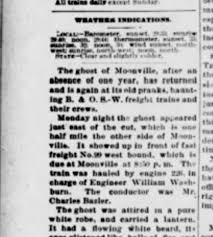
A newspaper story about the crash.
Within seconds he realized this light was headed straight for his train. The dispatcher had neglected to tell him another train was on the track. The two trains crashed head-on killing Lawhead and his fireman, Charles Krick instantly.

Today, no one would remember this tragedy except for the fact there has been a series of odd sightings for over a century in this tunnel.

In February of 1895, the Chillicothe Gazette published the following:

1895 Newspaper report about
Lawhead haunting.
“The Ghost of Moonville, after an absence of one year, has returned and is again at its odd pranks, haunting B&O S-W freight trains and their crews.

Monday night the ghost appeared just east of the cut, which is one-half mile the other side of Moonville. It showed up in front of fast freight No. 99 westbound, which is due at Moonville at 8:50 p.m. 

The Train was hauled by engine 226, in the charge of Engineer William Washburn. The conductor was Mr. Charles Bazler.

The ghost was attired in a pure white robe, and a carried a lantern. It had a flowing white beard, it eyes glistened like balls of fire, and surrounding it was a halo of twinkling stars. As the train approached the lantern was swung across the tracks . . .”

Since there have been countless sightings of this ghost at the end of this tunnel.

Witnesses today report seeing this apparition as well as a lantern swinging back and forth. Many have also felt a chill surround them at the end of this tunnel.

Photos have captured this phenomenon. Foggy mists have shown up as well as a figure, walking across the tunnel, wearing an engineer’s cap.

So is Theodore Lawhead trying to prevent another accident like the one that took his life? Some believe this is why his ghost lingers.

Tunnel with signal installed.
In the 1980s many train engineers, upon entering the tunnel, and seeing this light waving frantically hit their emergency brakes—the railroad in response to this dangerous situation installed a signal.

Crews were told they were only to heed this signal light and no others.

The freight trains stopped running in this area in 1988. The tracks were removed shortly after this. Today all that is left in Moonsille is a cemetery and the large railroad tunnel.

This, however, has not stopped the sightings of Lawhead’s ghost. Hikers, horseback riders and bicyclists all use this old train bed—and the sightings continue in this old tunnel.

Saturday, November 26, 2016

Johnny Morehouse and His Dog

Many claim Woodland Cemetery, located in Dayton, Ohio, is haunted. * 

The most famous story is about the ghosts of a five-year-old boy and his dog.

Woodlawn Cemetery
Like many ghost stories about young children, this one is more charming than scary.

In the mid-1800s residents of Dayton used a series of man-made canals to transport goods and people.

Miami and Erie Canal
The Morehouse family lived in the back of their shoe-repair shop in downtown Dayton. 

Behind this shop ran the Miami and Erie canal. In August of 1860, the Morehouse’s youngest son Johnny was playing near the trench with his dog. 

The young boy lost his balance and fell into the water.

His dog jumped in after him. He was able to pull his master out of the water, but it was too late—Johnny had drowned.

The Morehouse family buried Johnny at Woodlawn Cemetery. Within days of his funeral, people began to see an unusual sight. Johnny’s dog was lying on his grave and would not leave.

As the days passed, people worried this dog would starve to death, so they began to bring him food. 

Because of this dog’s constant vigil, a new headstone was carved for Johnny’s grave. It has “Johnny Morehouse” inscribed on the front and “Sweet Slumber” engraved on one side.

It depicts a large dog enfolding Johnny tenderly.

Today, this gravesite is the most visited in the cemetery. People leave offerings of coins, stuffed animals, various toys and food—in fond remembrance of this child and his devoted companion.


Offerings in remembrance.
For three months in 2008, a rumor was spread that the gravestone was vandalized. These stories were false. 

The head on the statue of the dog did disappear –the reason for this was with age it had fallen off. It was repaired and placed back on the figure.

Over the years, witnesses have claimed to see the ghosts of Johnny and his dog throughout the cemetery. They are seen running and playing together.

Many have heard the sounds of Johnny’s laughter as his dog barks.

Most impressive are the reports that people have seen what appears to be the statue of the dog breathing. Some have put their hands directly under the dog’s stone nostrils and felt these breaths.

*  Woodlawn is the 5th oldest garden cemetery in the U.S., Orville and Wilbur Wright are buried here as well as Erma Bombeck.

Wednesday, August 10, 2016

Ohio’s Engine House No. 16

Engine No. 16
This fire station located on North Fourth Street first opened in 1908 in downtown Columbus, Ohio. At first, a horse-drawn wagon was used then later a more modern fire engine.

While in use, Engine No. 16 was a favorite gathering place for all the area firemen. It was used for 70 plus years. When it closed in 1981, its rich past made it an ideal place for a museum about Columbus’ firefighting history.

Today the Central Ohio Fire Museum is a favorite destination for Columbus’ school children. They learn about firefighting and fire safety.

Central Ohio Fire Museum
One item that is not talked about is the firehouses’ resident ghost.

Most of the museum staff believe that a beloved ghost haunts Engine No. 16.


This ghost is Capt. George Dukeman—known more affectionately by his men as Captain D. He supervised the firehouse for many years. It is said he loved it so much he rarely went home.

He was known to make nightly rounds checking on his men and making sure everything was in its proper place in the firehouse.

No one in recent years has seen Captain D’s ghost, but his presence is often felt. It is believed that he often returns to “check on everything.”

Doors open and close on their own—they often close one after another as if someone is walking through the house.

Lights that are left on are found turned off and even stranger if someone forgets to turn on a light within seconds that light turns on without assistance.

It appears a children’s display at the back of the museum is one of Captain D’s favorite spots. This display shows the dangers of fire. Cloth flames spring to life at the touch of a button.

These flames turn on inexplicably several times each day.

Another ghost that haunts the building is a horse. In the area that once housed the stations’ stable, snorting and other strange sounds are often heard.

Engine House No. 16 is on the National Register of Historic Places.

Tuesday, October 27, 2015

Terrifying Tales: Myrtle Hill Murderer

It is said this evil woman crawls out of her grave in search of her next victim.

Myrtle Hill Cemetery
Myrtle Hill Cemetery is located in Liverpool Township, Medina County, Ohio. 

An alarming legend surrounds this cemetery. It includes a haunting and an insane woman who reaches up and grabs people if they dare to stand near her grave.

This popular legend supposedly began in the 1920s. A middle-aged wife and mother found herself living in a nightmare. Both her husband and her three sons were abusive toward her.

With no support and nowhere to turn, it is said this wife and mother slowly went mad. Lost in her own world, she began to plot how to kill her family.

One day, drawing water from the family well, a plan came into her frenzied mind. She would poison the well. That evening at supper, her husband and sons drinking this water, dropped dead.

Since the water was now poisoned, she dragged each of the four men’s bodies to the well, she hoisted them over the edge and dropped them down into the contaminated water.

When her neighbors questioned where her family was, she told them that they were away helping a relative. But when she could not provide any specifics, these people became suspicious.

Their suspicions were confirmed when a foul smell was noticed by the family well. The mad woman was arrested and put on trial.

Her defense brought in several neighbors to testify that her family abused her cruelly. She was found not guilty, by reason of insanity, and placed in an insane asylum.

Years later, when she died, her body was returned to her old home and buried in the Myrtle Hill Cemetery.

It wasn’t long before rumors were spread. It was said this murderous woman could climb out of her grave and claim new victims. Many believed she was a witch. The locals now frightened paid to have a large ball-shaped stone placed over her grave.

This was to keep her buried and people away from her grave.

This marker actually does not mark a grave but
instead marks the Stoskopf family plot.
But their efforts to keep people away just attracted more thrill-seekers. This was when something odd was noticed about this round stone.

During the winter months, people reported this stone was scorching hot to the touch. And during the summer months, the stone was ice cold. The locals felt this stone was also warning people to stay away.

Beginning in the 1940s, people also stated they saw a ghostly woman walking around the Myrtle Hill Cemetery—rumors spread this was the insane murderer.

The above is just a legend but it is based upon the following true story.

In 1925, 45-year old Martha Wise –whose family lived near the Myrtle Hill Cemetery—prepared New Year’s dinner for her family. She included an extra helping of arsenic for everyone.

She had previously murdered her first husband, Albert Wise and her mother, Sophie Hasel. At her trial, Martha admitted to poisoning several of her children--they survived--but her aunt and uncle died.

She stated the devil told her to do it.

Wise was placed in a reformatory on a first-degree murder charge. But later this charge was reduced to second-degree murder. She was granted parole in 1962, at the age of 74. She died in 1971 at the age of 83.

Two of her victims were buried at Myrtle Hill Cemetery. Some believe the ghost that is seen wandering the cemetery is actually Sophie Hasel—Wise’s mother.

Sunday, September 20, 2015

The Gray Lady of Camp Chase


Camp Chase Cemetery
This small two-acre cemetery, located in Columbus, Ohio, contains the graves of 2,269 Confederate soldiers. 

The men buried here did not die in battle but instead were imprisoned at Camp Chase during the Civil War.

Camp Chase was used initially to train Union volunteers with a few political and military prisoners kept on the site. 

With the onset of the war, and Union battle victories, Confederate officers began to be taken as prisoners of war.

Camp Chase, run by volunteers in 1862, at first was a lenient prison. Confederate officers could mail letters and receive gifts of food and money. The officers were even allowed to walk the streets of Columbus.

However, this changed when the federal government took over the management of the camp. All officer privileges were now eliminated—visitors and mail were banned.

The prison.
The living standards at the camp declined as more and more Confederate soldiers were imprisoned on the site. The prisoners who were now both officers and enlisted men, slept two to a bed and were provided little protection from the elements.

By 1863, there were 8,000 prisoners held at the camp, twice the number it was designed for. Many lived in tents.

The men weakened by the cold, and the meager rations began to succumb to diseases. In February of 1864 alone, over 400 men contracted smallpox and died.

At this point, Camp Chase's cemetery was established.

This photo was taken at the cemetery before 1902.
At the end of the war, the buildings at the camp were torn down. Some of the wood from these structures was used to make markers for the dead. Soon all that remained at the site was a stone wall, the rotting wood markers, and the bodies.

By 1896, the first memorial service honoring the dead was held at the site. This came about mostly through the efforts of a former Union officer, William H. Knauss--who wanted to foster the spirit of reconciliation-- he had been left for dead at Fredericksburg.

2007 Memorial Service
Hilltop Historical Society
Over the years, these memorial services have attracted thousands of visitors. They are held annually in June.

In June of 1902, the state of Ohio placed a granite memorial arch—built with funds given by the public. In 1906, Congress replaced the cemetery’s wooden markers with marble tombstones.

During the annual memorial services The United Daughters of the Confederacy pays tribute by placing flowers on the graves.

Arch placed in 1902.
Two graves at Camp Chase are given special attention, at other times of the year. Flowers are found placed on these two tombstones, this would not be considered unusual, except for the fact it is a ghost that does this.

No one knows for sure the identity of this spirit—called the Gray Lady. Some sources state her last name was Briggs.

She is seen putting fresh flowers on the graves of Benjamin Allen, as well as the tomb of an unknown soldier.

Several local and regional paranormal groups have investigated Camp Chase Cemetery—but the Gray Lady has eluded them.

Frederick “Freddy” Jones is one of the many who attends the memorial service regularly. He travels to Ohio in June, for his pizza business in Houston, Texas.

He believes in the Gray Lady for as a boy growing up in Columbus, he saw her.

At the age of fourteen he and several other boys were invited to a sleepover, just a few blocks from Camp Chase.

He and the rest of the group had heard stories about the Gray Lady. Late that night they snuck out and rode their bikes to the cemetery. The gate was locked so they climbed over the fence.

Freddy remembers that the tombstones glowed in the dark and that he was overwhelmed with an eerie feeling, as the group searched for Benjamin Allen’s grave. When they found it, there were no flowers on it.

Disappointed and sleepy, the group moved to leave, but they stopped when they heard what sounded like someone crying inside the cemetery—it was loud choking sobs.

They spotted a figure shrouded in the darkness, moving through the tombstones. It was a female, and she carried a bouquet of flowers.

Freddy remembers that every inch of her body was covered in clothes—with a high collar and long pleated skirts. She drew close enough that he saw glistening tears on her cheeks.

He watched as she floated, instead of walked, and was surprised he felt no fear. She then floated right through two trees.

She bent down at one grave and was mouthing words the boys could not hear—it appeared she was praying.

She placed the bouquet on top of the tombstone, and then turned and floated back the way she had come. She passed right through the iron fence that surrounded the cemetery and faded away.

None of the boys have ever forgotten this amazing sight. Their friendship was cemented that night because they shared this experience.

Freddy specifically states, he will never forget the wrenching sounds of the Gray Lady’s sobs.

The group always attends the annual Camp Chase memorial services.

Monday, July 20, 2015

Jilted Bride Bridge


Beaver Creek
In the early 1800s near what is now East Liverpool, Ohio was the small canal town of Sprucevale.

A young woman, Esther Hale lived near Sprucevale alongside Beaver Creek.

He friends knew her as a happy well-adjusted young lady. But her fate would not be a happy one.

Newly engaged to a local boy, Esther was ecstatic. She became more and more impatient as her wedding day drew near.

When the day finally arrived it is said Esther got up before dawn and put her wedding dress on. She stood in front of a mirror admiring her reflection.

As the time for the ceremony arrived Esther was concerned for there was no sign of her fiancé who had promised to accompany her to the community church.

She marched outside and stood on a small bridge that crossed Beaver Creek in hopes of seeing her beloved arrive. But the hours passed and he did not appear.


Bridge today

Dejected, Esther stood on the small bridge well after the sunlight had faded and the darkness of night enveloped her.

It slowly dawned on her that she had been “left at the altar.” She returned to her home and drew the curtains.

Several days later a group of friends concerned they had not seen her, arrived at her home. The knocked on her door but received no response.

They peered through one curtain and were shocked to see Esther sitting amidst wedding decorations still wearing her wedding gown.

They knocked on the door once more and pleaded with her to let them in, she assured them she was all right but she refused to open the door.

From then on Esther remained removed from society. Neighbors saw her in her garden or more often standing on the small bridge looking off into the distance.

Whenever she was seen she was still wearing her wedding dress, which was now stained and tattered.

Several months after her ruined wedding day the area was hit by a series of bad snowstorms. When the locals were finally able to dig out several mentioned that Esther had not been seen in quite awhile.

A small group made their way to her home only to discover a horrible sight. Esther Hale’s decaying body was sitting quietly in a chair. She was still wearing her rotting wedding gown.

Almost immediately after Esther was buried locals began to report a strange sight on the small bridge near Esther’s home.

People stated as they crossed this bridge Esther’s ghost still wearing her wedding dress, would reach out to them from the side of the road.

As the years passed, witnesses stated this strange sight was seen especially on August 12th the day that was supposed to be Esther’s wedding day.

Many accounts stated that her ghost would lunge at passing carriages on the bridge trying to claw her way into their vehicles.

These sightings persisted even after it was cars and not carriages that crossed this small bridge.

With time the story of this haunting included a warning that witnesses to Esther’s ghost should never let her touch them. For if this were allowed she would become young again but the person she touched would suddenly grow old and die.

So people to this day that cross this bridge are told they better beware.

Wednesday, June 10, 2015

Ohio: Salem Cemetery’s Ghosts

Salem Cemetery
Originally called Salem Church Cemetery this burial ground has been in use since Ohio’s pioneer days. It is located in Belmont County amidst the Egypt Valley wilderness area.

It got its name from the church that once stood across from it. Vandals burned down this church in the 1960s. This isolated area is prone to vandalism so during the hunting season people are posted at Salem Cemetery to protect the area.

This cemetery has two ghosts that wander through it. One was a murderer the other was his victim.

In 1869 Louiza Fox was a 13-year old girl who lived with her family in this sparsely populated corner of Ohio in Kirkwood Township.

The main industry in the area was coal mining.

Thomas D. Carr was a coal miner and a much older man than Louiza. The two met when Carr visited his employer--Alex Hunter’s home. Louisa was employed as a domestic servant.

Carr was attracted to her and despite their difference in age quickly obtained the Fox’s permission to marry their daughter.

But they changed their minds when they heard about Carr’s bad reputation and propensity for violence.

Born in Sugar Hill, West Virginia Carr enlisted at the age of 15 in the Confederate infantry. He was captured at Cheat Run WVA and held in a POW camp.

Finding out about his “notorious character” Louisa’s parents broke their promise to Carr. They cancelled the wedding.

Carr became enraged when he found Louiza also wanted to end their engagement.

On the night of January 21, 1869 Carr waited behind a fence along the route Louiza walked home from work. He waylaid her with her younger brother Willy.

Carr approached the siblings and sent Willy on ahead stating he needed to talk to his ex fiancé. He then kissed Louiza goodbye and slit her throat with a razor and stabbed her fourteen times.

He dumped her body in a nearby ditch. Willy saw the whole thing from a distance. He told his family what happened and a posse was quickly formed to search for Carr.

The next morning Carr attempted to commit suicide by slashing his throat and shooting himself but he was found alive and arrested.

The formidable Judge Way presided over an exciting 5-day trial. When his death sentence was handed down Carr laughed and stated he did “not care a damn if it was to be tomorrow.”

On March 8, 1870 while waiting to be hung Carr made a full confession. He also admitted to killing 14 other people. This makes him one of the 1800’s most prolific serial killers.

While being held Carr became a morbid celebrity. He entertained two female teenage visitors whom had crushes on him--the 1800 version of murder groupies.

He gave these two girls pictures of himself and his rings. He told them “they would all meet in heaven.”

Carr’s hanging was delayed by a “legal technicality” but he was finally hanged on March 21, 1870. He was the first person to be legally hanged in Belmont County.

Louiza’s worn headstone in Salem Cemetery reads:

Louiza Catherine
Daughter of John E. & Mary A,
Fox
Murdered by Thomas Carr
Jan. 21, 1869
Aged 13 years 11 months
and 13 days

There is also a marker at the spot where Louiza was murdered--it notes the same information her gravestone has.


Both Louiza’s and Carr’s ghosts have been seen wandering the Valley.

Louiza's gravestone
Louiza’s ghost tends to linger near her gravestone. She is heard crying near this spot. She is also seen on Starkey Road near the place where she was murdered. This spot is just a mile away from her burial site.

Carr was buried on the grounds of the county courthouse in St. Clairsville were he was executed. But this hasn’t stopped his ghost from wandering around the cemetery and valley where he once lived.