Saturday, July 25, 2015

Haunted Holland Island


This is a tale of a once-beloved town that is now underwater and the haunting that inspired a minister to try and save it.

Holland Island 1800s
Along the Chesapeake Bay lies a 400-year old island town that once was a vibrant fishing community. Now it is abandoned marshland that’s rapidly eroding.

Holland Island is Maryland’s haunted underwater ghost town.

Settled in the 1600s Holland Island was originally a Dutch colony of fishers and farmers. The island saw a resurgence of life in 1850, and in 1910 it was the largest inhabited island on the Chesapeake Bay, boasting 360 residents.

There were 70 homes and stores, a post office, church, baseball team, and medical offices.

In 1914 the climate took a turn for the worse, and the wind and tide started to quickly erode the western part of the island. This is where most of the island’s resident’s lived.

They were forced to move to the mainland. Some residents even removed their homes—board by board. The last family left the island in 1918. The island was abandoned with one exception.

The only person that remained on the island was Stephen White, a minister who established, “The Holland Island Preservation Foundation.” White sold the island to the Concorde Foundation in 2010.

This was the year the last remaining house collapsed. This house was built in 1888 and was the final reminder that the island was once home to a town.


Like most of the Chesapeake Bay islands, Holland Island is made up of clay and silt, not rock. Its western ridges were exposed to waves in the bay, making it prone to erosion.

The island’s size has been reduced by half, from 160 acres in 1915 to 80 acres in 2005.

Today the island is marshland and at high tide is completely submerged underwater.

So how is this story connected to a haunting?

Stephen White, a waterman, and former minister, first visited Holland Island as a young boy. Years later, he was inspired to save the island after visiting one of the island’s three cemeteries.

At this cemetery he spotted a gravestone that read:

“Forget me not, is all I ask.”

While he was taking a picture of this gravestone, he noticed a ghostly girl standing nearby.


Inspired to honor the gravestone inscription, and to not let the world forget this little girl or her home, White launched a massive campaign to save the island.

He hoped a wealthy donor or the government would assist him, but neither of these two things happened.

White and his wife did not give up, they made it their personal mission to save the island. They spend hours placing sandbags to stop the erosion along the island’s edges.

But despite their efforts in October of 2010, the island’s last house fell into the Bay.

Today two of Holland Island’s three cemeteries are underwater.

Here a link to the ballad of Holland Island House.

Friday, July 24, 2015

Savannah’s Bonaventure Cemetery


This cemetery today is over 150 years old and is considered to be Savannah’s most active when it comes to ghosts.

It at one time contained the famous Bird Girl statue, which appeared on the cover of John Benendt’s book, Midnight in the Garden of Good and Evil. This statue now resides in a nearby museum.

But there are many statues that remain in the cemetery some of which are known to be haunted.

Some of these statues have been seen moving. Several Angel statues beam or grimace, one statue in particular named Corinne is known to smile at visitors that she likes.

Corinne
Eerie sounds are heard at other statues. At an infant’s grave a crying baby is heard and at the tomb of a child—children are heard giggling.

Another legend connected to Bonaventure is about a pack of ghostly “hell hounds” that have been known to bark and snarl at lingering visitors.

No one has ever seen these dogs but many have heard and felt them. Visitors state they felt their breath on their heels or heard their angry barks in the distance.

Several visitors have claimed these dogs even chased them. They state they heard these vicious dogs bark and snarl at their back as they chased them through the cemetery.

The land the cemetery sits upon was once a large plantation. Josiah Tattnall, Jr. was a well-liked early citizen of Savannah. He was known to throw popular dinner parties. His immense mansion eventually caught fire and burned down.

But today, people still claim to hear the voices of people socializing and having a good time in the area where this mansion once stood.

One of the most well known hauntings at Bonaventure Cemetery involves the gravesite of a little girl by the name of Gracie Watson.

Gracie Watson
The plaque at her gravesite mentions she was a “beautiful and charming little girl” who died from pneumonia at the age of six.

Visitors to her gravesite are aware of her sad story. They often place coins and toys upon her grave. Every time these trinkets are removed it is said Gracie can be heard crying.

Her gravesite also has a statue that is unique for it has been known to cry. Many have claimed to see it weeping real tears. Others state that it actually weeps bloody tears.

These days Gracie’s gravesite is fenced off. Some state to protect it from visitor’s grasping hands—but others claim the fence is meant to contain Gracie’s playful spirit

Here is a short video of the cemetery showing many of the statues that are considered to be haunted.

Wednesday, July 22, 2015

Isle of Man’s Talking Mongoose


The “creature” in the following story has been compared to a German paranormal entity called a Kobold.

The Kobold like a poltergeist is a playful little spirit that plays tricks on humans. Kobolds can be malevolent or benevolent. They take on various forms including animals.

Photo James Irving took of Gef.
Irving farmhouse: Doarish Cashen
The story of the talking mongoose circulated in1930. It centered on an isolated hilltop farm near Dalby on the The Isle of Man. The owners of this farm, James and Margaret Irving witnessed a series of bizarre incidents.

They and their daughter 13-year old Voirrey started to hear an animal scratching behind the walls of their farmhouse—known as Doarish Cashen-- in September of 1931. Eventually, these sounds evolved into what sounded like a baby crying and then into clearly spoken English.

James, Margaret, and Voirrey Irving
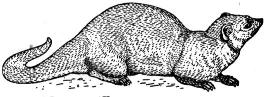
The entity that was talking introduced himself to the family as Gef, who claimed to be an earthbound spirit in the form of a mongoose. He told the family, he was born on June 7, 1852, in Delhi, India.

Voirrey Irving
Even though James and Margaret caught glimpses of Gef, the only person to actually see this spirit was Voirrey who described him as “a yellow rat-like creature, with a bushy tail.” Gef was friendly toward the Irving family, but he was also sometimes a nuisance to others.

When he wanted he could travel away from the farm and neighbors reported hearing odd sounds, which they believed was the Irving’s mongoose.

Gef loved to sing and knew the words to several favorite songs of the time.

He would spy on the Irving’s neighbors and return to share juicy gossip with the family.

The only proof he existed was the sounds he made, a few photos, Voirrey’s seeing him and the fact he moved or threw items around the farmhouse.

At one point he became so annoying to the family they announced they intended to move. This upset Gef so much he became more obedient.

The story about Gef eventually spread, journalists from all over flooded the Irving farm.

Harry Price, a famous paranormal investigator of the time visited the farm with a team. They found no conclusive evidence that Gef existed.

Photo Price's team took of Gef.
The family moved from the farm in 1937, later in 1947, the new owner claimed to have shot a “strange looking mongoose-like animal that he saw roaming his property.”

Some believe this was Gef, others felt Gef probably left the farmhouse along with the Irving family.

Still, others believed that Gef was just a fantasy that the Irving family made up to provide entertainment for themselves and neighbors.

Images of Gef for years were featured on beer mats in pubs across the Isle of Man.

Tuesday, July 21, 2015

Kwaidan: The Black Hair


This is a traditional story "kwaidan"—a Japanese ghost story—that Lafcadio Hearn shared in one of his books entitled Kwaidan.

Hearn’s history is shared here, along with another Yurei (ghost) story he collected.

The Japanese ghost story I share here-- The Black Hair is the original—this story is re-told in the modern-day film Kwaidan.

There was an impoverished samurai who lived in the capital city. His fortune changed when a foreign lord summoned him into service.

The Black Hair
The samurai gladly accepted his offer, but instead of taking his wife of many years with him, he abandoned her and took another woman he desired with him.

Many years later, the samurai, no longer in the service of the lord, returned to the capital city.

The samurai found himself longing for his old wife. One night at midnight, he returned to the old house, where he had lived with her.

In the autumn moonlight, he saw the gate to his old home was ajar. He went in and saw his wife sitting silently by herself.

To his joy, she expressed no resentment or bitterness toward him for his ill use of her. Instead, she greeted him with happiness.

The film version.
The samurai, now overwhelmed with gratitude, swore to her he would never leave her again. He said nothing could part them in the future.

Pleased with the happiness he now saw in her eyes, the samurai embraced his wife, and the two fell asleep in each other’s arms.

Bright sunlight awoke the samurai the next morning. He saw the house was more run-down than it had appeared in the moonlight.

He looked down at his wife, who was still lying in his embrace. To his horror, he found he was holding a corpse where only bits of flesh still clung to the bones.

The skull was wrapped in long black hair.

The samurai leaped to his feet and rushed to the neighbor’s house.

He asked, “What happened to the woman who lived next door?”

They told him, “She was abandoned by her husband many years ago. She died just last summer from an illness, brought on by her sorrow at this loss.”

Since there was no one to care for her or give her a funeral, her body remained where she had died.

A traditional Japanese belief is if a dead person is not given a proper funeral with respect after they die—they often return as a Yurei to seek revenge.