Showing posts with label Ireland. Show all posts

Wednesday, May 8, 2019

A Tragic Wedding


The ghost story holds a special place in Ireland. For hundreds of years, it provided home storytellers exciting material to share —especially in the rural areas.

One favorite, classic story often told in the evenings involved a newly married couple.

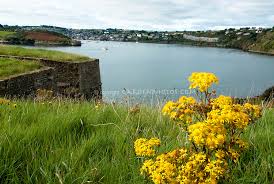
Sea view of Charles Fort.
This couple married at Charles Fort, or Dun Chathail near Kinsale, County Cork. This fort was built in 1677 and remained in use until the early 1920s. It was initially used to defend attacks from the sea.

The bride in this story was the daughter of Colonel Warrender, an early commander at the garrison.

This pretty young lady, named Wilful, fell in love with a visiting officer, named Trevor.

Permission was given and the pair married, as was the custom, the celebration lasted throughout the day.

In the early evening, the couple slipped away for a quiet stroll around the fort.

Charles Fort
A sentry standing guard on the one battlement, saluted as they passed. This soldier observed Wilful, as she stopped to admire the scene that lay before her.

She clapped with delight when she spotted a sweet briar of flowers that bloomed below. The sentry immediately offered to climb down and pick a flower for her.

Wilful charmed, by this daring offer, accepted. Irked, Trevor pointed out to the sentry that he was not allowed to leave his post.

The sentry then suggested, that if Trevor was willing, they could switch places. Trevor could put on his uniform and stand guard while he climbed down.

The groom balked at this idea, after all, he was a knighted officer, and it would be undignified to put on a private’s uniform.

But catching the pleading look in Wilful’s eyes, he agreed.

The sentry then went to retrieve a flower while Trevor stood guard. It was not long though before he became drowsy. He had drunk a lot of wine during the celebrations.

He fell asleep and slipped to the ground just as Colonel Warrender came looking for the happy couple.

The commander spotting who he thought was a sentry asleep, a severe dereliction of duty, drew his pistol and shot.

As he approached the body, he realized he had just killed his son-in-law.

When Wilful returned with her flower, she began to scream in agony as she spotted Trevor’s body. Before her father could stop her, she threw herself over the battlement.

Her body struck a buttress, and she died.

Battlement at Charles Fort
The colonel overcome at the sight of his daughter’s body, her bridal gown soaked in blood, moved to the seaward side and jumped.

His body hit the rocks below. A wave carried his body away.

This tragic event has been recounted many times over the centuries.

Soldiers at Charles Fort, both Officers and enlisted men began to describe strange activity.

Throughout the early 20th Century soldiers reported being shoved down stairs, many said an irrational feeling overtook them as they walked the battlements. They reported a force seemed to compel them toward the edge.

Many witnesses have seen Wiful’s spirit, she became known as The White Lady. She is spotted along the battlements wearing a bloodstained wedding gown.

White Lady Ghost
She is described as pale, always staring straight ahead, never moving. The one exception to this is when flowers are blooming.

Her ghost is seen walking toward this sight.

Even after the fort had been abandoned for many years, and lay in ruins, witnesses, still report seeing this female ghost.

Wednesday, December 16, 2015

Christmas Ghost Lights

In Great Britain there are many stories of ghost lights that appear around Christmastime—most remain beloved mysteries.

Here is a favorite witness account of ghost lights seen in Ireland.

On a dark night in 1910, a young 23-year old Oxford University student who was traveling home to Ireland for the holidays witnessed something he never forgot.

He and a university buddy were on horseback headed to his home in Limerick when near the village of Listowel they noticed a light about a half-mile ahead.

As they drew closer to this light, they saw it was not connected to a house, but instead, it was directly in front of them. As they watched it moved up and down and to and fro. It diminished to a spark and then expanded into a bright yellow flame.


Before they entered the village, they saw this light turn into two lights, which resembled each other. Suddenly these lights then joined into one luminous flame that was six feet high and four feet wide.

In the middle of each of the two flames that had joined, there appeared “radiant beings” which took on human forms. These two figures walked side by side.

Each figure had a brilliant white light or aura that surrounded them. Around their heads, they each had an even brighter halo.

The two young men watched in awe unafraid for they felt the love and peace the two figures exuded.

They continued to watch this phenomenon until a house blocked their view.

It is still a mystery what these two saw on this Yuletide night. Explanations put forward have included: the figures might be extraterrestrials, or were they the spirits of the dead?

A popular belief is these two men saw angels, which had come to earth to celebrate the joy the Christ Child brought to the world.

Friday, February 20, 2015

Guinness Family Curse

This Irish family it is said has been plagued by a curse through several generations.

Arthur Guinness founded the Guinness Brewery in 1759. He amassed a great fortune. Ten of his 21 children died.

After his death, several of his grandchildren also experienced misfortune. Several died of alcoholism and two died while in a mental institution.

Other heirs, not inheriting their Grandfather’s business acumen, ended their lives in poverty.

As more misfortune hit this family during the Second World War rumors started to spread the Guinness’ were cursed.

The Stern Gang, a Zionist terror group murdered Lord Moyne, a British minister to the Middle East, in Cairo in 1944.

Shortly before WWll ended, another member of the family, Edward Guinness the heir to the family fortune was killed in action.

The curse continued to plague the family. In 1978, the family experienced four deaths. Lady Henrietta Guinness jumped off an aqueduct in Spoleto, Italy.

A pint of Guinness
Today, 10 million pints are sold
every day.
In June of this same year a young Guinness heiress drowned in a bathtub while trying to inject heroin.

In the same month, Major Dennys Guinness, aged 44 was found dead in Hampshire of an apparent suicide.

In August, John Guinness an aide to British Prime Minister James Callaghan survived a head-on car collision in Norfolk but his four-year old son John was killed.Yet another son was injured badly.

Before this, Lady Henrietta’s cousin Tara Browne died in a car crash in Chelsea in 1966.

In 2005, the latest victim of this family curse died. Robert Hesketh, 48 was married to the daughter of the Guinness heir, Lord Moyne. Hesketh died in his sleep of a heart attack.


Click to enlarge.
In an interview published in the The Glasgow Herald, in July of 1978, Jonathan Guinness, the vice-president of the brewery adamantly denies that his family is cursed. He states the tragic deaths are just coincidences.

Friday, August 2, 2013

Ireland: Haddock's Ghost


By far one of Ireland’s most famous and well-documented ghost stories is about the Haddock Ghost. This story is a classic case of a ghost who returns to right a wrong. 

A man by the name of James Haddock, a farmer who lived in Malone just miles from Belfast, returned in spirit form after his death in 1657 in order to demand justice be done and the rightful heir to his property receive it. What is interesting about this case is Haddock’s ghostly appearances were even deemed true by the celebrated bishop of the time Dr. Jeremy Taylor.

James Haddock’s will stipulated that his wife, Arminell should receive his manor house and the area that surrounded it. His young son John Haddock was to receive the rest of his property when he turned 21. 

The executor of the will was a man by the name of Jacob Davis. Several years after Haddock died Davis married Arminell. She and Davis had a son. Davis then unscrupulously altered Haddock’s will making his own son the beneficiary of the land instead of John Haddock.

Jacob Davis might have succeeded with this deception except for several very unusual events. Late one night on Michaelmas * Francis Taverner a good friend of James Haddocks was heading home to Malone from Hillsborough when his horse stopped suddenly on the Drum Bridge near Brumbeg. Francis dismounted trying to coax his horse to continue when he was startled to see a figure in a white coat standing next to his elbow. 

Dumbfounded he realized this man resembled his old friend James Haddock who had died five years before.

This ghostly figure pleaded with Francis to help his son get his rightful heritage. Stunned Taverner refused, jumped on his horse and galloped quickly off the bridge.

“Where upon there arose a great wind and withal he heard hideous screeches and noises to his amazement.”

Once home, Taverner fell to his knees and asked for God’s protection. But after midnight the next night as Taverner sat with his wife by the fire Haddock appeared once more. Francis's wife didn’t see Haddock’s ghost as he once more appealed to her husband for help. He pleaded with Taverner to go to his widow and tell her that justice must be done for their son John. Again, Taverner resisted so Haddock’s ghost visited him every night for the next month. 

Shaken to his core, Taverner left Malone and went to Belfast to take refuge with a friend but Haddock’s ghost followed him. This time he demanded that Francis go to Arminell and upbraid her for what she had done to their young son. He told Francis if he did not do this there would be dire consequences.

Now desperate, Taverner confided in his chaplain, John South who then told the vicar of Belfast, Dr. Lewis Downes. These three men then went to Malone to convey the ghost’s message to Davis. But Davis shamelessly refused to surrender the land at which point Haddock’s ghost told Taverner to take the matter to court.

“Francis had spoken to the ghost of the futility of such proceedings, as he had no witness. ‘Never mind’ said the ghost, ‘I will be present and appear when called upon’.”

The case to return the estate to John Haddock was held in Carrickfergus. The opposing council abused Taverner and challenged him to call on his spectral witness if he could. This man then called facetiously for the ghost to appear, “James Haddock!” “James Haddock!” As this man’s tone became higher with his third summons, “James Haddock!” He received an unexpected response:

“An extremely loud clap of thunder shook the courthouse to its foundation. Then a ghostly hand hovered over the witness box and a spectral voice exclaimed, ‘Is this enough?’”

Jacob Davis sheepishly left the courthouse amidst jeers from the onlookers. He never made it home for on his way he was thrown from his horse and broke his neck. 

After this, Haddock’s ghost never again bothered Francis Taverner. The entire countryside hearing about these unusual events resulted in Bishop Taylor holding an inquiry into the matter. After he heard all the witness’ accounts he deemed the case to be true.

“… the only ghost who ever answered a summons in a court of law.”

There is one final curious note to this story. James Haddock who was buried in the Drumbeg Parish Church graveyard in the 17th century has a tombstone that will not stand upright. Even after repeated attempts to place it in an upright position this tombstone continues to fall down. It still lies flat in the family plot today surrounded by moss and grass.

*  Michaelmas or “Feast of Saint Michael and all Angels” occurs on September 29th. Because it is near the equinox in the Northern Hemisphere it is associated with the beginning of autumn.

Thursday, June 27, 2013

Haunted Leap Castle


Leap castle with its “Bloody Chapel” located in County Offaly in Ireland is considered extremely haunted. Its troubles started over 400 years ago when a fierce battle broke out in the O’Carroll family over who was to be the next clan leader. This bitter fight turned brother against brother. One brother, a priest, was holding a family mass in 1532 when his rival brother entered what is now called the Bloody Chapel and plunged his sword into his sibling, killing him. This first evil event is said to have put a curse on the castle. The ghost of this priest is still seen at Leap.

Over the years Leap Castle’s dungeon or oubliette off the Bloody Chapel was used to torture and kill prisoners. These prisoners were pushed down an opening in the floor where a spike impaled many eight feet below. The ones that didn’t die instantly found themselves left to smell the food aromas that arose from the rooms below as they starved to death. Workmen in the early 1900’s found evidence of this cruelty when they were cleaning out the oubliette-- they found human skeletons stacked on top of each other--it took several loads to remove all the bones.

Bloody chapel

In the late 1500s a fire gutted Leap Castle. Its gate remained pad-locked for 70 years. During this time witnesses often reported seeing lights from the upper windows late at night. One report states, “it was as if many candles were brought into these rooms”. Even today the opening above the oubliette and the dungeon itself is very active. Many witnesses have seen shadow figures and ghosts in the Bloody Chapel.

Oubliette

In the 1600s a family by the name of Darby owned the castle. They renovated Leap and made it their family home. In the 19th century a descendant of theirs, Mildred Darby was intrigued by "occult practices"-- a fad that had become popular. Out of curiosity she held several séances in the castle. Unfortunately she awoke a ferocious “elemental”. * In 1909, Mildred wrote an account of her terrifying ordeal after she held these séances for the Journal Occult Review:

“The thing was about the size of a sheep, thin gaunt and shadow in parts. Its face was human, or to be more accurate, inhuman, in its vileness, with large holes of blackness for eyes, loose slobbery lips, and thick salvia dripping jaw, sloping back suddenly into its neck. Nose it had none, only spreading cancerous cavities, the whole face being a uniform tint of grey. 

This too was the colour of the dark coarse hair covering it head, neck and body. Its fore arms were thickly coated in the same hair, so were its paws large loose and hand-shaped and as it sat on its hind legs, on hand or paw was raised, and a claw like finger was extended ready to scratch the paint. 

It lusterless eyes, which seemed half decomposed in black activities, and looked incredibly foul, stared into mine, and the horrible smell which had before offended my nostrils, only a hundred times intensified, came up into my face, filling me with deadly nausea. 

I noticed the lower half of the creature was indefinite and seemed transparent at least, I could see the framework of the door that led into the gallery through its body.”

After this account was published the castle gained the reputation for being even more haunted. It was stated that after Mildred’s innocent fun the castle became plagued with bad luck as well. The Darby family owned Leap for the next 113 years, until 1922. The Darby’s being English were literally driven out during the Irish struggle for independence.

In the 1970’s an Australian purchased Leap. He knowing it was haunted brought in a white witch from Mexico to cleanse the castle. After this it was stated that the spirits remained but they were no longer malevolent in nature. The current owners of the castle bought it in the 1990s. During renovations two freak accidents left the owner injured. In the first he suffered a broken kneecap and in the second a ladder he was standing on tilted backwards suddenly from the wall it leaned against, the owner then jumped several stories to the ground--he broke his ankle.

Despite these accidents the owners feel the spirits seem to be more at peace these days. But ghosts are still seen and felt. In 2002 the owner, his wife and a musician that was visiting stumbled across a ghostly old man sitting in a chair by the downstairs fireplace.

* Elementals are considered primitive ghosts. They become attached to specific places. These scary ghosts are malevolent in nature and are very unpredictable.