Showing posts with label Scotland. Show all posts

Tuesday, February 26, 2019

Blue Boy Ghost Story


As I have mentioned in other posts, our neighbors across the pond—the Brits love a good ghost story. They love them so much their newspapers, mainstream and tabloid alike publish them regularly.

You can always find a good ghost story or sighting, with pictures included, in the Daily Mirror and The Star, which are both tabloids. The Guardian, a mainstream English newspaper, also reports the latest paranormal sightings.

This might be the reason that 1 in 3 people in Great Britain believes in some form of paranormal activity. Just like in the U.S., more women than men hold this belief.

Coylet Inn
A widely debated ghost sighting received a lot of attention in the British papers recently.

The Ten witnesses were holding a hen party in August of 2017, in America, we call them bachelorette parties, at a remote estate in Argyll, Scotland.

During the festivities to celebrate the bride-to-be, these women gathered near the Loch Eck near the Coylet Inn to take photos in front of the lake and surrounding hills.

When the group gathered around to view the photos on the camera, they saw a young boy crouching behind a log in the second picture.

They were surprised for no children were staying with them at this remote inn, and they wondered how this boy could appear in the second photo taken just seconds after the first.

The first photo was taken. Click to enlarge.

The second photo was taken seconds later. Click to enlarge.

When they shared this photo with the Coylet staff, what they were told frightened them. They packed their bags and immediately left.

They were told the story of “The Blue Boy.”

Loch Eck
Several centuries before their visit, a mother and her 4-year old son had visited the inn. While they slept, the boy prone to sleepwalk left his bed. The next morning they found his body turned blue from the cold waters in the lock. He had drowned.

The Blue Boy ghost has been seen at the inn and the surrounding area since this tragedy.

He is often heard crying. It is believed he is looking for his mother. Wet footprints are spotted in the inn’s hallways leading nowhere.

Items in Room 4 where he and his mother stayed are found moved about, and for years, witnesses have sensed his presence in this room.

Film Poster
In 1994, a film starring Emma Thompson was made at the Coylet about this haunting. The director, Paul Murton, while editing the film, saw a strange blue mist in several of the scenes. No one had seen this mist during the filming.

Since this story was published, some contend what was captured was just a clever photo-bomb, but others knowing the history of the inn doesn’t blame the hen partygoers for leaving early.

Saturday, December 12, 2015

Memories of Killiecrankie Pass

“It is said that once a location has witnessed so much death it never forgets . . .”
                                                                --Cavan Scott, Countryfile

Killiecrankie Pass and River Garry
Located in Perthshire County in Scotland Killiecrankie Pass lies in a beautiful glen along the River Garry a few miles north of Pitlochry. The River Garry flows through a steep-sided gorge fringed by dark green woods.

It was here in 1689 where a fierce battle was fought.

By 1688, James ll of England—James Vll of Scotland—had been replaced by William of Orange. James was an unpopular ‘Catholic” king, so the English Parliament officially invited William to invade. James fled to the continent without a fight and the Protestant William took his throne.

King James Vll/ll

William, Prince of Orange
In Scotland, people’s loyalties were bitterly divided between William and James. This division was so deep that fathers often fought against their sons.

At the Killecrankie battle---

Mackay of Scourie led William’s forces—he was a Highlander when ironically most Highlanders supported the opposing Jacobite cause.

General Huge Mackay

James Graham of Claverhouse
"Bonnie Dundee"
At the head of the Jacobite rebels was James Graham, Viscount Dundee who was known as Bonnie Dundee. He ironically was a Lowlander but the troops he led where Highlanders.

In July of 1689, Blair Castle in Perthshire was seized by the Jacobites, Mackay knew he must re-capture the castle at all cost—but a large contingency of Jacobite Highlanders were moving to block his path.

Mackay had 3,500-foot soldiers and two cavalry groups.

Despite being outnumbered by at least a thousand men, the Jacobites had two advantages. They knew the gorge like the back of their hands, and they were experienced fighters when it came to steep and rocky terrain.

Amazingly, most of the Jacobites fought barefoot.

On July 27th the two opposing armies met at Killiecrankie Pass. Dundee’s Jacobites had a good vantage point on a hilltop looking down at Mackay’s English Government troops.

Highland Charge

It was a July day, and the sun was in their eyes, so they waited until 7:00 p.m. to attack. When Dundee gave the signal, two thousand men poured down this hillside in a deafening onslaught.

Battle at Killiecrankie
Mackey’s men briefly fought but they then turned and fled. This would have been the end of the battle but for a turn of bad luck-- their retreat was stopped by the steep-sided gorge. This battle then turned into a massacre. *

*  One government soldier, Donald McBane leaped 16 feet across the river to get away. This incredible feat is commemorated with a plaque at the spot it took place—known as Soldier’s Leap.


During this battle, ten thousand Government soldiers were either killed or captured. A third of the Jacobite men were killed, including their leader Bonnie Dundee.

Modern day visitors to Killiecrankie Pass state they have experienced this brutal battle first hand.

Several witnesses have seen soldiers marching as if to battle, while others have seen an eerie red glow engulf the gorge.

A female witness picnicking with her family said she saw a replay of the battle and another female witness states she saw the bodies of dead English officers at her feet while walking through the gorge.

This haunting appears to be an “anniversary haunting” for most of the strange encounters people have experienced happened on the date—July 27th—when the battle took place.
Depiction of Pass from the 1800s.
A fanciful story connected to this haunting was told on the BBC program, Countryfile.

This legend states witnesses have also seen an apparition of a young woman who wanders among the bodies robbing them of their valuables. Along with this is a warning—if she knows she is being watched, she will chase after the witness. If she catches up and touches or taps them on the shoulder—they will die within the year.

Killiecrankie is managed by the National Trust for Scotland today. It is open year-round to the public.

Wednesday, November 25, 2015

The Ghosts of Rosslyn Chapel

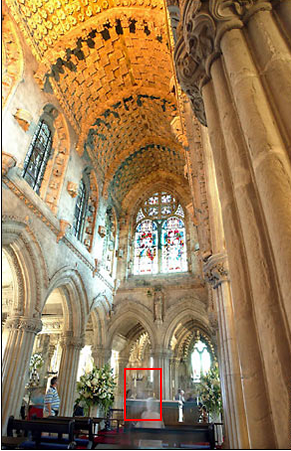
Rosslyn Chapel
Owned by the St. Clair or Sinclair family since 1446 Rosslyn Chapel located in Midlothian, Scotland is surrounded by many myths and mysteries.

The most famous legend connected to Rosslyn involves the Knights Templar * and their quest for the Holy Grail—which was the chalice used by Christ at the Last Supper.

Knight Templar
Drawn by
Agnieszkaw@Dreamstime.com
One myth states this chalice is supposedly hidden somewhere within the chapel.

* The Knights Templar known for their prowess in battle and finances were a Christian military order that played an integral part in the early Crusades. However in 1307, rumors about the order’s secret rituals spread which led to their eventual downfall.

Templars burn at stake.
Philip lV of France deeply in financial debt to the Templars conveniently accused them of heresy and fraud and burned several of their leaders at the stake.

The Rosslyn Chapel was built in the 15th century for the Prince of Orkney, Sir William St. Clair. He most likely was involved in the Order of the Knights Templar.

The chapel is known for its mysterious and intricate carvings that have stumped historians for generations. They reflect biblical, masonic, pagan and Knights Templar themes.

Some of these carvings are out of time and place—they were carved in the chapel 200 years before Columbus discovered America. They depict items only found in the New World-- American cactus and Indian sweet corn or maize.

Corn or Maize carvings.
Apprentice Pillar
One legend states an Apprentice who was a stonemason was murdered in the chapel. This young man is said to have carved a beautiful pillar while his master was away in Rome looking for inspiration. When his master returned, he found the post surpassed his own skill. In a jealous rage, he then killed the Apprentice.  

When the Prince of Orkney died he was buried in the chapel—after this, all male members of the St. Clair family were buried in vaults below the chapel, without coffins but instead in full knight regalia until the 1700s.

In the crypt located below the chapel, visitors for years have experienced a mysterious dark wind without an apparent source.

Chapel Crypt
Another legend states when a descendant of the Prince of Orkney dies the whole chapel appears to be on fire. Sir Walter Scott wrote about this phenomenon in his narrative poem Lay of the Last Minstrel.

The Chapel altars were smashed during the Reformation in 1592—since it was a Catholic church-- the chapel was then left to ruin until the 18th century. In 1736, the ceiling and floors were restored which saved it from complete decay. In 1861, the architect David Bryce was commissioned to restore Rosslyn.

Today the chapel is widely known because of Dan Brown’s bestselling novel The Da Vinci Code. But it has been famous for longer than this—partly because of the ghosts seen at the chapel.

There have been numerous sightings of phantom monks in and around the chapel.

One curator witnessed a ghostly monk praying at an altar in the crypt. This monk was seen surrounded by four guardian knights.

In other sightings, witnesses have come forward to state they saw monks dressed in grey or black both inside and outside the chapel at night.

Other curators have reported hearing strange sounds when there is no one around.

A group of actors rehearsing for a play at the chapel in 2006 had one cast member claim to see a strange “fairy-like“ entity roaming the grounds and another actor stated he saw a ghostly figure in the chapel.

The year before another actor rehearsing a play inside the chapel heard a child’s voice in the crypt. He shouted down, “I am locking up.” However, when he went down, there was no one there.

Recently odd lights have been witnessed in the chapel.


Kannard's photo.
Here is a photograph and the enlargement that Brian Kannard took in the Rosslyn Chapel. The English paper The Telegraph published it in 2007. Kannard states he does not know if it is a ghost or not.

Enlargement of what he captured.

Sunday, August 30, 2015

An Oath vs. Family Honor


“What is a Scotsman without his word? Aye, but what is a Highlander without his kin and clan to count on?”

                              --Storyteller Duncan Campbell Crary

A choice Major Duncan Campbell, made one night in 1747, sealed his fate.

The major was an officer in the Scottish 42nd—Highland—Regiment. This group of soldiers was a fierce fighting force known as the Black Watch.

Original Inverawe.
Duncan Campbell was the Laird of the Scottish house of Inverawe. The legend states one night, a desperate man with blood on his hands and kilt came knocking at his door. He begged the laird for sanctuary.

Duncan swore on the ceremonial dirk at his side that he would shelter the man. This oath was not taken lightly for Highland lairds were duty-bound by their promises.

Fate took a dark twist when just hours later, a group of men showed up at Inverawe to inform Duncan a highwayman had murdered his cousin, Donald Campbell. The men told the laird they had seen this man head toward Inverawe.


Duncan duty bound by a “sacred oath of protection” had no choice but to protect this man from the gang that stood at his door—so he told them he knew nothing.

Later that night, he was awakened from his dreams by an awful moaning. When he opened his eyes, he saw the ghost of his cousin Donald, standing at the foot of his bed.

In a deep voice, Donald stated, “Inverawe! Inverawe! Blood has been shed. Shield, not the murderer!”

Donald’s ghost appeared several more nights pleading with Duncan to hand over the murderer. Duncan conflicted confronted the killer, but remembering his promise, he had to back down.

The ghost appeared one last time, stating, “Farewell, Inverawe! Farewell, till we meet at Ticonderoga!”

This name held no meaning for Duncan, and as the years passed, he forgot these words. That is, until 1788 when the Major’s regiment was sent by the British Crown to help fight the French and Indian War in the Colonies.

The Major and his men marched north from Albany, New York to attack the French-controlled Fort Carillon—later named Fort Ticonderoga—on Lake Champlain.

On the eve of this battle that occurred on July 8th Donald Campbell’s ghost once more visited Major Duncan Campbell in his tent. He told Duncan that he soon would pay for his betrayal.

The battle the next morning was the bloodiest of the war. There were more than 3,000 casualties. The Black Watch suffered the most of any unit on either side. Over 200 men of the 1,000 Scots that fought were killed. Over 250 were wounded—including Major Campbell.

Campbell’s grave marker.
On it, Inverawe is spelled wrong.

He suffered a flesh wound to his arm, but this wound festered and turned gangrene. Nine days after the battle Major Duncan Campbell died.

When the Scottish author Robert Louis Stevenson was fighting Tuberculosis in the late 19th century in the Adirondacks of New York he heard the tale of Major Duncan Campbell.

In December of 1887, in Scribner’s Magazine, he published a poem entitled Ticonderoga, a Legend of the West Highlands. His poem quickly became famous around the world.

Here is a link to this poem. In it, he misnames Duncan Campbell—Duncan Cameron.

Saturday, July 18, 2015

The Montrose Ghost, Part ll


Desmond Arthur
in plane.

In 1913, a pilot Lieutenant Desmond L. Arthur crashed his BE-2 biplane over Montrose airfield in Scotland. Three years later when it was determined it was pilot error that caused the crash—the ghost of the Lieutenant returned feeling his name had been smeared.

Some state his ghost stopped making appearances at Montrose when his name was cleared in 1917 but many more believe he continued to haunt this base used by the Royal Flying Corp.

In 1940, people believe that Lieutenant Arthur’s ghost made another appearance. There is a full account of this sighting here.

One night a Hurricane pilot at Montrose went up to search for a reported Heinkel bomber but instead he encountered a mysterious biplane that “cut him off on final landing several times.”

Then in 1942 a flight officer crashed during take off over Montrose. It is said he was not popular among the ground crews and that someone tampered with his plane.

A new soldier assigned to the base saw a ghostly figure walk out of the bases morgue while on guard duty.

Many feel this pilot's ghost then started appearing--others feel it was Arthur's ghost that was continuing to be seen.

In 1949 new pilots assigned to Montrose were greeted with a printed document that welcomed them and then mentioned a former member of the Royal Flying Corp—Lieutenant Desmond L. Arthur haunted the camp.

Lieutenant Desmond Arthur
Dozens of witnesses came forward to state they had seen his ghost. A Scottish clerk awoke early one morning to find an officer wearing flight gear and an officer’s hat staring at him.

“He was standing by a desk, he was immersed in rifling through papers.”

He stated this phantom figure didn’t have feet—it appeared as if his knees were floating on air.

In May of 1963, after Montrose had been closed for several years Sir Peter Masefield was flying a personal aircraft over the now abandoned Montrose when he spotted a most unusual aircraft.

BE-2 biplane
This other plane appeared to be a BE-2 biplane—a trainer that the Royal Flying Corp used during World War l.

Masefield was surprised for he didn’t know there were any of these types of planes that would still fly.

He spotted the pilot who wore an old-fashioned leather helmet, goggles and flying scarf.

He then watched in horror as the right wing of this craft broke off. He saw this airplane spin out of control—twisting and spinning straight down.

Masefield landed quickly on the old Montrose airstrip and went in search of the crashed plane. But he found no plane or wreckage.

Montrose airfield remains closed today.

In Part l of The Montrose Ghost initial sightings of Arthur’s ghost are shared.

The Montrose Ghost, Part l


When a pilot’s name is smeared he returns to clear his name . . .

Desmond Arthur
On the morning of May 27, 1913, Lieutenant Desmond L. Arthur a black-haired fiery Irishman who was a pilot at Montrose airfield in Scotland took off for a routine training flight in his BE-2 biplane.

Tragically while flying over this airfield his right wing suddenly snapped off which sent his aircraft plummeting to the ground-as hundreds watched. The jerking of the out of control plane broke Arthurs seatbelt in half and the pilot tumbled out of the plane. Every bone in his body was crushed as he hit ground and died.

Plane after crash.

The initial inquiry into this crash determined that it was caused by work left uncompleted being done on this aircraft by the ground crews.

Lieutenant Desmond L. Arthur was then buried with military honors.

But in 1916, three years later a government investigation found that this crash was caused by pilot error instead. Many who had known Arthur did not believe this for the Lieutenant was an experienced pilot.

Right after this new conclusion was released strange activity started to occur on the Montrose base. Lieutenant Arthur’s ghost started to make appearances.

These sighting were so widespread and terrifying that men stationed at Montrose started to request transfers.

Several officers—including Major Cyril Foggin-- saw the ghost of who they felt was Arthur heading down the path that led to the door of the old mess hall on base. Each time as this figure neared this door and opened it they saw it then just vanish.

At first, none of these men talked about what they had seen afraid they would be reprimanded.

Ariel view of Montrose in 1917
Other officer’s were awakened to find a soldier in a flight gear sitting at the edge of their beds staring at them. One senior flight instructor challenged this apparition, “Who the bloody hell are you, and what the hell are you doing here?”

He received no reply as he watched the form slowly fade away.

Several men on guard duty where scared out of their wits when they challenged a pilot who appeared out of nowhere—that then flickered out of sight.

These men despite the consequences abandoned their posts and fled for their lives.

Soon word got out in the Royal Flying Corps around the world that Montrose was haunted.

After almost every officer on base had seen the apparition the ghost became known as the “Irish Apparition” or simply the “Montrose Ghost.”

A question began to be asked, “Why was Lieutenant Desmond Arthur’s ghost appearing now—3 years after his death?

Finally, C.G. Gray the editor of the flying magazine, The Aeroplane provided a plausible link as to why Arthur’s ghost was appearing. He didn’t like being blamed for a crash that was not his fault.

Yet anther government investigation was opened in 1917 and this time the Lieutenant’s name was cleared when it once again was determined that it was ground crew error and not pilot error that caused the crash.

Lieutenant Desmond L. Arthur’s good name and reputation were restored.

Some researchers at this point state that Desmond Arthur’s ghost now pleased with the outcome appeared one last time with a smile on its face and has not been seen since –but there is evidence this is not the case.

In Part ll of The Montrose Ghost, Lieutenant Arthur’s ghost continues to make appearances on this base for the next 46 years.