Showing posts with label legends. Show all posts

Wednesday, November 25, 2015

The Ghosts of Rosslyn Chapel

Rosslyn Chapel
Owned by the St. Clair or Sinclair family since 1446 Rosslyn Chapel located in Midlothian, Scotland is surrounded by many myths and mysteries.

The most famous legend connected to Rosslyn involves the Knights Templar * and their quest for the Holy Grail—which was the chalice used by Christ at the Last Supper.

Knight Templar
Drawn by
Agnieszkaw@Dreamstime.com
One myth states this chalice is supposedly hidden somewhere within the chapel.

* The Knights Templar known for their prowess in battle and finances were a Christian military order that played an integral part in the early Crusades. However in 1307, rumors about the order’s secret rituals spread which led to their eventual downfall.

Templars burn at stake.
Philip lV of France deeply in financial debt to the Templars conveniently accused them of heresy and fraud and burned several of their leaders at the stake.

The Rosslyn Chapel was built in the 15th century for the Prince of Orkney, Sir William St. Clair. He most likely was involved in the Order of the Knights Templar.

The chapel is known for its mysterious and intricate carvings that have stumped historians for generations. They reflect biblical, masonic, pagan and Knights Templar themes.

Some of these carvings are out of time and place—they were carved in the chapel 200 years before Columbus discovered America. They depict items only found in the New World-- American cactus and Indian sweet corn or maize.

Corn or Maize carvings.
Apprentice Pillar
One legend states an Apprentice who was a stonemason was murdered in the chapel. This young man is said to have carved a beautiful pillar while his master was away in Rome looking for inspiration. When his master returned, he found the post surpassed his own skill. In a jealous rage, he then killed the Apprentice.  

When the Prince of Orkney died he was buried in the chapel—after this, all male members of the St. Clair family were buried in vaults below the chapel, without coffins but instead in full knight regalia until the 1700s.

In the crypt located below the chapel, visitors for years have experienced a mysterious dark wind without an apparent source.

Chapel Crypt
Another legend states when a descendant of the Prince of Orkney dies the whole chapel appears to be on fire. Sir Walter Scott wrote about this phenomenon in his narrative poem Lay of the Last Minstrel.

The Chapel altars were smashed during the Reformation in 1592—since it was a Catholic church-- the chapel was then left to ruin until the 18th century. In 1736, the ceiling and floors were restored which saved it from complete decay. In 1861, the architect David Bryce was commissioned to restore Rosslyn.

Today the chapel is widely known because of Dan Brown’s bestselling novel The Da Vinci Code. But it has been famous for longer than this—partly because of the ghosts seen at the chapel.

There have been numerous sightings of phantom monks in and around the chapel.

One curator witnessed a ghostly monk praying at an altar in the crypt. This monk was seen surrounded by four guardian knights.

In other sightings, witnesses have come forward to state they saw monks dressed in grey or black both inside and outside the chapel at night.

Other curators have reported hearing strange sounds when there is no one around.

A group of actors rehearsing for a play at the chapel in 2006 had one cast member claim to see a strange “fairy-like“ entity roaming the grounds and another actor stated he saw a ghostly figure in the chapel.

The year before another actor rehearsing a play inside the chapel heard a child’s voice in the crypt. He shouted down, “I am locking up.” However, when he went down, there was no one there.

Recently odd lights have been witnessed in the chapel.
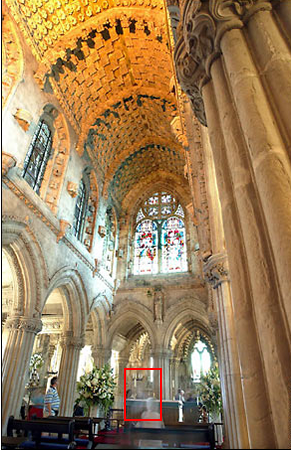

Kannard's photo.
Here is a photograph and the enlargement that Brian Kannard took in the Rosslyn Chapel. The English paper The Telegraph published it in 2007. Kannard states he does not know if it is a ghost or not.

Enlargement of what he captured.

Tuesday, October 6, 2015

The Removal of Black Aggie, Part l

The name Black Aggie was given to a statue that initially stood in Druid Ridge Cemetery in Pikesville, Maryland. It marked the grave of General Felix Agnus.

Black Aggie in Druid Ridge Cemetery
This statue, dramatic in appearance is an unauthorized replica of a statue sculpted by Saint-Gaudens in 1891—called Grief. It depicts a dark, seated figure that wears a shroud.

This statue was placed in Druid Ridge in 1926. Soon after several scary legends were attributed to it.

The main legend stated that if someone dared to spend the night sitting on the lap of Black Aggie they would encounter the ghost buried there.

Another legend stated that all the ghosts in this cemetery would gather together at this statue once a year.

Other tales stated that grass would not grow in the areas where the statue’s shadow rested during the day. A more startling claim was the statue’s eyes would glow red at night, and that Black Aggie would physically move.

These legends attracted unwanted attention. Many people broke into Druid Ridge Cemetery at night and the statue was frequently vandalized.

Spot where the statue once stood.
Fed up, the Agnus family donated the statue to the Smithsonian in 1967, however its original base remains at the General’s grave.

Today Black Aggie is displayed in the courtyard behind the National Courts Building in Lafayette Square in Washington, D.C.

In Washington, D.C.
Ironically, another grave statue that is located at Green Mount Cemetery in Montpelier, Vermont has inherited the legends that originally surrounded Black Aggie.

In Part ll of The Removal of Black Aggie, one story that inspired the interest that surrounds this statue is shared.

Wednesday, June 17, 2015

Time Slips: Phantom House and Vanishing Hotel Room

Time slips is a phenomenon where a person or persons witness scenes or objects apparently from another time period--predominantly in the past.

One case of a phantom house being seen happened near Bury St. Edmunds, in Suffolk, England in 1926.

Bradfield St. George
church
Ruth Wynne had moved to the area recently to teach school. Wanting to explore her new home Wynne and a 14-year old pupil, a Miss Allington went for a walk from Rougham Green rectory toward Bradfield St. George church.

It was a cloudy day as the two women walked through a farmyard toward the road. Opposite them was a high brick wall and iron gates through which they saw a large Georgian house surrounded by tall trees.

Miss Wynne was surprised because no one had mentioned such a grand house being in the neighborhood. The two women unconcerned then proceeded to their destination the church which was only 300 feet away.

They returned home via a shortcut so they did not pass the stately house again.

It was a year later when both women walked the same footpath through the farmyard to the road but this time they where astonished to see there was no wall, iron gate or grand house.

Instead the area was overgrown with trees, weeds, plants and ponds. The two never saw the house again. They did research but where perplexed to find there was no record of a Georgian mansion existing in the area.

No one has been able to explain what the two women saw.

Another, more fanciful time slip story involves a mother and daughter whom are traveling together. This well-known legend is called The Vanishing Hotel Room.

They were returning from India and stopped at a hotel room in Paris. The mother fell ill so the daughter heads out to get some medicine for her mother.


When she finally returns to the hotel after hours of searching she does not recognize anyone and both the hotel room--they were staying in--and her mother have vanished.

In a classic ending it is stated the daughter never finds her mother or finds out what happens to her.

In another twist to the ending it is stated the daughter after a long investigation finds that the hotel management upon finding the mother has the plague has her moved from the hotel in order to avoid a public panic.

This story is cited in several books as a “true supernatural story.”  But this story is a classic example of folklore.

In a previous post the story of two English married couples in 1979 who stayed at an old-fashioned hotel in southern France on their way to Spain is shared. On the way back, the hotel that appeared to be from another era is no longer there.

Bold Street
The Bold Street, Liverpool time slip stories are also shared


In this post the Palace of Versailles time slip story is briefly mentioned. Both these stories are considered by some to be more credible and can be found here.

Tuesday, January 27, 2015

Ghost Hollow’s Curse


Residents that live around the old settlement town of Ripley, Oklahoma, on windy nights state they hear some chilling sounds coming from a large old oak tree.

Ripley is near the city of Cushing in Payne County. This county was opened to settlement in the Oklahoma land run in April of 1889.

An old oak tree in this area was an ideal place to hang people. The hollow this tree still stands in is considered haunted and cursed. This place was dubbed Ghost Hollow for this reason.


In the late 1800s Payne County was still an untamed, lawless land. The only justice imposed was at the end of a rope, or from the barrel of a Colt pistol.

In 1899, three horse thieves were left hanging from the limb of this oak tree in the hollow. This was not the first or last time this tree had been used for this purpose.

The following tales are often told around a campfire.

One legend states that a young Indian girl, in spite of her father’s wishes, ran away to marry a white man.

The father found them and shot at the young man. But his bullet hit his daughter instead, killing her.

It is said in his grief and despair resulted in a curse on Ghost Hollow, where he found the two lovers.

His daughter was 17-years old at the time of her death. It is said every 17 years a death occurs in this hollow.

One victim of this curse was a gambler from Ripley. He was hanged from this tree when he was caught cheating at cards.

In the early 1900s, a human skeleton was found in the hollow. Yet another body was found in 1922. Then in 1939, there was a fatal car wreck on a nearby road. All 17 years apart.

Local witnesses state that on windy nights in Ghost Hollow, they have heard terrible moans coming from this old hanging tree. They say this sound raised the hair on their necks and made their hearts beat faster.

One Boy Scout troop passing through the hollow one night, stated all their horses were spooked when they entered Ghost Hollow.

Yet another legend that surrounds the hollow states an innocent man was hung from this tree in 1887. The next day, all of the bark from this tree, mysteriously fell off.

Since during full moons witnesses state, this tree glows brightly.

Of course, wind makes horses spook, and moonlight makes things glow, but I love these old stories...

Wednesday, May 28, 2014

Ghosts of Dug Hill, Part l


In years past settlers in the interior of southern Illinois used a rough “cut” through the hills near Jonesboro, Illinois to reach the Mississippi River. This cut was known as Dug Hill Road.

Dug Hill Road
1928
Today this road located 5 miles west of Jonesboro on State Highway 126 has lost its rustic appearance but in the 1860s it was a dark secluded spot that posed many dangers to both the locals and travelers that used it.

For this reason Dug Hill gained a reputation as being one of the haunted roads in southern Illinois. Stories of strange sights were often told and with each telling these legends grew.

Here are two of these stories.

The Murder of Marshall Welch

In April of 1865 near the end of the Civil War, a Marshall by the name of Welsh arrested 3 deserters from the Union army. He did not treat these men kindly. He took them to Jonesboro and turned them over to the authorities.


A few days after these men were jailed word reached Illinois that the war had ended--General Lee had surrendered at Virginia. These 3 men were then released.

They were bitter and angry at how Welch had treated them and they set out to get revenge. One late evening as Welch passed through the cut heading home these men lay in wait. They shot and killed him as he rode by. They left him lying in the middle of Dug Hill Road.

Welch’s body was found quickly but these 3 men were never arrested or punished for this crime.

Soon after Welch’s death local farmers and travelers who passed through the cut started to report unusual activity. Welch’s ghost was seen walking along this road wearing bloody clothing.

Several witnesses stated that he pleaded for help--as they approached he just vanished. More often his ghost was seen lying in the center of the dusty trail.

One wagon driver traveling through the cut spotted a man lying facedown in the road. He stopped his team and climbed down to see if he could help.

When he leaned down to turn the man over, his hands passed right through him. He tried once more but his hands only touched the dirt beneath the body.

Terrified, he ran to his wagon. He urged his horses forward. As he reached the spot where the body lay he felt a bump as his wagon wheels went over the phantom corpse.

He looked back and saw that the body was no longer there.

The Spectral Wagon

Yet another strange sight seen along Dug Hill Road is that of a ghostly wagon.

One cold dark snowy night in December a farmer named Bill Smith was driving his team of horses through the cut. He had to stop because the harness had slipped off one of his horses. As he repositioned it he heard a disturbing sound approaching him from down the road.

He heard the loud crushing sound of wagon wheels in the crusted snow approaching his position quickly. A chill ran down his spine. The wagon was approaching too fast and he knew the narrow road would not accommodate both wagons.

If he could not move his wagon or call out a warning both drivers would be killed.

He yelled loudly into the darkness but he feared the other driver had not heard him over the racket. He was right for the other wagon drew closer. In a panic, he attempted to move his wagon.

At any moment the two wagons would crash but then the farmer saw a shocking sight. The other wagon did crest the hill but the noise was no longer coming from the road. He looked up to see a man fiercely whipping two black horses.

The horses’ hooves pounded the air and the wagon wheels spun as if they were on the ground. This eerie sight soared above the farmer’s head headed for the next hill.”

  --taken from The Big Book of Illinois Ghost Stories by Troy Taylor

This flying wagon then disappeared from view and its loud crushing noises slowly faded away.

Yet another legend connected to Dug Hill Road I first read about in Troy Taylor’s book. This legend is about a mythical creature or boogeyman. Read about it in Ghosts of Dug Hill, Part ll.

Friday, November 22, 2013

The Legends that Surround Proveglia Part ll


Photo: Ransom Riggs

In Part l of this post I discussed the darker history of Proveglia Island located in the lagoon near the Grand Canal in Venice, Italy and why it is most likely haunted. In part, this history has resulted in several traditional legends being connected to the island for centuries. But in more recent years several television shows have sensationalized the island’s story into almost mythical proportions.

These stories have gotten so out of hand tourists are no longer allowed to visit Proveglia. Another result is the locals these days deny the islands history *--the only thing they mention is that in the 1960s the island was used as an “elderly home.” Actually these residents were indigents or homeless. In 1968 this institution was closed and it was the last time the island was inhabited.

It is true that the island in the 20th century housed a mental institution. A traditional legend recounts the story of a “mad” doctor at this hospital who tortured his patients with the hopes of becoming famous. More recently, it has been stated he performed lobotomies using crude tools, such as, hand drills, chisels and hammers. It is also stated this doctor went insane when the spirits of the patients he killed started to haunt him. He then climbed the islands’ bell tower and jumped. He did not die but as he lay on the ground a white mist engulfed him and choked him to death.

This mad doctor’s ghost is said to still haunt the island--specifically the bell tower.

Photo: Ransom Riggs
One part of the traditional legend is that the mental patients who were confined on Proveglia often reported hearing what they felt were the spirits of plague victims moaning and screaming at night. This was brushed off until staff members also heard these strange sounds. The islands’ bell tower, which is the only section that still stands of an old church, is also heard ringing at night.

As mentioned in Part l of this post--hundreds of thousands of plague victims died on the island and were hastily buried. This story is dark enough but recent myths have exaggerated it. It is stated that the ashes of the plague victims who were burned still cover the island’s ground. This is not true.

Vineyards grow on the island today and one writer even stated that these human ashes help the grapes to grow. Taking this legend to the next level it was mentioned that it should make people think twice before drinking wine made from these grapes. The more traditional lore just states that the islands food supply was once grown near some of these graves.

Photo: Ransom Riggs
A recent legend is that fishermen do not fish near the island afraid they will catch “human bones” in their nets. In reality modern day fisherman fish the beautiful teal waters near the island-- their nets can be seen flung off one of the islands’ canal docks

The Venetian government today owns Proveglia but at one point it was in the hands of a private owner. Another recent story states that one family who intended to buy the island as a holiday home decided to visit. But it is stated they left in the middle of the night. They would not talk about why they left in such a hurry but their daughter had to have fourteen stitches on her face.

People who have had the opportunity to visit the island state that there is a strong air of sadness. The recent legend ramps this up and states that evil lurks in every corner. One group of visitors supposedly upon entering the old hospital heard a loud voice order them “to get out.”

Another story is that a group of psychics upon visiting the island announced that the activity they felt was so dark they would never return. Similar stories circulate about people who have snuck on the island--they state they will never return.

Photo: Ransom Riggs

As a result many Venetians believe these myths so it is actually hard to find local boat owners that are willing to travel to the island--this is especially true with the ban that has been put in place.

Many feel the island is haunted--after all it experienced incredible human suffering but this real activity is low key in comparison to the legends that are told.

* The bars that covered the mental hospital's windows can still be found stacked on the ground near this rotting building.