Showing posts with label battle. Show all posts

Saturday, December 12, 2015

Memories of Killiecrankie Pass

“It is said that once a location has witnessed so much death it never forgets . . .”
                                                                --Cavan Scott, Countryfile

Killiecrankie Pass and River Garry
Located in Perthshire County in Scotland Killiecrankie Pass lies in a beautiful glen along the River Garry a few miles north of Pitlochry. The River Garry flows through a steep-sided gorge fringed by dark green woods.

It was here in 1689 where a fierce battle was fought.

By 1688, James ll of England—James Vll of Scotland—had been replaced by William of Orange. James was an unpopular ‘Catholic” king, so the English Parliament officially invited William to invade. James fled to the continent without a fight and the Protestant William took his throne.

King James Vll/ll

William, Prince of Orange
In Scotland, people’s loyalties were bitterly divided between William and James. This division was so deep that fathers often fought against their sons.

At the Killecrankie battle---

Mackay of Scourie led William’s forces—he was a Highlander when ironically most Highlanders supported the opposing Jacobite cause.

General Huge Mackay

James Graham of Claverhouse
"Bonnie Dundee"
At the head of the Jacobite rebels was James Graham, Viscount Dundee who was known as Bonnie Dundee. He ironically was a Lowlander but the troops he led where Highlanders.

In July of 1689, Blair Castle in Perthshire was seized by the Jacobites, Mackay knew he must re-capture the castle at all cost—but a large contingency of Jacobite Highlanders were moving to block his path.

Mackay had 3,500-foot soldiers and two cavalry groups.

Despite being outnumbered by at least a thousand men, the Jacobites had two advantages. They knew the gorge like the back of their hands, and they were experienced fighters when it came to steep and rocky terrain.

Amazingly, most of the Jacobites fought barefoot.

On July 27th the two opposing armies met at Killiecrankie Pass. Dundee’s Jacobites had a good vantage point on a hilltop looking down at Mackay’s English Government troops.

Highland Charge

It was a July day, and the sun was in their eyes, so they waited until 7:00 p.m. to attack. When Dundee gave the signal, two thousand men poured down this hillside in a deafening onslaught.

Battle at Killiecrankie
Mackey’s men briefly fought but they then turned and fled. This would have been the end of the battle but for a turn of bad luck-- their retreat was stopped by the steep-sided gorge. This battle then turned into a massacre. *

*  One government soldier, Donald McBane leaped 16 feet across the river to get away. This incredible feat is commemorated with a plaque at the spot it took place—known as Soldier’s Leap.


During this battle, ten thousand Government soldiers were either killed or captured. A third of the Jacobite men were killed, including their leader Bonnie Dundee.

Modern day visitors to Killiecrankie Pass state they have experienced this brutal battle first hand.

Several witnesses have seen soldiers marching as if to battle, while others have seen an eerie red glow engulf the gorge.

A female witness picnicking with her family said she saw a replay of the battle and another female witness states she saw the bodies of dead English officers at her feet while walking through the gorge.

This haunting appears to be an “anniversary haunting” for most of the strange encounters people have experienced happened on the date—July 27th—when the battle took place.
Depiction of Pass from the 1800s.
A fanciful story connected to this haunting was told on the BBC program, Countryfile.

This legend states witnesses have also seen an apparition of a young woman who wanders among the bodies robbing them of their valuables. Along with this is a warning—if she knows she is being watched, she will chase after the witness. If she catches up and touches or taps them on the shoulder—they will die within the year.

Killiecrankie is managed by the National Trust for Scotland today. It is open year-round to the public.

Wednesday, September 2, 2015

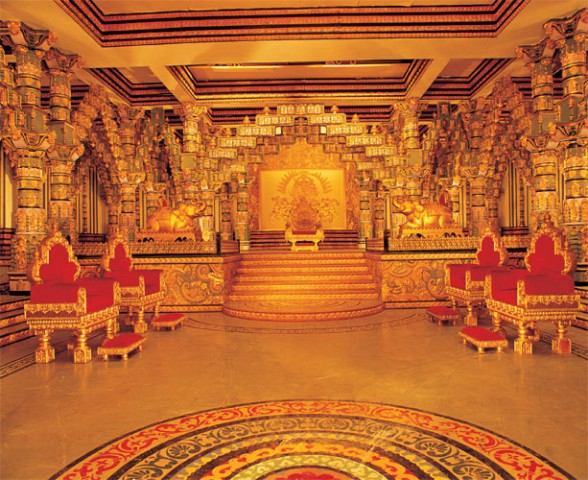
India’s Ramoji Film City


Ramoji Film City

This city is India’s version of Hollywood. Ramoji is located in Hyderabad. It was first opened in 1996 and covers over 2,000 acres making it the largest film facility in the world.

Many Hindi, Malayalam, Bengali and English television and films are produced out of this studio. It has gained a reputation of being “the land of a million dreams.”

Hyderabad’s picturesque scenery plus several man-made attractions make it an ideal area to film.

Ramoji is like Universal Studios in that it is also has an amusement park, which attracts a large number of tourists.

This film studio and the hotels that support the film and tourist industry are considered to be haunted which attracts even more attention to the area.

Film set.
Many point to the area’s history to explain these hauntings.

The city was built on the war grounds of the Nizam sultans. Thousands of soldiers that died during these battles are buried in the area.

One indication the ghosts that haunt the area are deceased soldiers is the fact that strange marks resembling Udu—the sultans’ language—has been discovered on mirrors.

Ghostly activity often happens during shoots.

One of the most chilling stories involves crewmembers that work with the lights high up. Unseen hands have shoved several of these men—they have fallen and serious injuries have been the result.

These large lights have also crashed down from the ceilings for no apparent reason.

Central Jail set.
Food left out overnight in various rooms have been discovered scattered across the floors in the morning—no one has claimed to see these ghosts but strange sounds heard and images spotted are common occurrences.

Because of this activity there are areas at the studio that are avoided or never used.

Women at the studio are often the victims of this activity. In various changing rooms shadows are seen and many females have reported having their clothes or costumes torn by unseen hands.

Another active spot is the various ladies’ restrooms where doors are knocked on—when they are opened no one is there.

The activity at Film City has become so annoying that efforts have been made to exorcise the ghosts but these attempts have all failed. Officials avoid discussing the hauntings.

Saturday, January 17, 2015

The Night Marchers of Kipapa Gulch


The Kipapa Gulch is located in central Oahu in Hawaii. It is haunted by the spirits of Hawaiian warriors that lost their lives in a bitter battle that was fought here in the 15th century.

The bridge today.
Today the bridge that crosses this gulch has experienced more than its fair share of freakish head-on car collisions. Some blame these accidents on the "evil" spirits that linger from this battle.

A Beloved King

The people of Oahu were starving. They rebelled and killed their chief.

They chose another leader named Mailikukahi. He was born in Kukaniloko, a place highly regarded because it was hallowed ground.

Mailikukahi became a beloved King. His wise, firm and judicious government has been compared to England’s King Arthur.


He opened schools to educate his people, a privilege once restricted to those of higher status.

Mailikukahi abolished human sacrifice. As a religious leader, he built Heiaus, which are temples, where his people could take refuge and be healed when they were sick.

He encouraged his people to cultivate the land and raise animals so they could feed themselves. He instated a code of laws that demanded the islands’ leaders stop stealing from the people or death would be the penalty.

He didn’t demand an auhau or tax from the people for they willingly brought the fruit of their labors to him.

The people of Oahu now prospered. Word of Mailikukahi’s accomplishments spread throughout the Hawaiian Islands.

But jealousy reared its ugly head.

Kipapa Gulch
The Battle of Kipapa Gulch

The peace and prosperity of Mailikukahi’s government intimidated the chiefs of Maui and the big island of Hawaii.

They were worried about his power and influence. Jealous of his successes, they worried it was a threat to the power they held over their own people.

In 1410, they declared war on Mailikukahi’s government. These two island chiefs invaded Oahu, landing in Waikiki--they then marched inland.

They met Mailikukahi and his men at Kipapa Gulch, where a gruesome battle ensued.

Battle of Kipapa Gulch
Mailikukahi and his warriors were able to prevail over these invaders. The bloodshed of the fallen, literally flooded this gulch.

The corpses of thousands of warriors that invaded Ouha lay dead. The name Kipapa was given to the area--meaning “paved way’’-- or paved with the dead.

The two leaders skulls were taken and placed on poles as a reminder to others of their fate if they chose to invade Oahu.

Restless Spirits

The Hawaiian people believe this bloody battle left behind many torn or unsettled spirits.

They state these fallen warriors haunt the Kipapa Gulch Bridge and the surrounding area. The many head-on car accidents that happen on this bridge are attributed to them.

So is this just a legend or do these spirits haunt this area?

Residents have reported seeing torches floating through the air--following a path down the mountain to the ocean through this gulch.

These Hawaiian spirit warriors are called the “Night Marchers.”

The White Lady

Another spirit said to haunt this bridge is a White Lady. She appears on this bridge at night dressed all in white.

When drivers pass by this bridge, the lady then just disappears. This recent story is similar to two others I share here and here.

The Kipapa Gulch Bridge is located between Mililani Town and Waipio.

Saturday, July 19, 2014

Haunted Fort Bragg


This is a 1st person account given by a U.S. Marine participating in war games at Fort Bragg in Fayetteville, North Carolina.

In March of 1978 I was a part of a field exercise in the woods at Fort Bragg. My buddy and I were hold up in a foxhole in a forward position charged with the task to report any sounds or movement we might observe to headquarters.

We had done this in the past and after we checked our radios we settled in for a long wait. It was early morning around 4:30 a.m. and the damp mist that surrounded us seemed to permeate my bones.

My buddy caught a few winks as I looked into the dense fog. The time crept by so slowly I felt myself nodding off but I caught myself determined to fight the boredom.

After a while I heard the faint sounds of a conversation in the woods near me. I then smelled the aroma of hot coffee. I quietly listened for the next 15 minutes as the voices became gradually louder.

I then saw several men wearing blue uniforms nearby. I rubbed my eyes for all our men wore green uniforms not blue. I checked and these men were definitely wearing blue old-fashioned uniforms.

It dawned on me that their uniforms looked like the type worn by Union soldiers during the Civil War.

These men moved so close to my position that I could have reached out and touched them. I clamped my hand over my buddies’ mouth waking him.

He sat quietly and watched these men as they went about their morning chores--his mouth was wide-open.


We then heard gunshots and men shouting. We saw a group of Confederate soldiers in worn and tattered grey uniforms attack the Union camp.

It grew colder as we watched this battle. The Union soldiers managed to drive the Confederate soldiers back into the surrounding pines. Then all these men just faded away into the mist.

I looked at my buddy and asked, “Did you see that?” He nodded yes. We both agreed that it would probably be best if we didn’t mention what we had seen. We never did tell anyone.

After we got back to our post in Jacksonville, North Carolina I decided to do some research on the history of the area.

I discovered that on the spot where our foxhole was located a Civil War battle was fought on March 10, 1865. Two Confederate brigades had attacked a Union Division at a place called Monroe’s Cross.

The sights, sounds and smells that I experienced that morning were very real.

Monday, March 24, 2014

The Tatum Haunting


The story of this haunting first aired in October of 1988 on the television show Unsolved Mysteries. 

I remember it distinctly because of a statement James Tatum made when he was interviewed about the haunting he and his wife, Katherine had experienced in their new 2-story home outside Atlanta, Georgia.

James Tatum was a retired army officer who appeared visibly upset as he stated, “If that bell rings again, I won’t answer it.”

The bell he referred to was a little angel bell his wife kept upstairs. James was an early riser, he would go downstairs to the living room, drink coffee and read the newspaper as his wife still slept. 

When Katherine awoke, she could not always get his attention by calling out his name, so she rang this little bell if she needed her husband’s assistance.

One morning James heard the bell ring, so he headed upstairs, but Katherine was still in bed asleep. Later the couple joked that it must be the “ghost.” 

This was half in jest and half serious for Katherine had experienced several odd things in their home in the previous months.

A few days later the bell rang again, but Katherine was asleep. The couple decided to instate a code where James would only respond to the signal if he heard 3 rings.

The ghost heard their bargain for James was summoned upstairs yet again to find Katherine asleep. He found the bell in their guest bedroom sitting in its usual place on a table. As James left the room, he heard the 3 rings once more.

James then emotionally told Katherine, “That he wasn’t going to answer that bell ever again.” After this, the bell remained silent.

The Tatums
For months Katherine had been the ghost's primary target until James' encounters with the bell. 

A year after they moved into their home in Marietta she was up at 2:00 a.m. using the restroom when she saw a man pass by the door. She assumed it was James and called out, but he didn’t respond.

She followed this figure in the dark as it headed toward the staircase. She called out again--no response. 

She returned to the master bedroom to find James in bed. She told him what she had seen, he grabbed his gun and searched the house but everything was locked and he saw no one.

Later, Katherine remembered that the figure wore a long coat and floppy hat that was drawn down over his face. She also realized what she had seen was a ghost. James at first didn’t know what to make of her experience.

This ghost continued to tease and scare Katherine. 

One afternoon James who was doing on an odd job upstairs left his drill propped against a wall and went down to watch T.V. Katherine heard this drill being turned on and off repeatedly and wondered what James was doing. But she discovered James was downstairs.

One afternoon as she watched T.V. in the bedroom she heard a popping sound in the middle of the room, she turned the set off so she could hear. She got up and discovered a field of static electricity in the middle of the room. She then moved back into a corner at which point this field followed her and popped right near her face.

The ghost also moved items in the master bedroom as Katherine lay in bed reading. 

James kept a small wooden bowl near the closet where he put the loose change from his pocket. One afternoon, Katherine heard coins dropping so she looked up expecting to see James. Instead, she saw the coins dropping one by one into the bowl from an unseen hand.

Another time the ghost moved a tray that held a glass of water and TUMS that was kept by the bed. Katherine heard the wafers drop one by one down onto the plate and then the whole thing hit the floor.

One evening as Katherine bent down to slip a casserole into the microwave she felt two hands tug at the hem of her shirt. She looked up only to see James through a window outside.

After the bell incident Katherine checked into the history of the land their new house sat upon. She discovered that a Civil War battle--The battle of Kolb’s Farm-- was fought in June of 1864 near their subdivision. I write about the Kolb's farm haunting here.

Battle of Kolb's Farm
Other homeowners in the Tatum's subdivision have also experienced hauntings.

In October of 2007 a male resident out for a drive one night with his teenage son spotted a horse and a Union cavalry officer in his car headlights.* 

The father quickly braked, and the horse passed right in front of their car. The two males watched in awe as the figure moved across the road and right through a fence--the horse and rider then just faded away.

* They were crossing the Kennesaw Mountain where a much bloodier battle occurred right after the Kolb Farm skirmish.

Monday, January 28, 2013

The Ghosts of Cedar Creek


On October 19, 1864, an American Civil War battle was fought in the Shenandoah Valley in Virginia. 

Confederate Lieutenant General Jubal Early’s “Army of the Valley” troops launched a surprise attack at dawn * against the encamped “Army of Shenandoah” led by Union Maj. General Philip Sheridan. 


Maj. General Philip Henry Sheridan


What happened next resulted in one of the most dramatic and bitter battles fought in the Civil War. This battle’s outcome changed the course of the war and helped Lincoln get elected to a second term. 

The Battle of Cedar Creek as it is known also left many restless spirits who still linger on this battlefield today.

Lt. General Jubal Early
In mid-October of 1864, the Union army no longer considered the Confederate’s Valley’s troops much of a threat. 

With half rations and sheer will power, General Early marched his Confederate troops day and night so he could surprise General Sheridan’s Union troops camped at Cedar Creek. 

General Sheridan, himself, was staying the night in Winchester, he had just returned from a conference in Washington that morning when he heard the distance canon fire. 

He quickly dressed and jumped on his faithful black horse, Rienzi, and charged to the battle.**


Within thirty minutes, he encountered his retreating men. That morning, Early’s half-starved men had managed to drive back seven Union infantry divisions who found themselves bombarded by their own artillery. The Confederacy had managed to commandeer these guns. 

This sent the Union soldiers in retreat. 

This initial Confederate success was surprising considering these troops at first ignored their officers as they raided the Union supply tents in search of food.  

General Early gave up this advantage when he made the decision not to pursue the Union troops north of Middletown--for the Union army was in chaos when they reached Middletown, having lost many of their leaders.

This Confederate mistake gave Sheridan, when he arrived, the time to quickly rally his men. The result was he was able to turn his Union troops around and launch several counterattacks. 

Sheridan's men spent the afternoon hitting various spots along the Confederate line, which ultimately broke down their defense. This turned the tide of the battle, and the Confederate’s now were the defeated. 

General Sheridan became a famous hero*** and the Confederate’s loss effectively ended their invasion of the North. They were never again able to threaten Washington, D.C., through the Shenandoah Valley. 

They also could no longer protect one of their vital economic assets-- Virginia. Sheridan’s victories in this Valley and Sherman’s successes in Georgia resulted in Abraham Lincoln being re-elected as president.


The fierceness of this battle left 8,000 soldiers dead--many others were wounded. Within days of the fight, the local residents started to notice activity they could not explain. 

A church that had been used as a Union field hospital during the battle became the focus of much of this activity. Many of the dead were hastily buried here in the yard, and then later these bodies were unearthed and placed in pine boxes to be sent back up north. Residents felt this was the main reason that Cedar Creek was haunted.

Witnesses saw a light leave the church late at night and go over to where the pine coffins were stacked. One resident stated it was if someone was searching through them with a candle, but no one has seen a human figure holding this light. 

When the coffins were removed, it was hoped the activity would cease, but it continued. Late at night cries of pain, moans and footsteps were heard near the church, but again no one is ever seen. 

In recent times witnesses have heard the whine of shots overhead and the distant boom of cannon fire.

One farmer who was leasing a barn that was located upon the battlefield saw something that terrified him one night. He was up in the loft, throwing down hay to his horses when he spotted a man wearing a threadbare uniform standing below him. 

He yelled at the man that he did not allow bums to stay in his barn. When the stranger did not respond or leave, he became angry. He lurched at the figure with his pitchfork, but the fork’s tines went right through this dark figure. He ran from the barn too scared to finish feeding his horses.

Another farmer, walking along a road one night, saw a ghostly officer leading his troops. He first stated, he heard a bugle sound, and then he saw these phantom men who walked right past him without noticing his presence. ****

One phenomenon that has been heard by many is that of a phantom band. Military style music is heard faintly in the distance. Residents state they hear first a horn, a drum and then the entire band starts playing, but as soon as it starts it then abruptly stops.

* Some historians point out that this attack should not have been a surprise for one Union General by the name of Emory believed a Confederate attack was imminent due to information he received that the Southerners were spying on the Union position. 

Emory did report this to General Wright, who was temporarily in command while Sheridan was in Washington. Unfortunately, Wright dismissed it.

** After the battle General Sheridan changed his horse’s name to Winchester.

** Two future American presidents fought in the Battle of Cedar Creek-- Col. Rutherford B. Hayes and Capt. William Mckinley. Hayes was elected to office in 1876 and Mckinley in 1896.

**** This is typical to battlefield phantom sightings where the haunting is most likely residual in nature as opposed to an intelligent haunting.