Showing posts with label photograph. Show all posts

Wednesday, February 24, 2016

The Cleveland Museum of Art

Two ghosts have been seen at this art museum when a portrait of them was on display in this building.

Cleveland Museum of Art
1916 Building
The Cleveland Museum of Art opened its doors in 1916. It has been expanded and renovated over the years. It sits in northeastern Ohio in in the town of Cleveland. It is by the city’s Wade Lagoon and Fine Arts Park.

Claude Monet, the forefather of French Impressionism had a distinct appearance while alive. His salt and pepper beard and favorite bowler hats made him easily recognizable.

When this Cleveland art museum installed a show in 2011 entitled: Painting the Modern Garden, Monet to Matisse, staff at the museum saw Monet’s ghost.

Monet's Water Lilies displayed in museum.
Jeffrey Strean, the museum’s director of design and architecture saw Monet standing on a balcony overlooking the space used for this new show. Monet stood and watched directly above where a vintage photo of him was being hung.

Ghost or Monet look-alike.
In a gallery located in the original space in the museum known as the 1916 Building, one of the original directors of the museum has been seen.

William Milliken
William Mathewson Milliken has been seen wandering through this space. He began work in the museum in 1919 and by 1930 he became the museum’s second director. In all, he worked at the museum for 38 years. He retired in 1958 and passed away in 1978.

Under his guidance the museum gained an international reputation.

He is seen wearing his favorite tweed jacket with elbow patches. He appears to clutch a folder under one arm. It was not until the staff went through the museum’s photograph collection that this connection was made.
Renovated haunted gallery at museum.
In this gallery, night watchmen report their flashlights malfunction. When they enter the room their lights extinguish, once they leave the room their lights turn back on.

During one renovation workmen wearing hardhats reported something similar. The lights on their hats would go out in this gallery only to turn back on once they left the room.

Jean-Gabriel du Theil
at signing of
Treaty of Vienna.
Another haunting involves an oil portrait entitled, Portrait of Jean-Gabriel du Theil at the Signing of the Treaty of Vienna done by Jacques André Joseph Arel. The ghost of Jean-Gabriel du Theil has been seen observing his image.

Water leaks and electrical shorts plagued the corner where their picture once hung. When this oil painting was put in storage the issues stopped.

The above stories where first written down by Carolyn Ivanye the museums protection services operations manager.

Wade Lagoon above and more renovated space below.
This museum celebrates its Centennial anniversary this year.

Wednesday, November 25, 2015

The Ghosts of Rosslyn Chapel

Rosslyn Chapel
Owned by the St. Clair or Sinclair family since 1446 Rosslyn Chapel located in Midlothian, Scotland is surrounded by many myths and mysteries.

The most famous legend connected to Rosslyn involves the Knights Templar * and their quest for the Holy Grail—which was the chalice used by Christ at the Last Supper.

Knight Templar
Drawn by
Agnieszkaw@Dreamstime.com
One myth states this chalice is supposedly hidden somewhere within the chapel.

* The Knights Templar known for their prowess in battle and finances were a Christian military order that played an integral part in the early Crusades. However in 1307, rumors about the order’s secret rituals spread which led to their eventual downfall.

Templars burn at stake.
Philip lV of France deeply in financial debt to the Templars conveniently accused them of heresy and fraud and burned several of their leaders at the stake.

The Rosslyn Chapel was built in the 15th century for the Prince of Orkney, Sir William St. Clair. He most likely was involved in the Order of the Knights Templar.

The chapel is known for its mysterious and intricate carvings that have stumped historians for generations. They reflect biblical, masonic, pagan and Knights Templar themes.

Some of these carvings are out of time and place—they were carved in the chapel 200 years before Columbus discovered America. They depict items only found in the New World-- American cactus and Indian sweet corn or maize.

Corn or Maize carvings.
Apprentice Pillar
One legend states an Apprentice who was a stonemason was murdered in the chapel. This young man is said to have carved a beautiful pillar while his master was away in Rome looking for inspiration. When his master returned, he found the post surpassed his own skill. In a jealous rage, he then killed the Apprentice.  

When the Prince of Orkney died he was buried in the chapel—after this, all male members of the St. Clair family were buried in vaults below the chapel, without coffins but instead in full knight regalia until the 1700s.

In the crypt located below the chapel, visitors for years have experienced a mysterious dark wind without an apparent source.

Chapel Crypt
Another legend states when a descendant of the Prince of Orkney dies the whole chapel appears to be on fire. Sir Walter Scott wrote about this phenomenon in his narrative poem Lay of the Last Minstrel.

The Chapel altars were smashed during the Reformation in 1592—since it was a Catholic church-- the chapel was then left to ruin until the 18th century. In 1736, the ceiling and floors were restored which saved it from complete decay. In 1861, the architect David Bryce was commissioned to restore Rosslyn.

Today the chapel is widely known because of Dan Brown’s bestselling novel The Da Vinci Code. But it has been famous for longer than this—partly because of the ghosts seen at the chapel.

There have been numerous sightings of phantom monks in and around the chapel.

One curator witnessed a ghostly monk praying at an altar in the crypt. This monk was seen surrounded by four guardian knights.

In other sightings, witnesses have come forward to state they saw monks dressed in grey or black both inside and outside the chapel at night.

Other curators have reported hearing strange sounds when there is no one around.

A group of actors rehearsing for a play at the chapel in 2006 had one cast member claim to see a strange “fairy-like“ entity roaming the grounds and another actor stated he saw a ghostly figure in the chapel.

The year before another actor rehearsing a play inside the chapel heard a child’s voice in the crypt. He shouted down, “I am locking up.” However, when he went down, there was no one there.

Recently odd lights have been witnessed in the chapel.


Kannard's photo.
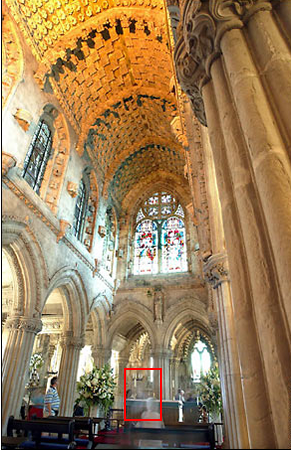
Here is a photograph and the enlargement that Brian Kannard took in the Rosslyn Chapel. The English paper The Telegraph published it in 2007. Kannard states he does not know if it is a ghost or not.

Enlargement of what he captured.

Friday, October 23, 2015

A Beloved Home

Over the years as people have discovered I have an interest in ghosts they have opened up and shared their ghost stories with me. They have shared stories that happened to them, a relative or even a friend.

A co-worker told one of the best stories I have ever heard.

This woman had grown up back east and later moved with her husband to New Mexico.

When she was a young child her father and mother had moved the family, which included three daughters to a rural suburb outside the city. The girls were ecstatic for they now had several acres to explore.

They moved into a small house on the property. This house became a life-long obsession for her father. She told me she couldn’t remember a time while growing up where their new home was not under construction or being renovated. 


The kitchen alone was changed so often that her mother often stated that her children grew up with a helping of sawdust in their food.

She laughed and told me that sometimes she wondered whom her father loved more, his family or their home. He would sometimes leave special events in his daughters’ lives early, such as graduations, just so he could finish laying floor tiles etc.

Years after his daughters married and his wife had passed her father still lived in his beloved home. He died—no surprise—doing what he loved, fixing something in his home.

Several years later when this co-worker and her husband were visiting friends and family in their home state, the sister they were staying with received an odd phone call.

The woman that now lived in the home where they grew up requested to meet them. They arranged to have lunch together the next day.

The woman told them she loved their old home. Even though the suburb was not as rural as it once had been the house was still surrounded by untouched acreage.

She told them that the summer before her daughter had held her wedding reception at the home. My co-worker and her sister thought this was nice but they noticed the lady was becoming nervous.

She finally bent down and pulled out a photograph from her purse. She told them it was a photo taken at the reception. She mentioned that when the photographer had her daughter view the wedding pictures so she could choose which ones she wanted he had gone out of his way to point out this one.

Uncomfortable now, she told the sisters that this photo, which was of the wedding party lined up, had a strange transparent man at the end of the bride’s side.

He was unusual because he was not dressed for a wedding instead he wore paint overalls and a work hat. None of her family or herself remembered seeing this man during the reception.

At this point, the sisters requested to see the photo. It was their father at the end of the line. His ghost was still hanging out at his beloved home.

Years later, while visiting this co-worker at her home she took me over to a photo that hung on her living room wall. It was the wedding reception photo with her father.

Sunday, September 13, 2015

The Ghost That Screamed

A former paranormal show on Destination America entitled, Casefiles Unknown first presented this story.

One segment entitled, The Ghost That Screamed talks about a teenager who died in a car crash in 1984.

Photo of the car crash. Photo credit: Big Picture Agency, Inc.


Four teenagers were driving near the Hyde Park golf course headed to a rock concert on a foggy, wet street when the 4-wheel-drive they were in hit a curve and left the road and crashed into a group of trees.

Two teenage boys and one girl survived the impact. The fourth a 16-year-old boy seated in the front passenger seat died at the scene of the crash.

When Officer Brian Coyle and his partner of the St. Paul Police Department arrived at the scene—the fourth teenager was wedged inside the car under the dashboard. Coyle took several photographs at the crash site.

Several days after he turned the department camera into the Film Property Room, he received a call from the officer who developed the photos he snapped at the crash site. This officer requested he should stop by.

Coyle was shown the photos from the scene. There were images on these snapshots that had not been there at the time they were taken.

Several had strange red and yellow lights streaking through them. In another one taken above the driver’s side door--there was a face that appeared to be in agony and was screaming.

This image had both distinct hair and profile. Neither officer had an explanation for what they were looking at.


Photo: Big Picture Agency, Inc.
Another clear image in this photo was outlined clearly on the driver’s side door. It was the translucent figure of a Labrador dog sitting.

These photos were taken before the advent of digital photography and photoshop.

Later, several experts who were consulted could not explain several of the images that appeared in these photos. For a long time, Officer Coyle did not address this issue in public, knowing how the friends and family of the deceased boy felt.

It has been over 30 years since this accident occurred, but these photos still elicit strong emotional responses.

A psychic who contacted Officer Coyle afterward feels that the face is the image of the boy’s soul leaving his body—he is resisting—saying “no” because dying was not what he expected that December evening two days after Christmas.

As for the dog—it is a Chocolate Lab—it was the deceased teen’s pet—which had passed away before the crash. The psychic feels this dog was sent to escort its master with other spirit guides to the afterlife—proving pets have souls too. 

Click to enlarge the first photo on this post--dog outline can be seen clearly. Plus look past the hood of the crashed car--three fuzzy figures are standing between the trees.

Tuesday, September 1, 2015

A Vigilante Hanging


Nevada City and the surrounding area, which included Virginia City, got their start when gold was discovered in Adler Gulch in 1863.

Nevada City was apart of Idaho Territory, until 1865, when it became the capital of Montana.

At this time, there was no law enforcement in the area—there was only a “miners court.”

Plummer Gang
robbing stagecoach.
So when George Ives, a member of the Plummer Gang * murdered a young Dutchman by the name of Nicholas Tibalt, in cold blood, it was vigilantes that responded.

Tibalt had been given gold by his employers, Burtchy and Clark, to buy mules. On his return trip, he was murdered, and the remaining gold and mules were stolen.

Ten days later, the body of Tibalt was brought back to Nevada City in a wagon. Ives, as he arrived in Virginia City, with the mules, had openly bragged, “the Dutchman would never trouble anybody again.”

Hearing about Ives’ boast, twenty-five men rode out to capture him. He was returned to Nevada City and put on trial. This proceeding, held outdoors, lasted three days as 2,000 area residents watched.

During his trial Ives’ “criminal friends”—including Sheriff Plummer of Virginia City-- tried to help him by planning his escape by intimidating witnesses—but neither worked.


Henry Plummer
Sheriff Plummer never arrived to lead the gang’s plan to help Ives, for he stayed away hearing vigilantes were looking for them, and the escape plan was thwarted because vigilante guards with loaded shotguns guarded Ives.

The miner’s court convicted Ives of the charges, and quickly arranged his hanging. A forty-foot pole was run through the window of an unfinished house, and a rope was draped over it.

Just fifty-eight minutes after he was found guilty, George Ives was hanged. He was buried next to his victim Tibalt—it was believed at the time that this would let Tibalt know his death had been avenged.


Outdoor museum Nevada City
Shortly after Ives’ hanging—the infamous Montana Vigilantes group was formed. Within the first month, twenty-four men found guilty by the vigilantes were hanged. Most of these men were apart of the Plummer Gang.

Just six years later, in 1869, the gold boom in Alder Gulch had ended, only a hundred people remained. By 1872, Nevada City was a ghost town.

During its heyday the placer mines of Alder Gulch yielded over thirty-five million dollars in gold.

By the early 1920s, many of the buildings in Nevada City had been destroyed.

In the 1950s a couple, Charles and Sue Bovey who collected Old Montana buildings bought Nevada City, and started to place other historic frontier buildings along the back streets of this ghost town.

They were careful to keep the original layout of the city intact.

In 1997, the State of Montana purchased the town. Today the Montana Heritage Commission runs Nevada City, as an outdoor museum. The last of the ninety historic buildings were placed on the site in 1978.

One hundred and fifty years after George Ives was hanged, three employees of the Montana Heritage Commission, Dan Thyer, Bill Peterson, and John Ellingsen were doing a research project at the site.

Historic Marker
Peterson took a photograph of Thyer and Ellingsen standing next to a historical marker that shows the spot where Ives was hanged.

When this photo was uploaded to a computer, the two men were not even in the shot. Instead, there is a mysterious, transparent figure of a man, who the three did not recognize.

They concluded this must be the ghost of George Ives.


The mysterious photo that was taken.
In the following short video Dan Thyer discusses the history of the Ives hanging, plus there is a clear shot of the mysterious figure that Peterson captured in the photograph.


* The Plummer Gang were Road Agents or highwaymen led by Sheriff Plummer. This was during the Civil War, and many wounded soldiers from both the North and South landed in Montana Territory. This made for a hostile atmosphere.

In May of 1864 Montana Territory was created by an Act of Congress and signed by President Abraham Lincoln. This insured Alder Gulch was under the jurisdiction of the United States—or the North.

The “vigilantes” were former wounded Northern soldiers who were there to ensure none of the 30 million dollars in gold mined in the Gulch in just 3 years from 1863 to 1866 reached the South.

So these vigilantes in remote Montana actually played a role in the outcome of the Civil War.

Wednesday, November 5, 2014

Tornado Victim Returns as Guardian Angel


The Tragedy

A deadly tornado struck Moore, Oklahoma, a suburb of Oklahoma City on the afternoon of May 20, 2013.

Ariel view of Plaza Towers Elementary
after tornado.
Seven school children died in the hallway of Plaza Towers Elementary when this EF5 tornado hit.

Nicolas McCabe
Nicolas McCabe a 9-year old third grader was one of these victims.

A Comforting Photograph

Six weeks later the McCabe family during a Fourth of July celebration took a picture of Nicolas’ cousin, Madison playing with a sparkler.

Nicolas’ father Scott McCabe noticed there were two faces in this photo--in the front is Madison just behind her is the face of his deceased son appearing to “watch over” his cousin.

He was not surprised to see Nicolas in this photo--he always loved the Fourth of July and firecrackers.

Some skeptics have stated this second face is just a blurred image of Madison a “double image” caused by movement of the camera.

Madison
Scott McCabe and his family do not agree. When Scott’s brother first saw the photo the hair stood up on the back of his neck.

Scott states it is obvious there are two faces in the photograph. There are two different skin tones and the two images have their own distinct facial features.

Scott goes on to state that he can see Nicolas’ Plaza Towers school T-shirt in the photo. Nicolas was buried in this shirt.

Scott McCade
The McCabe family takes comfort from this photo. Scott believes it proves that Nicolas is watching over the family.


Here is the photo:
Fourth of July 2013
Click to enlarge

Friday, October 4, 2013

Raynham Hall’s Brown Lady


Most people who are interested in ghosts are familiar with this photograph. The ghost captured in this picture is known as the Brown Lady. Her spirit was first seen in 1835 in Norfolk, England at a 16th century country home called Raynham Hall. The Townsend family has owned this hall for over 400 years. The ghost that haunts their home is said to be Lady Dorothy Walpole. She is known as the Brown Lady because she wears a brown brocade dress.

The story behind this haunting is considered a legend by some and by others true. It is stated that Lady Walpole’s ghost lingers at Raynham Hall because of what her husband did to her. Charles Townsend found out that his wife had been unfaithful to him--he was not a man to forgive or forget. Documents from the time indicate that Dorothy died and was buried in 1725. But...

Many feel her death and funeral were faked. Charles known for his violent temper took his revenge. The legend states that he actually locked her away in a remote area of the hall. She was not allowed to see her children for the rest of her life.* In 1726 at the age of 40 she died from smallpox. Another version states she actually broke her neck when she was pushed down the hall’s grand staircase.

Portait of Lady Dorothy Walpole
National Portrait Gallery, London
Since her death her ghost has been seen on several occasions. The first sighting occurred in 1835. It was during a Christmas gathering at the hall when Colonel Loftus and another guest at this party saw her figure as they went to their bedrooms to retire for the evening. The colonel described her “as a aristocratic looking women wearing an old fashioned brown dress.” He saw her clearly and was able to draw a sketch of her likeness. He pointed out that she was missing one important detail--her eyes. He just saw empty sockets. He also stated that her face glowed with an “eerie light”.

The second sighting was in 1836. Captain Frederick Marryat, a navel officer and a close friend of Charles Dickens was a houseguest at Raynham when he and two of his companions saw the Brown Lady. He stated that she smiled at him and the others with a very “diabolic” smile. The captain who was known to be very brave acted uncharacteristically out of fear. He took out his pistol and fired at the figure. The ball passed right through the ghost and slammed into the door behind.

The Brown Lady was seen for a third time in 1926. The son of the Lady Townsend at that time and one of his friends saw her apparition on the staircase. He stated afterwards that this ghost looked exactly like a portrait of Lady Dorothy that hangs in the hall. Lady Townsend and her son had not heard of the Brown Lady before this encounter.

The fourth sighting in 1936 provided the world with proof that there was indeed a ghost at Raynham Hall. A London photographer, Captain Hubert C. Provand and his assistant Indre Shirva were photographing the hall’s grand staircase for a spread in Country Life magazine when Shriva spotted something unusual. He “saw a vapory figure-- gradually taking the shape of a woman” moving down the stairs toward them.

Under Shirva’s direction Provand quickly took off the lens cap as Shirva pressed the trigger to activate the camera’s flash. Later when this negative was developed the famous image of the Brown Lady appeared. Country Life published this now famous photo along with others taken that day in December of 1936. ** Afterwards several people claimed the photo was faked but the magazine held firm in its conviction that it was authentic and had not been tampered with.

Since this sighting in 1936 the Brown Lady had not been seen again.

In one article I read it was speculated that since there is a pattern of 100 years between two of these hauntings and yet another 100 years between another sighting and when the photograph was published that the the Brown Lady might just make another appearance in 2036.

* Some state this is why she returns--she is looking for her children.

**  This photograph also appeared in Life Magazine in January of 1937.

This site "Dorothy, Viscountess Townsend" has good information about Lady Dorothy and the haunting.