Showing posts with label gold rush. Show all posts

Monday, March 18, 2019

The Mystery of Silver Heels

Mount Silver Heels
Located off Highway 9 near Alma, Colorado once stood a thriving mountain mining camp called Buckskin Joe.

Buckskin Joe
Courtesy of Historical Society
of Colorado.
In 1859, Joseph Higgenbottom *, an eccentric prospector established Buckskin Joe. Word spread fast about the discovery of gold in this camp and by 1861 it hosted 2,000 residents with several saloons, gambling halls, and even a traveling minstrel show.


One bright and sunny day the stagecoach brought a beautiful dance hall girl who became the talk of the camp.

Her real name is long lost, but the miners who showered her with admiration and gifts called her “Silver Heels” for the fancy heeled shoes she wore during her nightly dance performances.

After a few performances word got out that Silver Heels planned to move on. A desperate contingent of men approached her and begged her to stay, and to their relief, she agreed.

But little did she know her happy dancing days were about to end. In the Winter of 1861, an outbreak of smallpox hit the camp. The town leaders sent to Denver for nurses, but they never arrived.

The town was overwhelmed with the sick and dying. Silver Heels could be found traveling from cabin to cabin tending to the sick and caring for their families. She even helped bury the dead.

By the spring of 1862, the worst of this disease was over.

Those miners who remained wanted to show their gratitude to the merciful dancehall girl, but she seemed to have vanished. A group of miners searched the surrounding mountains when it was established she had not left Buckskin Joe by either horse or stage.

As the months passed the mystery of her disappearance deepened. The rumors began to fly. Had she contracted smallpox herself and died? Or maybe she had survived but now found herself with a pox-scarred face, so she was too ashamed to be seen.

As it turned out these rumors were not far from the truth for in the summer of 1862, a ghostly female figure began to appear in the camp’s cemetery.

Buckskin Joe Cemetery

She was seen wandering among the tombstones wearing a heavy black veil. The figure always carried flowers, which she would place on several graves. Was she still comforting those whom she had lost?

The old cemetery is the only part of the Buckskin Joe camp that still remains today. Silver Heels’ ghost has been seen for well over a century and a half in this cemetery. When witnesses approach her, they report her figure seems to just blow away on the wind.

Mount Silver Heels
After her disappearance the miners named one of the surrounding mountains-- Silver Heels, to honor her.

* Higgenbottom traded his claim, which later produced most of the 16 million in gold mined in the camp, for a revolver and a few other items and left the area.

Saturday, June 20, 2015

Helena: The Hanging Tree, Part l

Law was slow in coming to the Montana gold camps in the mid-1800s. The gold rushes brought a myriad of unsavory lawless characters into Montana territory.

Panning for gold/
With no law enforcement present “miner’s courts” were established but they were ill-equipped to handle the crimes that occurred in these wild camps and settlements.

The result was vigilantes took the law into their own hands. In the span of a few short months, from late 1863 to early 1864 vigilantes hung two- dozen men.

Helena in 1871.
Helena, Montana one of these early settlements was known for its Hanging Tree or "Murderer’s Tree" as it was known. More than 11 men were hanged on this tree from 1865 till 1870.

This ancient large Ponderosa pine stood east of the settlement at the head of Dry Gulch. Its bare massive lower branches--twenty feet above the ground-- reached out in a tangle.

Hanging Tree.
The Hanging of Compton and Wilson.
Click to enlarge
Montana Historical Society

Twelve-year-old Mary “Molly” Sheehan, later to become Mrs. Peter Ronan recalled coming upon one of these hangings on her way to school in 1865. At the age of 70, she described the sight--it being fresh in her memory--something she could not forget.

It was:

Mary Ronan's book,
Girl From the Gulches.
“A pitiful object, with bruised head, disarrayed vest and trousers, with boots so stiff, so worn, so wrinkled, so strangely the most poignant of all the gruesome details.”

This body was left hanging for three days as a warning to others.

David Hilger was a youngster when his family moved to Helena in 1867. He recalls climbing the Hanging Tree’s dead branches where rope burns were evident on the lower limbs.

He and his friends played marbles under this tree. One afternoon in 1870 as they played their game, it was interrupted.

Arthur Compton and Joseph Wilson were about to be lynched by an angry mob for robbery and attempted murder.

George Leonard, their victim, was a quiet German who lived near Bear Creek along the Missouri River. Leonard had traveled to Helena to buy supplies.

He stopped off in Reed’s Saloon for a few drinks. Compton and Wilson rented horses and watched and waited.

At 6:00 p.m., Leonard headed home on his horse. Compton and Wilson waylaid him at Spokane Creek. They fired seven times, hitting him only once in the hip.

When Leonard fell from his horse they pistol-whipped him around the head and left him for dead.

But Leonard did not die. David Hilger recounts an angry mob fueled by vigilantes approached the courthouse where the two men were confined.

The crowd forced their way in and took the two men to the steps of the courthouse where they conducted an impromptu trial.

“. . . All those in favor of taking Joseph Wilson and Arthur Compton and hanging them forthwith will signify by saying aye.”

Hilger remembered:

“I never in my life heard such a motion carried with such force and it seemed the ‘ayes’ could have been heard at the top of Mount Helena.”

The two men’s fate was sealed. They were marched to the Hanging Tree, where they were put in a wagon standing on a dry-goods box. Their hands and feet were bound together. Then they were asked if they had any final words.

Wilson remained silent, standing erect and motionless. Compton however, said, “Boys, goodbye. Don’t lead the life I have the past few days.” He had to be supported on the box because his knees were shaking.

Then the "all ready" was given and with a quick stroke of a horse’s back, the wagon lunged forward. The two men’s bodies were swinging in the air.

Compton’s neck was broken in the fall, but Wilson was not so lucky. The noose had slipped to the back of his neck, and he died of strangulation. Both men were pronounced dead after fifteen minutes.

The Vigilante hanging of Compton and Wilson.
Click to enlarge
The crowd did not disperse until the bodies were cut down and buried. Compton and Wilson were the last two to be hanged on this tree. Future executions were done on the gallows at the courthouse.

Afterward, David and his friends went back to playing marbles under the tree.

A photograph of this hanging hung in the hallway of the local Jefferson Elementary School for years as a reminder to the students “crime doesn’t pay.”

In Part ll of Helena: The Hanging Tree, the tree is chopped down, and a new eyewitness account of a ghost sighting is shared along with more recent sightings. All are scary.

Friday, March 27, 2015

Lyle and the Groveland Hotel

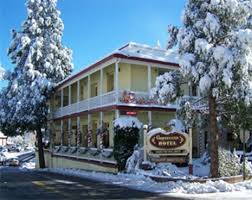
Groveland Hotel in winter.
This charming Bed and Breakfast offers 17 unique rooms for guests that come to stay in the small Sierra Nevada Mountain town of Groveland California near the entrance to Yosemite Park.

Initially built in 1849 this structure was an adobe trading post. It then was used as a gambling house, saloon, hotel, Ranger Station, business offices and even a Greyhound Bus Stop.

This picture was taken in early 1900.
Peggy and Grover Mosley bought this old run-down building in the 1990s. They spent two years and a million dollars to renovate this structure.

One room in this hotel is always in high demand. Number 15 is where Lyle resides. He is the inn’s ghost. Peggy and her employees enjoy sharing stories about Lyle.


During California’s Gold Rush this building was considered the most elegant house on the hill. So when Lyle, a reclusive miner, struck it rich he took up residence in Room 15.

His new living arrangement was also convenient for he worked the Spring Gulch Mine nearby. Lyle stayed in Room 15 for years.

He was found dead in this room in 1927, underneath him, was a box of dynamite one of the tools of his trade.

Lyle haunts Room 15 and the area that surrounds it. He was known to be obsessively neat and tidy while alive and it appears his ghost is the same.

Lyle's Room 15 today.
Female guests that stay in this room find if they place their cosmetics on Lyle’s dresser he does not like this clutter for when they return their makeup is no longer on the table. They often discover their items placed on the sink instead.

One female guest even watched as her makeup flew off the back of the dresser and landed on the floor.

Lyle’s ghost also likes to mess with the water. Taps are often turned on when no one is around--Peggy and Grover experienced this when they were the only two in the hotel.

Lyle also turns on the water in shower stalls in rooms near Room 15 when no one is around.

Another prank he enjoys is messing with the room door locks near Room 15. Guests return to find their room keys temporarily do not work.

There is also a romantic tale told about Lyle. Peggy states that if his ghost has not been active for a while, it means he is visiting The Hotel Charlotte across the street from the Groveland.

While alive, Lyle had a love affair with the original owner of this hotel--Charlotte.

Hotel Charlotte 

Tuesday, May 13, 2014

The Vineyard House: Dreams of Wealth, Part ll


The Ghostly Activity

This mansion that once was the center for California’s Gold Rush social elite was used for the next sixty-two years as a restaurant and boarding house.

Vineyard House built in 1878
Tenants during this time often complained of mysterious voices and phantom footsteps that thumped throughout the mansion at night when everything was quiet.

One border left the house in the middle of the night so frightened he refused to say what he had seen.

Many attributed this activity to the ghost of Robert Chalmer, the original owner--it was felt his restless spirit still resided within the mansion.

Other tenants reported hearing grunts, rustling skirts, metallic bangs, and heavy breathing. One couple complained of being woken up by noisy guests entering the front door and walking up the stairs.

When they went to shush these revelers they saw three men dressed in Victorian clothing vanish right in front of them.

Renovated Mansion

In 1975 a successful restaurateur bought the mansion. He proceeded to restore the home to its original glory. He had the paint stripped from the walls, floors, and banisters so the original wood could be showcased.

He carefully picked out the colors for the new wallpaper, paint, and other accessories. But each time these items were delivered, he found they were all the wrong colors. This continued for quite a while until one day he looked in an old scrapbook.

He realized the colors that had arrived were the colors of the original mansion. Some otherworldly presence was taking a hand in his renovations.

Items in the mansion started to be misplaced and then were found later in unlikely places--this happened with bud vases, dishes and cups.

A pub was built in the basement near where Robert’s cell once was. Many patrons and barkeeps felt that since Robert did not drink while alive, he now frowned upon the fact liquor was being served.

Cups that hung from nails in the wall that were reached for moved inexplicably. One cup would shake and bang against the others, or all of them would rattle against the wall.

Shot glasses that were placed on the bar were often found turned upside-down when the bartender turned back to fill them with liquor. At other times they would slide on their own across the bar.

This activity became so pronounced the new owner shut the house down. Today it stands empty.

Check out The Vineyard House: Dreams of Wealth and Loss, Part l where I talk about the two friends who married the same woman.

The Vineyard House: Dreams of Wealth, Part l


The Gold Rush

This rush lured many men to California all with dreams of becoming rich. But the reality was most did not attain this dream.

Two men who were friends, Robert Chalmers a German and Martin Allhoff a Scotsman both headed to California with high hopes. Both did pan some gold, but life in the fields was hard, and neither struck it rich.

Unlike many who had failed, these two men did not return home. Instead, both stayed in Coloma, a community near the American River nestled close to the Sierra Nevada Mountains. Allhoff grew grapes for wine, and Chalmers bought the Sierra Nevada Hotel.

Robert Chalmer
Robert Chalmer made a choice that doomed his hotel from the start. He wanted to provide a family atmosphere, so he did not serve liquor at his restaurant. In a time when bars and saloons were on every corner, this was not the best choice.

Even though Robert was an active member of the community and sponsored civic activities his hotel remained empty. His cash dried up quickly, and he found himself without assets.

In contrast, Martin Allhoff married a lady by the name of Louise and started to grow three varieties of grapes. These grapes: Concord, Catawba, and Eden thrived in the California sun. He then aged them into palette delights in his cellars. It was not long before his wines were winning awards.

But Althoff also made some bad choices. He was brought up on charges of tax and liquor license violations and jailed. Feeling he had disgraced his wife, children, and business he in despair committed suicide at the age of forty.

Martin Althoff
Robert Chalmer, a widower, who was in search of options found his friend’s widow Louise alone and sole owner of a very successful vineyard. He promptly married her in 1869. The vines thrived, and the wines continued to win awards.

The Vineyard House

Vineyard House on the right.
Sierra Nevada Hotel across
from the house.
Robert built his dream house on a hill overlooking Coloma in 1878, for Louise and the children. Their Victorian mansion had 4-stories, 19 rooms, 9 fireplaces with a large shaded porch that wrapped around the home.

This mansion quickly became the place where the local wealthy and elite gathered and partied. Many of the guests had made their fortunes during the Gold Rush.

Former President Ulysses S. Grant was visiting the home where Chalmers announced proudly that he intended to run for the State Legislature. The Chalmers were happy and seemed to have it all, but then disaster struck.

Robert started experiencing a loss of memory. Louise became concerned when he would say one thing and do another. He became short-tempered and scared Louise, the children, and the household staff.

His odd behavior worsened. Every time a grave was dug in the cemetery across from the mansion Robert would cross the road and lay down in the freshly dug hole. He would be found with his arms across his chest.

Louise Althoff then
Chalmer
The family and employees had to restrain him and forcefully take him home. As his behavior became more violent, several of the staff threatened to quit. For the safety of all concerned Louise made a hard decision.

She had a cell with iron bars constructed in the basement of the mansion. Robert was then lured into this space and locked in. His mind was lost to madness. He spent his days moaning and banging his head against the bars.

He was fed and checked on every day, but there was little anyone could do to help him. He eventually lost his sight to the basement’s darkness. In the end, he became convinced that Louise was trying to poison him--he stopped eating and starved to death in 1881.

Louise died thirty-two years later in 1913. The mansion was then sold to a series of owners and quickly became run down.

Check out The Vineyard House: Dreams of Wealth and Loss, Part ll where I share stories about the ghostly activity in this 100+ year-old mansion.

Tuesday, March 4, 2014

Juneau’s Alaskan Hotel


The U.S. bought Alaska from the Russians in 1867. Just 13 years after this in 1880 Joe Juneau and Richard Harris discovered gold in the Silver Creek Basin-- soon after the Alaskan Gold Rush began with a vengeance. 

A small tent city named after one of these men, located along the Inner Passage became the capital of the territory--Juneau, Alaska.

The McCloskey brothers, who struck it rich during this rush--along with another investor, Jules B. Caro had a 3-story hotel built near the steamship docks in Juneau in 1913. 

When visitors walk into this 101- year old hotel today they often get a strong sense that they have entered another time. For the Akaskan Hotel has retained most of its original frontier charm.


The hotel also retains several ghosts. It is said after the Alaskan was renovated in 1978 this ghostly activity became even more pronounced. 

One ghost that resides in the hotel is called, Alice. The local legend states Alice first came to the Hotel during the gold rush with her husband. His goal like thousands of others was to strike it rich.

Alice's husband left the hotel promising her he would return within 3 weeks. But when he didn’t return even after many weeks Alice believed her husband was dead. She became desperate for she had used the little money she had. 

In Alaska, the men have always outnumbered the women -- this was especially true during the early 1900s so there were several brothels.

Alice stranded and feeling she had no choice became a lady of the evening. But in a tragic twist of fate, her husband returned just a few weeks later. When he discovered what she had done he became enraged and killed her in a room located in the back of the Alaskan Hotel.

Present day staff and guests have encountered Alice's ghost on many occasions. Her presence is most often felt in the back of the hotel--in Rooms 218 and 219. Several guests who have stayed in these rooms who had no prior knowledge of this haunting have demanded to be moved.

Various staff members have stated that they are always uncomfortable when they are in this area of the hotel. Housekeepers recount how they often discover towels or other items either moved or misplaced in these two rooms. Several have seen Alice's ghost sitting on one of the beds.

One visitor told the staff after his stay that he felt waves of unhappiness and disappointment in one of these rooms. 


Alice’s ghost is sometimes seen walking up and down the hotel’s staircase. One desk clerk at the hotel saw her ghost walk up these stairs late one night. He described her as a blonde lady wearing a white dress.

Alice’s ghost has also been seen in the hotel’s bar. This room has several mirrors and many patrons have seen her form reflected out of the corner of their eye.

One summer resident of Juneau had her own strange encounter in the Alaskan Hotel but not with this ghost. One day while visiting a friend she used the hotel's restroom. She was surprised as she entered this room to see how outdated and old-fashioned it was.

Later that same day she was back in the hotel--she again entered this restroom--but this time it was modern. Flustered she came rushing out to query the staff on what had happened to the quaint décor she had seen earlier that day. They had no idea what she was talking about. Evidently, she experienced a “time slip.”

Saturday, November 30, 2013

The Nevada City's Exchange Hotel


Nevada City, California first became a town during the Gold Rush years. 

The first “easterners” to come to the area built a cabin along Deer Creek. They staked a claim in 1849, just a year after the find at nearby Sutter’s Mill, which started the California Gold Rush. 

The town’s first name was Deer Creek Diggins.

By 1850, it was decided that the town needed an official name. The name “Nevada” was chosen--Nevada is Spanish for snow-covered--because it had been a particularly snowy winter.

Through the 1850s and 60s Nevada grew in prominence. It became a county seat in 1851 for the new state of California. At its peak, Nevada had 10,000 residents. 

But unlike most boom mining towns Nevada stayed lawful, in part because of the town’s leadership. 

This was also in part due to a caste system that was put in place. The town’s working miners lived in Grass Valley nearby while the prosperous mine owners resided in Nevada.

The town went through one more name change in 1864. The western part of Utah Territory was formed into the new state of Nevada. So the word “city” was added to distinguish between the two.


Nevada City Mine 1866

At one time, the stamp mills that surrounded Green Valley and Nevada City crushed ore from the underground mines 24/7 in search of gold. The last mines in the area were closed in the 1950s.


Ophir Quartz Mill 1866
Grass Valley
The town’s first hotel, saloon, stagecoach stop, and mail center were known as Bicknell’s Block. The original building burnt down but it was rebuilt. 

This building eventually became the Nevada Exchange Hotel. In 1977, this hotel was placed on the National Register of Historic Places and is considered the oldest continuously operated hotel west of the Rockies.

In 1985, the entire downtown area of Nevada City was registered as a national historic landmark. 

This small town’s charm and beauty make it a tourist attraction today. It has many buildings that reflect Victorian, Colonial, Greek Revival, and California Gothic architecture.

One attraction for ghost hunters is the National Exchange Hotel, just like the town this hotel has an interesting history. This structure is haunted.

One female ghost is seen in the hotel’s bar area and restroom. She was murdered in the hotel. It seems she owed a man some money--unfortunately, she refused to pay him. One night he broke into Room 48 and hid in the closet. When the lady returned, he slit her throat. She haunts this room as well.

Known as just "National Hotel" today.
Another ghost seen at the National is that of a little girl named Elizabeth. It is believed she died of a childhood illness--most likely mumps. She stayed in a room on the third floor, while at the hotel. 

Many guests have felt her presence in Room 78. Strange knocking noises are heard. Elizabeth is seen playing in the 3rd-floor hallways. She is seen riding a tricycle and skipping rope.

Yet another ghost at the National is that of a man. He is described as wearing black pants, a white shirt, and a black vest. He is seen walking up a staircase. Witnesses who have followed him mention they saw his profile clearly, but then he just vanished.

Wednesday, June 19, 2013

The Lost Souls at San Miguel Mission


San Miguel located north of San Luis Obispo in California was one of the oldest missions secularized when Mexico won their independence from Spain. In the early 1840s the Mission system began to collapse at which point San Miguel was left to crumble. In July of 1846 Petronilo Rios and his business partner William Reed bought the Mission for a few hundred dollars. 

Reed then opened the Mission as a lodging and trading post. Reed demanded all his trade be done in gold and that all his guests pay him in gold. The reason for this was California was not yet apart of the U.S. so currencies from Mexico and the U.S were considered worthless. Besides, gold was plentiful because this was at the beginning of California’s Gold Rush.

As his business grew Reed who lived at Mission San Miguel with his family unfortunately bragged openly that he had amassed a small fortune from this new enterprise. He foolishly told many that he had his gold hidden within the mission walls. On the afternoon of December 4, 1848 six nefarious men arrived at the Mission. 

These men were Joseph Lynch who was a deserter from the US Army. Pete Raymond who had killed a man and escaped from jail. Another two, Pete Remer and Peter Quin were both deserters from the warship Warren. * And a man named Sam Bernard who was accompanied by an Indian named John from Soledad.

Lynch and Raymond had murdered two other travel companions on their way from the gold fields to Soledad. Once at the Mission the men sold 30 ounces of gold to Reed for $30 per ounce. They left the mission the next morning and headed south for San Marcos Creek. But knowing the stories about Reed’s hidden gold their greed got the best of them and they then returned to the Mission.


During the evening of December 5th they brutally killed everyone at San Miguel. Bernard returning from fetching firewood hid an axe among the wood. He hacked at Reed several times with this axe then the Indian John finished him off by stabbing him with a knife. Bernard and the others then proceeded to Reed’s rooms and killed most of the women and children. The group then stalked the rest.

Besides Reed ten other people were murdered including Reed’s wife Maria Vallejos Reed who was pregnant and their four-year old son. Reed’s brother-in-law Jose Vallejos, Maria’s midwife Josefa Olivera and the midwife's fifteen- year old-daughter were victims as well. Martin Olivera’s grandson was killed along with a Negro cook, an Indian sheepherder and his young grandchild. Four of the victims were young children--including Maria’s unborn child. 

The murderers piled all the bodies in the Carpenter’s shop and then sat down and drank some of Reed’s good wine. They spend time looking for Reed's gold but didn’t find it. The few valuables they did find were not worth much. **


The killers left the Mission that night, a posse caught up with them two days later near Santa Barbara at Rancho Ortega. Unbeknownst to the group the same night they committed the murders a mail carrier, James Beckworth had found the bodies. Shocked, he quickly rode to Monterey to inform the military governor. 

A posse was immediately gathered to track them. One item that helped them was an earring known to belong to Maria Reed which was found near San Luis Obispo, the first place these men had camped for the night after the murders. When the posse caught up to them a fight ensued. 

Sam Bernard was shot and killed. Pete Raymond jumped into the surf in an effort to escape and drowned. Peter Quin was wounded and captured after killing a member of the posse. Joseph Lynch and Peter Remer were also captured and later they confessed to their roles in the murders. The Indian, John had parted ways with the group before they reached Santa Barbara--he was never found.

The three men that were captured were executed by a nine-man firing squad that was sent from Monterey on December 28, 1848. Reed’s partner Petronilo Rios helped bury the murdered victims at the Mission. They were all placed in a mass grave. The sight of the dead children disturbed him for years to come. 

This grave is located near the rear door of the Mission’s sacristy. Since, many people have seen the ghost of William Reed at the Mission wearing his winter pea coat--this was one of the items the murderers stole. Another ghost that is seen is felt to be Maria Reed she is seen wandering the Mission grounds wearing a white dress. Other witnesses have heard muffled screams coming from the chapel. While some have seen the apparitions of two young boys at the Mission.


Recently, the young granddaughter of a woman who has worked in the Mission gift shop for 35 years was alarmed when she told her grandma, “I saw an Indian boy and he couldn’t talk. He has an owie on his neck.” Another recent witness saw a man step out of the wall on the south side of the Mission church. He was described wearing a navy blue pea coat.

*  It was not uncommon for men during the Gold Rush to jump ship and head for the gold fields.

** William Reed's hidden gold has never been found.