Showing posts with label Montana. Show all posts

Tuesday, August 6, 2019

Haunted Little Bighorn


There are many reasons why this famous western battlefield is an excellent place to visit, especially if one wants to encounter a ghost.

George Armstrong Custer
It was here where “Custer’s Last Stand” took place in June of 1876.

On this grassy hill in south-central Montana, Lt. Col. George Armstrong Custer led the U.S. 7th Cavalry into battle against thousands of Lakota (Sioux) and Cheyenne warriors.

All 263 of Custer’s men perished in this battle, which became known as the Battle of Little Bighorn. Over 100 warriors died as well during this two-day fight.
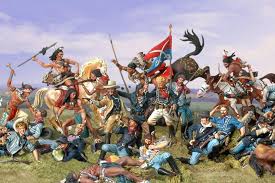
Custer's Last Stand
A historian, John Doerner, states it is not surprising this site is haunted considering all the bloodshed, scalping’s, and mutilations that took place on this hill.

After this battle, the U.S. tripled its efforts to force the Plains Indians onto reservations. They accomplished this within the year.

National Cemetery
Today, the location is a National Monument. The areas with the most activity are the battlefield, Stone House, and the National Cemetery.

Visitors and employees at the park agree that the ghosts appear to be restless.

Chief Crazy Horse
One of the chiefs that
participated in the battle.
Many report hearing the sounds of Indian warriors charging on horseback through the cemetery. The curious who have visited this cemetery at night state they felt random cold spots that had no source.

In August of 1979, a Park Enforcement Officer was alone on “Last Stand Hill.” He felt a sudden drop in temperature, and a strong force appeared to walk right through his body.

He heard a steady murmur of voices and left quickly, not wanting to know if they addressed him.

Two visitors at separate times, both had similar disturbing experiences. Both men, one from New Orleans, and the other from Minneapolis claimed to be transported back in time.

They witnessed soldiers and warriors fighting to the death.

Both of these visitors were so unsettled by what they saw—they had to be “calmed down.”

Battlefield at Little Bighorn.
A former Native American Park Ranger, Mardell Plainfeather, saw the ghosts of Indian warriors in 1980.

Late one evening, driving home she spotted two warriors sitting on horses, silhouetted upon a bluff. One of these men lifted himself off his saddle and looked directly at Mardell.

He was dressed for war, painted, with feathers in his long hair. Both men held shields and had bows.

Mardell stated she was not frightened by their presence, but she was curious.

A very active site at Little Bighorn is Stone House. This home was first the superintendent’s residence. It then was used in the summer months as apartments for the staff.

In the winter, this home was closed and locked. This is why the following two sightings are so unusual.

Neil Mangum while walking home through the cemetery, during winter nights often saw the second-floor lights on in the Stone House. He then would turn them off.

He did this despite the fact he knew---the ghosts in the house were turning them on.

Mardell also saw these lights on, in the 1980s during the winter months. But she would never enter the home alone. On night she requested Mike, a Park Ranger, accompany her.

At the same time, Mike’s wife Pam was watching TV in their nearby apartment when the screen went blank, and a strange voice stated, “Second Floor” three times.

This freaked her out until Mike returned unharmed.

Several staff members observed and heard activity when they stayed at the Stone House for one or two nights when they first arrived at the park to work.

This activity included knocks and loud bangs, doorknobs moving on their own, unexplained footsteps coming from empty rooms, and personal items being moved about by unseen hands.

The Stone House at Little Bighorn.
A female ghost was observed walking down the stairs. Most believe this activity occurs because the home’s lower level was once used to store bodies until they could be buried in the years after the battle.

When Mike and Pam first came, they stayed in the upstairs apartment for several nights, they didn’t encounter anything during this time, but their dog was always nervous—pacing back and forth.

In the summer of 1986, a new Park Ranger stayed at Stone House his first two nights. He was in a second-floor apartment sleeping, when he awoke to find a presence sitting on the edge of his bed.

He reached for his Colt .54 as he saw this shadowy figure move from the foot of his bed. He saw the torso of a soldier, but the head and legs were missing.

He watched as this strange figure quickly moved into the next room and then disappeared.

People have also seen a variety of other apparitions in Stone House, including George Custer. Today the home is used as a library and conference center.

Tuesday, September 1, 2015

A Vigilante Hanging


Nevada City and the surrounding area, which included Virginia City, got their start when gold was discovered in Adler Gulch in 1863.

Nevada City was apart of Idaho Territory, until 1865, when it became the capital of Montana.

At this time, there was no law enforcement in the area—there was only a “miners court.”

Plummer Gang
robbing stagecoach.
So when George Ives, a member of the Plummer Gang * murdered a young Dutchman by the name of Nicholas Tibalt, in cold blood, it was vigilantes that responded.

Tibalt had been given gold by his employers, Burtchy and Clark, to buy mules. On his return trip, he was murdered, and the remaining gold and mules were stolen.

Ten days later, the body of Tibalt was brought back to Nevada City in a wagon. Ives, as he arrived in Virginia City, with the mules, had openly bragged, “the Dutchman would never trouble anybody again.”

Hearing about Ives’ boast, twenty-five men rode out to capture him. He was returned to Nevada City and put on trial. This proceeding, held outdoors, lasted three days as 2,000 area residents watched.

During his trial Ives’ “criminal friends”—including Sheriff Plummer of Virginia City-- tried to help him by planning his escape by intimidating witnesses—but neither worked.


Henry Plummer
Sheriff Plummer never arrived to lead the gang’s plan to help Ives, for he stayed away hearing vigilantes were looking for them, and the escape plan was thwarted because vigilante guards with loaded shotguns guarded Ives.

The miner’s court convicted Ives of the charges, and quickly arranged his hanging. A forty-foot pole was run through the window of an unfinished house, and a rope was draped over it.

Just fifty-eight minutes after he was found guilty, George Ives was hanged. He was buried next to his victim Tibalt—it was believed at the time that this would let Tibalt know his death had been avenged.


Outdoor museum Nevada City
Shortly after Ives’ hanging—the infamous Montana Vigilantes group was formed. Within the first month, twenty-four men found guilty by the vigilantes were hanged. Most of these men were apart of the Plummer Gang.

Just six years later, in 1869, the gold boom in Alder Gulch had ended, only a hundred people remained. By 1872, Nevada City was a ghost town.

During its heyday the placer mines of Alder Gulch yielded over thirty-five million dollars in gold.

By the early 1920s, many of the buildings in Nevada City had been destroyed.

In the 1950s a couple, Charles and Sue Bovey who collected Old Montana buildings bought Nevada City, and started to place other historic frontier buildings along the back streets of this ghost town.

They were careful to keep the original layout of the city intact.

In 1997, the State of Montana purchased the town. Today the Montana Heritage Commission runs Nevada City, as an outdoor museum. The last of the ninety historic buildings were placed on the site in 1978.

One hundred and fifty years after George Ives was hanged, three employees of the Montana Heritage Commission, Dan Thyer, Bill Peterson, and John Ellingsen were doing a research project at the site.

Historic Marker
Peterson took a photograph of Thyer and Ellingsen standing next to a historical marker that shows the spot where Ives was hanged.

When this photo was uploaded to a computer, the two men were not even in the shot. Instead, there is a mysterious, transparent figure of a man, who the three did not recognize.

They concluded this must be the ghost of George Ives.


The mysterious photo that was taken.
In the following short video Dan Thyer discusses the history of the Ives hanging, plus there is a clear shot of the mysterious figure that Peterson captured in the photograph.


* The Plummer Gang were Road Agents or highwaymen led by Sheriff Plummer. This was during the Civil War, and many wounded soldiers from both the North and South landed in Montana Territory. This made for a hostile atmosphere.

In May of 1864 Montana Territory was created by an Act of Congress and signed by President Abraham Lincoln. This insured Alder Gulch was under the jurisdiction of the United States—or the North.

The “vigilantes” were former wounded Northern soldiers who were there to ensure none of the 30 million dollars in gold mined in the Gulch in just 3 years from 1863 to 1866 reached the South.

So these vigilantes in remote Montana actually played a role in the outcome of the Civil War.

Monday, July 27, 2015

Bannack: A Ghost Town with Ghosts


Bannack

Bannack, Montana was established in 1862 when gold was found along Grasshopper Creek.

Like other gold rushes, miners flooded into this settlement in search of their fortunes. It was not long before the hills surrounding the community were filled with as many as 10,000 miners.

With this large population came violence.

In 1883, a fast-talking, handsome, well-dressed newcomer, by the name of Henry Plummer, impressed several leading community members. It wasn’t long before he was elected sheriff.

Henry Plummer
But what the unsuspecting citizens of Bannack did not know is Plummer was actually the head of a secret band of road agents called the “innocents.”

They began to terrorize travelers between Bannack and Virginia City, robbing and killing more than 100 men within a few short months.

In December of 1883 the miners formed the Montana Vigilantes and during the next 42 days they hanged 24 gang members, including Henry Plummer.

Later, the authenticity of this story was questioned by historians—some believed it was just a cover the vigilantes used to mask their own nefarious activities in the area.

Today the ghost town of Bannack is a state park. Many people believe that the ghost of Henry Plummer—wrongly hanged—haunts the area. His motivation is said to be the need to clear his name.

Hotel Meade
Another ghost that resides in Bannack is seen on the second floor of the Hotel Meade.

This structure built in 1875 was originally used as a courthouse. In 1881 when Bannack lost its county seat status to nearby Dillon the building was abandoned until 1890.

It then was remodeled and reopened as a plush hotel. It remained a hotel for many years—in its final reincarnation it was used as a hospital.

Today visitors experience cold spots and see the apparition of a teen-age girl on its second floor. Others report hearing the sounds of children crying. One investigator caught these sounds during an EVP session.

The first sighting of this ghostly girl happened over 100 years ago. It is said she is Dorothy Dunn a 16-year old resident of Bannack who drowned while swimming in a dredge pond along Grasshopper Creek.

Shortly after her death, Dorothy’s ghost first appeared to her best friend who was with her at the time of her death.

Since this initial encounter numerous witnesses have reported seeing a teen-age girl wearing a long blue dress on the second floor of the old Hotel Meade.

Children most often see her. One 7-year old saw Dorothy and she states this ghost tried to talk to her. She saw Dorothy’s mouth moving but heard no sound.

Others have seen Dorothy’s ghost standing at an upstairs window as they stood in the street below.

Yet other witnesses have seen ghostly women dressed in their best finery in various places around the old town.

When the mines played out in Bannack it quickly was abandoned. By the 1940s it was a ghost town.

The Montana Department of Fish, Wildlife and Parks stepped in to save the town from the elements and vandalism by making it a state park in August of 1954.


Today, over 60 structures remain and the staff gives tours—as well as allowing individuals to explore this historic site on their own.

The following photograph was taken at Bannack’s General Store. Two photos were taken one right after the other. In the second photo this mist appears—it is believed to be paranormal in nature.

Sunday, June 21, 2015

Helena: The Hanging Tree, Part ll

Hanging Tree
In Part l of this post the Lawless days during Helena, Montana’s gold rush era is recounted. The community had a Hanging Tree were more than eleven men were hanged by vigilantes in the mid-1800s.

In 1875, a Methodist minister, Reverend W.E. Shippen who owned the land where the large Ponderosa pine Hanging Tree was located arranged to have it chopped down.

Despite a public outcry, he followed through--most likely to get rid of this macabre symbol from a time when citizens in the community took the law into their own hands.

By the1880s homes were being built in this area.

In 1900, a workman digging in a backyard in the area near where the tree once stood discovered a grave. In 1931, yet another grave was found close to the first.

It is believed these were the bodies of two men who were hanged. The boots worn by one identified him as James Daniel who was hanged in 1866. It was his body, Mary ‘Molly” Sheehan (Ronan) saw hanging from the tree. Ronan’s account is shared in Part l of this post.

The hanging of James Daniel
Residents for the past 145 years who live near where the tree once stood state “intense emotions” linger. They feel that many of the men who were hanged do not rest in peace.

The earliest encounter with a ghost happened in September of 1872 before the tree was chopped down. A resident had stayed late to finish his work.

It was dark and snowing when he headed home. But a strong force compelled him to change directions, and he found himself standing in front of the Hanging Tree. What follows was published in a letter to the editor of the Rocky Mountain Gazette. It is a wordy account, so it is paraphrased.

"As his eyes adjusted to the darkness, he could see the trees stark and lifeless outline. He spotted the form of a man. He was hanging a few feet below a lower limb.

After a momentary panic, he regained his composure and moved closer to the tree. The figure was dressed in black clothing, and his back was turned away from the witness.

The man saw no rope extending from the limb. The figure was suspended in mid-air. He saw the form was not solid but instead was transparent.

Suddenly the figure raised its arms and changed position. He could now see its face--it was ghostly pale. The apparition spoke two words, “October 7th and then disappeared."

With this initial sighting, some feel this set the other spirits that were hanged “free.” This is believed because for many years people have experienced strange events in the neighborhood.

One house along Hanging Tree Gulch Rd today.
Activity encountered includes: voices heard outside at night, footsteps in people’s attics and marbles found in homes as well as their gardens.

This last is connected to David Hilger and his friends playing marbles under the Hanging Tree--which is described in Part l.

The Jones family who lives in the area state they do not believe in ghosts but every time their daughter visits them she hears the voices outside.

One house in the neighborhood was remodeled recently. A crew of workmen who applied new drywall and plaster left soon after to let the walls dry. When they left the house, it was locked securely, and no animals were inside.

When the workmen returned, they found “claw-like” scratches marring every wall. The plaster had to be reapplied.

Herb Dawson, an architect, has experienced several odd things in his home located in the Hillsdale area. He, like many others, has found the mysterious marbles throughout his home and on his front porch.

One of his most frightening experiences occurred as he was stripping the paint from his parlor’s woodwork. A knife on the mantle behind him flew across the room and hit the wall inches from his head.

Hector Cano and his girlfriend live near Herb Dawson. He has also heard things he cannot explain. One night while lying in bed, a noise woke him up.

He saw his wife’s son from a previous marriage standing before him. This boy was saying, “Get away from me. Get away from me!”

Cano asked him what he was talking about and as he looked up he saw a tall bald man with four others standing behind him.

The tall man was trying to get hold of the young boy.


Hanging of Compton and Wilson
Click to enlarge
In Part l of Helena: The Hanging Tree, more information about the hangings is shared.

Saturday, June 20, 2015

Helena: The Hanging Tree, Part l

Law was slow in coming to the Montana gold camps in the mid-1800s. The gold rushes brought a myriad of unsavory lawless characters into Montana territory.

Panning for gold/
With no law enforcement present “miner’s courts” were established but they were ill-equipped to handle the crimes that occurred in these wild camps and settlements.

The result was vigilantes took the law into their own hands. In the span of a few short months, from late 1863 to early 1864 vigilantes hung two- dozen men.

Helena in 1871.
Helena, Montana one of these early settlements was known for its Hanging Tree or "Murderer’s Tree" as it was known. More than 11 men were hanged on this tree from 1865 till 1870.

This ancient large Ponderosa pine stood east of the settlement at the head of Dry Gulch. Its bare massive lower branches--twenty feet above the ground-- reached out in a tangle.

Hanging Tree.
The Hanging of Compton and Wilson.
Click to enlarge
Montana Historical Society

Twelve-year-old Mary “Molly” Sheehan, later to become Mrs. Peter Ronan recalled coming upon one of these hangings on her way to school in 1865. At the age of 70, she described the sight--it being fresh in her memory--something she could not forget.

It was:

Mary Ronan's book,
Girl From the Gulches.
“A pitiful object, with bruised head, disarrayed vest and trousers, with boots so stiff, so worn, so wrinkled, so strangely the most poignant of all the gruesome details.”

This body was left hanging for three days as a warning to others.

David Hilger was a youngster when his family moved to Helena in 1867. He recalls climbing the Hanging Tree’s dead branches where rope burns were evident on the lower limbs.

He and his friends played marbles under this tree. One afternoon in 1870 as they played their game, it was interrupted.

Arthur Compton and Joseph Wilson were about to be lynched by an angry mob for robbery and attempted murder.

George Leonard, their victim, was a quiet German who lived near Bear Creek along the Missouri River. Leonard had traveled to Helena to buy supplies.

He stopped off in Reed’s Saloon for a few drinks. Compton and Wilson rented horses and watched and waited.

At 6:00 p.m., Leonard headed home on his horse. Compton and Wilson waylaid him at Spokane Creek. They fired seven times, hitting him only once in the hip.

When Leonard fell from his horse they pistol-whipped him around the head and left him for dead.

But Leonard did not die. David Hilger recounts an angry mob fueled by vigilantes approached the courthouse where the two men were confined.

The crowd forced their way in and took the two men to the steps of the courthouse where they conducted an impromptu trial.

“. . . All those in favor of taking Joseph Wilson and Arthur Compton and hanging them forthwith will signify by saying aye.”

Hilger remembered:

“I never in my life heard such a motion carried with such force and it seemed the ‘ayes’ could have been heard at the top of Mount Helena.”

The two men’s fate was sealed. They were marched to the Hanging Tree, where they were put in a wagon standing on a dry-goods box. Their hands and feet were bound together. Then they were asked if they had any final words.

Wilson remained silent, standing erect and motionless. Compton however, said, “Boys, goodbye. Don’t lead the life I have the past few days.” He had to be supported on the box because his knees were shaking.

Then the "all ready" was given and with a quick stroke of a horse’s back, the wagon lunged forward. The two men’s bodies were swinging in the air.

Compton’s neck was broken in the fall, but Wilson was not so lucky. The noose had slipped to the back of his neck, and he died of strangulation. Both men were pronounced dead after fifteen minutes.

The Vigilante hanging of Compton and Wilson.
Click to enlarge
The crowd did not disperse until the bodies were cut down and buried. Compton and Wilson were the last two to be hanged on this tree. Future executions were done on the gallows at the courthouse.

Afterward, David and his friends went back to playing marbles under the tree.

A photograph of this hanging hung in the hallway of the local Jefferson Elementary School for years as a reminder to the students “crime doesn’t pay.”

In Part ll of Helena: The Hanging Tree, the tree is chopped down, and a new eyewitness account of a ghost sighting is shared along with more recent sightings. All are scary.