

There are many reasons why
this famous western battlefield is an excellent place to visit, especially if one wants to
encounter a ghost.
 |
| George Armstrong Custer |
It was here where “Custer’s
Last Stand” took place in June of 1876.
On this grassy hill in
south-central Montana, Lt. Col. George Armstrong Custer led the U.S. 7th
Cavalry into battle against thousands of Lakota (Sioux) and Cheyenne
warriors.
All 263 of Custer’s men
perished in this battle, which became known as the Battle of Little Bighorn.
Over 100 warriors died as well during this two-day fight.
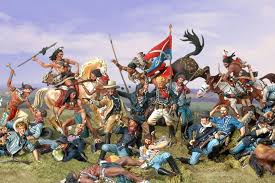 |
| Custer's Last Stand |
A historian, John Doerner,
states it is not surprising this site is haunted considering all the bloodshed,
scalping’s, and mutilations that took place on this hill.
After this battle, the U.S.
tripled its efforts to force the Plains Indians onto reservations. They
accomplished this within the year.
 |
| National Cemetery |
Today, the location is a
National Monument. The areas with the most activity are the battlefield, Stone
House, and the National Cemetery.
Visitors and employees at the
park agree that the ghosts appear to be restless.
 |
| Chief Crazy Horse One of the chiefs that participated in the battle. |
Many report hearing the
sounds of Indian warriors charging on horseback through the cemetery. The
curious who have visited this cemetery at night state they felt random cold
spots that had no source.
In August of 1979, a Park Enforcement
Officer was alone on “Last Stand Hill.” He felt a sudden drop in temperature,
and a strong force appeared to walk right through his body.
He heard a steady murmur of
voices and left quickly, not wanting to know if they addressed him.
Two visitors at separate
times, both had similar disturbing experiences. Both men, one from New Orleans,
and the other from Minneapolis claimed to be transported back in time.
They witnessed soldiers and
warriors fighting to the death.
Both of these visitors were so unsettled
by what they saw—they had to be “calmed down.”
 |
| Battlefield at Little Bighorn. |
A former Native American Park
Ranger, Mardell Plainfeather, saw the ghosts of Indian warriors in 1980.
Late one evening, driving
home she spotted two warriors sitting on horses, silhouetted upon a bluff. One
of these men lifted himself off his saddle and looked directly at Mardell.
He was dressed for war,
painted, with feathers in his long hair. Both men held shields and had bows.
Mardell stated she was not
frightened by their presence, but she was curious.
A very active site at Little
Bighorn is Stone House. This home was first the superintendent’s residence. It
then was used in the summer months as apartments for the staff.
In the winter, this home was
closed and locked. This is why the following two sightings are so unusual.
Neil Mangum while walking
home through the cemetery, during winter nights often saw the second-floor
lights on in the Stone House. He then would turn them off.
He did this despite the fact
he knew---the ghosts in the house were turning them on.
Mardell also saw these lights
on, in the 1980s during the winter months. But she would never enter the home
alone. On night she requested Mike, a Park Ranger, accompany her.
At the same time, Mike’s wife
Pam was watching TV in their nearby apartment when the screen went blank, and
a strange voice stated, “Second Floor” three times.
This freaked her out until
Mike returned unharmed.
Several staff members
observed and heard activity when they stayed at the Stone House for one or two
nights when they first arrived at the park to work.
This activity included knocks
and loud bangs, doorknobs moving on their own, unexplained footsteps coming
from empty rooms, and personal items being moved about by unseen hands.
 |
| The Stone House at Little Bighorn. |
A female ghost was observed
walking down the stairs. Most believe this activity occurs because the home’s
lower level was once used to store bodies until they could be buried in the years after the battle.
When Mike and Pam first came,
they stayed in the upstairs apartment for several nights, they didn’t encounter
anything during this time, but their dog was always nervous—pacing back and
forth.
In the summer of 1986, a new
Park Ranger stayed at Stone House his first two nights. He was in a
second-floor apartment sleeping, when he awoke to find a presence sitting on
the edge of his bed.
He reached for his Colt .54
as he saw this shadowy figure move from the foot of his bed. He saw the torso
of a soldier, but the head and legs were missing.
He watched as this strange
figure quickly moved into the next room and then disappeared.
People have also seen a
variety of other apparitions in Stone House, including George Custer. Today the
home is used as a library and conference center.


