Showing posts with label superstitions. Show all posts

Saturday, June 1, 2019

Whistling Down Bad Omens


Various techniques to finger whistle, 1893.

In many cultures, whistling is thought to bring bad luck.

In the UK one superstition about whistling involves 7 spirits or birds. It is believed when a person hears their call –it means death or at least a great calamity.

In the 19th-century English miners would refuse to enter mines if this spectral whistling was heard.

In many Slavic cultures, including Russia and Romania, it is considered bad luck to whistle indoors.

It is believed if this done, it will bring hardship to the household via the loss of one's money—hence the phrase, “Whistling money away.”

Whistling
However, it was believed whistling outdoors was okay.

The origin of this Slavic superstition dates back to a belief that whistling was a magical way to call the wind. Sailors used this when all was quiet—so they could continue to their destinations.

So the belief was if whistling indoors brings wind—it will surely blow everything away, including any money the family possesses.

In Korea, it is believed if a person whistles in their home—it will call a snake out—or even worse a ghost. School children are warned not to whistle.

In Lithuania is it is forbidden to “whistle while you work,” for it will summon an evil demon.

Many cultures, including-- Mexicans, Turks, Arabs, Japanese, Native Hawaiians, and Canadians all hold a tradition that states it is unwise to whistle at night.

It is believed evil spirits will then haunt the whistler.


Theater production
with props.
Theater workers believe whistling is unlucky. This superstition also has its roots in sailor beliefs.

Many stage technicians had sailing experience. They were hired because of their knowledge of intricate rope systems.

Stage productions often required these ropes to be manipulated—to assist an actor to fly on stage or to move about props during a production.

There was and is a strong belief that if someone were to whistle, it could cause a worker to miss a cue, which might endanger the actors on stage. For example, a prop might fall on an actor if a cue was early or missed.

Another theater superstition involves someone whistling backstage during a production. If the audience hears this, it is believed it will bring everyone bad luck.

In ancient China, there was a superstition that advised against whistling.

Skilled practitioners of a form of yoga known as “breath yoga”-- that involves whistling—caused the summoning of evil spirits.

It was also said they could use this yoga to predict weather patterns.

One summer, I encountered a group of teen boys fishing at a small pond in southern Colorado. Without thought, I began to hum and then whistle.

One of the teens that I did not know approached me. He was noticeably mad and punched me on the arm.

This group believed that whistling would prevent the fish from biting.

Thursday, September 15, 2016

The Golden Eagle


In Stephen King’s book entitled Christine, a car, a vintage Plymouth Fury, named Christine, possesses its teenage owner, Ernie. Ernie does not know this car had been responsible for the deaths of the previous owners’ wife and daughter.

This car eventually also is responsible for Ernie’s death. King’s book and the film based upon it are still popular.

King is a master at writing horror stories—this genre is compelling entertainment—but what is interesting is there is a car that people point to as being a real-life Christine.

The Golden Eagle is a 1964 Dodge Limited Edition. Its history reflects eerie similarities to King’s fictional car. Some consider this car haunted. Others believe it is “the evilest car in America.”

This vehicle was initially used as a police car in Old Orchard Beach, Maine. The three officers that drove the car all died in bizarre murder-suicides. Each of these officers killed their families and then themselves.

This Dodge after this was sold quickly for it now had a dark reputation. Wendy Allen’s parents bought the car. The Allen family used it regularly for many years without incident. Except for one thing-- if they drove it on the highway random doors would fling open without cause.

The Golden Eagle
Wendy states her family was never harmed by the car, but in the 1980s and 90s, several local churches decided the vehicle was demonic. Allen thinks this is because the car gained a bad reputation for killing at least 14 people.

Wendy feels people’s fears about the car are based in superstitions.

The most bizarre stories about these deaths involve children. One child in the 1960s and another in the 1980s were both hit by cars and flung across the street. Their bodies were both found under the Golden Eagle. Both died before paramedics arrived.

In 2008, another child was dared to just touch the Dodge, he then died along with the rest of his family, including their dog, two weeks later in a house fire.

After being vandalized.
In the 1980s, members of local churches hearing about this strange car began to vandalize it. After this damage was done, two leaders from these vandal groups died in two separate horrific car crashes where they both were decapitated by 18-wheelers.

Yet another four members died after being hit by lightning. Today the old Dodge is in pieces. Members of another church stole the car, chopped it up and placed these parts in various junkyards.

Wendy Allen upset, and not believing the rumors the car is demonic requested people help her locate and retrieve the vehicle. The Dodge’s parts today are hidden so people can’t find them.

So did these deaths actually happen? Wendy Allen says they did, but that the connections to her family car are all just coincidence.

Sunday, November 22, 2015

Victorian Death Customs and Superstitions, Part ll


Many superstitions surround death. During the Victorian Era, many of these beliefs were off-putting, to say the least.


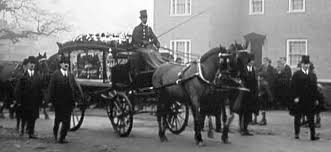
Victorian funeral procession.
Europeans and Americans during this era believed it was bad luck to meet a funeral procession head-on. If one saw one approaching, it was recommended they turn around. If this could not be done, it was said this person should hold on to a button until this funeral cortege passed.

If a clap of thunder was heard it meant the deceased had reached heaven, or if a raindrop fell on a funeral procession, it was said the departed would go to heaven.

If the deceased had led a good life, flowers would bloom on their grave, but if they had been evil, only weeds would grow on their grave.

If a person smelled roses and there were none around, it meant someone was going to die.

If a person saw himself or herself in a dream, their death would surely follow. In another post, the result of a dream that Abraham Lincoln had is shared.

If a sparrow lands on a piano, someone in the home is going to die. Or if a picture falls off the wall, someone close to them will die.

Never wear anything new to a funeral, especially shoes.


If a person heard three knocks, and no one is there, it usually meant someone close to them had died. This superstition is known as “the three knocks of death.”

A single snowdrop in a garden foretells death, as well as the hoot of an owl. If a bird pecks at or crashes into a person’s window, there has been a death.

Large drops of rain warned that there had just been a death.

If a person spills salt, they should throw a pinch over their shoulder, to prevent death.

If it rains on an open grave, it means another family member will die within the year.

One should never speak ill of the dead, because they will come back to haunt that person, or at least bring them misfortune.


In Part l of Victorian Death Customs and Superstitions, several strange customs connected to death are shared.

Thursday, May 21, 2015

Superstitions Shared in Children’s Poetry

Superstitions were placed in poems so they could easily be remembered. The format used most often for this was children’s rhymes.


A classic example of this is the children’s nursery rhyme, One For Sorrow. Verses were used because they could also be sung.

Magpie
In this rhyme, the number of magpies one sees was used to determine how much good or bad luck a person will experience. The use of the magpie is significant because, in many cultures, this bird was considered an ill omen.

In America where magpies are less common, jackdaws, crows, and Corvidae were associated with this poem.

One of the earliest versions of this rhyme was recorded around 1780 in Lincolnshire:


One for sorrow,
Two for mirth,
Three for a wedding,
And four for death.

Another early version that expanded this theme was from London in 1846:

Counting Crows (title in America)

One for sorrow,
Two for luck; (or mirth)
Three for a wedding,
Four for death; (or birth)
Five for silver,
Six for gold;
Seven for a secret,
Not to be told;
Eight for heaven,
Nine for hell
And ten for the d(evil)’s own sell!

A more modern and common version is:

One for sorrow,
Two for joy,
Three for a girl,
Four for a boy,
Five for silver,
Six for gold,
Seven for a secret,
Never to be told.

Another old superstition is if your ears itch, someone is talking about you.

“If your right ear itches, someone is speaking well of you and if your left ear itches, someone is speaking ill of you.”

More modern version:

“If your ears are ringing, someone’s talking about you.”

This superstition was first mentioned in Pliny’s “Natural History” encyclopedia over 2000 years ago.

In Janet S. Wongs book, Knock on Wood she shares poems about classic superstitions for children that address black cats, garlic, horseshoes, ladders, clover, salt, and mirrors, etc.

Here is her poem about ears itching.


ears

Your right ear itches? Let it be.
Someone talks about you now,
how kind you are, smart, how good.
Let it be, let songs be sung.

Your left ear itches? Pinch it quick.
Someone talks about you now,
how mean you are, dumb, how bad.
Pinch it, let him bite his tongue.

Wong’s book can be bought on Amazon.

Saturday, March 7, 2015

Superstitions, Bad Luck and Friday the 13th

Today is one of those days that some people still dread. Many claim the number 13 has brought them bad luck. And when it is combined with a Friday--they just will not take chances.


Triskaidekaphobia is a fear of the number 13. It is said on Friday the 13th the bad luck this number brings is tripled.

Superstitions are based in the belief that something terrible will happen if they are not observed or followed. Unfortunately, some in history proved to be harmful. But most were not.

Today most are no longer believed.

Here are just a few superstitions that were passed down from one generation to the next.

Did you know?

If you go to bed on one side of the bed and get up on the other side, it is considered bad luck. Through history many have taken this belief seriously--it is where the phrase: “He or she got up on the wrong side of the bed” came from.

Did you know?

Superstitions like black cats crossing your path, breaking mirrors, walking under ladders, and opening an umbrella inside a building all bring bad luck. This last superstition is useful for it is challenging to get an opened umbrella through a doorway.

Did you know?

You should never vow your love for another under a full moon. It dooms it. Hundreds of years ago humankind felt that the moon was erratic at best. It changes size throughout the month and completely disappears during eclipses.


Did you know?

When you yawn, you must always cover your mouth. After all, this is just good manners.

But this belief actually came about because people felt the devil makes people yawn so he can enter and possess them. So people would make the sign of the cross over their mouth initially--this evolved into covering the mouth.

Did you know?

On Friday the 13th, or on any day, you should never cross a knife and fork on the dinner table. This is why many traditional place settings place the knife and fork on opposite sides of the plate. Crossing these two utensils was believed to bring bad luck in the form of difficult times ahead.


Did you know?

That a gift given to a recipient should never be given outright. It should be loaned only, or a small token should be given in return, such as a nickel of penny. This was done because it was felt a gift given outright meant a severing of the bond of friendship.

This superstition has some truth to it. How many times have people loaned money and lost a friend?

Did you know?

Thirteen people should never sit down and eat at the same table. This brings bad luck-- this superstition comes from the  “Last Supper.”

The Last Supper

Another superstition states if 13 people meet in one room, one of them will die before the end of the year.

Yet another superstition that involves the number 13 is one that is still practiced. Most tall buildings still do not acknowledge there is a 13th floor.

Did you know?

That you should never go out on a first date on a Friday night. Of course, today Friday is date night--but in the past, people felt a courtship was doomed if started on a Friday night.

In England, hundreds of years ago, if a young couple was seen out on a Friday night, they were serenaded with the banging of pots and pans, to shame or embarrass them into delaying their courtship until the following day. 

Did you know?

It was initially believed broken mirrors brought 7 years of bad luck because they not only were a reflection of the person--they held bits of a person’s soul.


Another superstition surrounding mirrors was that it was essential to cover them, in the presence of the sick and dying. If this was not done, it was believed the patient might see death lurking in the reflection.

Did you know?

Bringing a woman on board a boat or ship was considered bad luck. An old maritime superstitious belief was a female’s presence, could endanger the crew. It was even believed a female could cause everyone on board to die.

Did you know?

Another maritime superstition involves the tradition that no one on board a boat could speak the name of one particular fish. It was called: The beast, the redfish, the foul fish, or merely the fish. But it was never called by its real name--salmon.

Friday, March 21, 2014

The Superstition and Curse that Surrounds Macbeth


Actors say, “Break a leg” not “Good Luck.”

The Superstition

Stage actors are renowned for believing in a variety of superstitions. Often it is thought that if these superstitions are not respected, it can make or break a play’s chances for success.

For the 400 years, William Shakespeare’s play Macbeth has been performed, there has been one superstition that has always been followed faithfully.

It is considered bad luck for the cast or crew to say the name of the play Macbeth. Especially while inside the theatre, except during rehearsals and performances.

To prevent this, a long-standing tradition involves calling Macbeth by various other names.

Americans actors call the play, Mackers. Other euphemisms include: “the Scottish play” or “the Glamis comedy” or just “that play.”


Legend states this superstition began with the very first production of Macbeth in August of 1606. 

A boy named Hal Berridge was playing the role of Lady Macbeth when he became ill with a high fever. He died backstage, and Shakespeare then had to go on stage and play the character himself.

It is stated Shakespeare performed the part poorly. Later, he chewed out his fellow actors when he heard them complaining about “that play.” 

This supposedly started the superstition of not referring to Macbeth by name.

There is a ritual that is followed if someone slips and says, Macbeth. The actor or crewmember must walk out of the room and shut the door. They then turn around three times and say a “dirty” word or spit. Finally, they must knock on the door and ask to enter the room again.

The Curse

Many in the theatre world believe the play Macbeth is cursed. 

This is thought because Shakespeare used an authentic “witches chant” in the opening scene, to please King James l, who prided himself on being an authority on demonology.

1st Witch:

“Round and round the cauldron go:
In the poisoned entrails throw.
Toad, that under cold stone
Days and nights has thirty-one
Sweated venom sleeping got,
Boil thou first in the charmed pot.

All: Double, double toil and trouble,
Fire burn and cauldron bubble…”

As it turned out, the King was displeased with the play, and the “witches” of the time were unhappy with Shakespeare’s negligent exposure of their craft. It is said they cast a curse on the play for eternity, as punishment.

The above belief is archaic, but the numerous instances of bad luck that have impacted productions of Macbeth over the years leave room for doubt.

Any seasoned theatre actor will gladly share a story that points to this curse’s existence. Here are just a few examples from the many performances of Macbeth, that have been plagued by this curse.

An actor playing the part of Macbeth in Amsterdam, in 1672, mistakenly substituted a real dagger for a prop and killed a fellow actor playing the role of Duncan in full view of the audience. 


In 1721, a nobleman in one audience got up and crossed the stage to talk to a friend during one scene--the actors chased him out of the theatre. He returned with the militia who set the theater on fire.

Two competing productions of Macbeth were playing in New York in 1849. One starred an English actor named William Charles Macready, the other starred an American actor named Edwin Forrest.

During one performance given by Macready fans of Forrest’s production were in the audience--they pelted Macready with chairs and fruit. 

The militia was called out and fired on the crowd. Twenty people died--many of them trampled to death. Thirty others were wounded.

In 1934, a British actor Malcolm Keen turned mute on stage and the actor who replaced him Alister Sim, famous for his film role as Scrooge, developed a high fever and was hospitalized.

Olivier as Macbeth
In a 1937 production, a 25-pound counterweight crashed onto the stage barely missing Laurence Olivier. It broke his sword, which flew into the audience where it struck a patron. This man, shortly afterward, died of a heart attack.

John Gielgud starred in another production in 1942. Three of his fellow actors--which took the roles of two witches and Duncan all died. The set designer committed suicide during this run.

Actor Harold Norman was acting in Macbeth on a Thursday when he was stabbed during the final sword scene in the play. He later died of his wounds.

Ever since Norman's ghost is seen on Thursday nights at the Coliseum Theatre in Oldham, on the spot where he was accidentally stabbed.

During an outdoor performance in Bermuda, in 1953, that starred Charlton Heston, a gust of wind blew smoke and flames being used to make the scene more realistic--into the audience--they fled. 

Heston was soaked in Kerosene-- he suffered burns to his groin and one of his legs.

In 1971, Roman Polanski, just two years after his wife Sharon Tate was killed by the Manson murderers, began to shoot a film version of Macbeth. The first day of filming his cameraman almost died in a freak accident.

In 1981, a production of Macbeth was being performed at the Lincoln Center in Washington D.C. 

J. Kenneth Campbell who played the role of Macduff, was mugged shortly after the first performance.

In July of 2013, one actor made sure the "show must go on." 

Kenneth Branagh's sword hit him during an opening battle scene--at St. Peter's church in Manchester. 

He was treated by an on-site paramedic, and then returned to the performance. After the final curtain call, he was taken to the hospital.

Many outside the theatre community discount this curse. 

It is stated that Macbeth has many fight scenes, and the lights are often kept low for effect, so this is more likely the reason for accidents.

This explanation does not explain the burning, or the riot, or the illnesses that have occurred over the years.

Wednesday, March 27, 2013

Haunted Mirrors

Recently, a haunted mirror sold on eBay for 150 American dollars. The two British men who sold it claimed it had brought them bad luck. 

It seems their landlord threw it out, and they fished it out of a dumpster near their London home and placed it on a wall. A short five months later, they were trying to get rid of it--with the disclaimer that it was haunted.


These two claimed that they had experienced financial difficulties and illness since acquiring this mirror. They had both been awakened in the middle of the night by “screaming pain.” Both of them had felt a strong “sense of impending doom.” They saw flickering shadows reflected in this mirror, and one stated he had woken up covered in “deep red scratches.” 

Of course many supposed “haunted items” are sold on eBay each year, but this story is fascinating because it actually is similar to several documented cases involving haunted mirrors.

For generations, people have been fascinated by reflective surfaces. Because of this, many folktales and legends have been created. Mirrors are connected to “portals.” I wrote about this connection in another post here. 


Here are more superstitions or s in relationship to mirrors. For mirrors are believed to pose dire risks.

If a person is in bed and ill in a room, all the mirrors should be covered. The reason for this is when a person is vulnerable to a mirror, if it is a portal, it can take their soul.

People should never look into a mirror at night or by candlelight. The reason for this is because you might see a ghost or even your own death.

This one I mentioned in my other post. When a person dies in a room, all the mirrors should be covered or turned toward the wall. The reason for this is so the dead person’s soul does not become lost in a portal.

When a person is sleeping, they should cover all the mirrors in the room. The reason for this is so negative energy cannot attack them. Along with this, it is said that a person should never place their bed in a way that a mirror can reflect it.

Finally, a person should move their mirrors to different areas of the room. The reason for this is so spirits or ghosts cannot use it as a portal.

The above beliefs above are, of course, superstitions. But here are some documented cases of how people acquired mirrors--that then caused them paranormal problems. So there are mirrors that should be avoided.

Here are some suggestions that people should avoid.

Don’t buy or place old mirrors in your home.

If a previous owner to the home you rent or buy leaves a mirror or mirrors behind--get rid of them.

If a mirror has been used for any kind of spiritual work e.g., divination or scrying, get rid of them because these practices supposedly open portals. 

People who do this professionally-- often cleanse or do a ritual with these mirrors to protect themselves.

Using a Ouija board can open a portal as well. If there is a mirror nearby, it can become the host for this portal.

Finally, many places that are reputed to be haunted, such as old hotels, have mirrors that are portals. I have never encountered “a portal,” but I find this information interesting.

Saturday, March 23, 2013

Death Poetry: The Rime of the Ancient Mariner


An English poet, Samuel Coleridge wrote a poem in 1798 entitled, “The Rime of the Ancient Mariner.” Experts have picked apart and overanalyzed this poem for two centuries. 

Christians state this poem is one of redemption where through prayer man becomes closer to God. 

Scientists state this poem reflects the higher power of the physical or natural world, which dominants man. 

Others state it is a tale of crime and punishment. 

Coleridge’s poem does reflect the elements above but from a spiritual perspective, this poem has two realms, one being reason and the other imagination.

Coleridge’s assigns his main character the “Ancient Mariner” the role of storyteller. This mariner is doomed to share his tale with those who will listen. He imparts or teaches a moral lesson that cannot be ignored--describing his own terrible misdeed-- he warns that man must not forsake the spiritual or natural world for the pursuit of pleasure. His tale is poignant for his mistake caused the agonizing deaths of 200 souls. In retribution, he wanders the earth telling his tale of woe as a warning.

Side by side with this theme is a very compelling story that entertains and draws the reader in. Coleridge uses old-fashioned spelling, the ancient belief that “gods” have the power to meddle in men's lives and the sense that this tale was passed down through the generations. He used these devices to ingeniously give the reader the flavor of bygone days. 

But it is the supernatural elements in his poem that attract many readers. For the "Rime of the Ancient Mariner" is a tale of superstitions, curses, ghosts, and a ghost ship.

The poem begins with the Ancient Mariner telling his story to a “wedding guest” he detains. He captures this man’s attention by describing a storm that drove his ship off course into dangerous waters. Then an albatross--a sea bird-- saves his ship. It leads his ship away from the icy waters of the Antarctic. But even as his crew praises this bird, the Mariner shoots and kills it without regret:

“With my cross-bow
I I shot the Albatross.”

This angers the crew for they believed this albatross had bought the south wind that led them out of danger. But they soon forget their ire as the weather warms.

Unbeknownst to the crew, the killing of the albatross has caused the wrath of the gods who send spirits to chase the ship. The south wind calms, and the vessel and crew are stranded:

“Water, water, everywhere, 

And all the boards did shrink;
 
Water, water, everywhere,
 
Nor any drop to drink.”

The crew, tormented by thirst is again angry with the Mariner, so they place the dead Albatross around his neck. * Their ship now encounters the spirits on the ghostly ship that followed them--on board is a skeleton- who is “Death” and a deathly pale woman:

“The Night-Mare Life-in-Death was she,

Who thicks man's blood with cold.”

These two spirits roll the dice for the souls of the crew. Death wins. Life-in-Death wins the soul of the Mariner--a prize she considers more valuable. The Mariner will now face a fate worse than death for he is cursed--he is made to watch each crew member die one by one:

“Each turned his face with a ghastly pang,

And cursed me with his eye.”

The Mariner finds himself stranded and alone:

“Alone, alone, all, all alone,

Alone on a wide, wide sea!”

“The many men, so beautiful!

And they all dead did lie:

And a thousand thousand slimy things

Lived on; and so did I.”

This curse is temporarily lifted and the Mariner who once saw all sea creatures as “slimy things” now can see their beauty:

“O happy living things! no tongue

Their beauty might declare:

A spring of love gushed from my heart,

And I blessed them unaware:

Sure my kind saint took pity on me,

And I blessed them unaware.”

As he blesses them, the albatross falls from his neck:

“The self-same moment I could pray;

And from my neck so free

The Albatross fell off and sank

Like lead into the sea”.

The Mariner is partially redeemed:

“The man hath penance done,

And penance more will do.”

The bodies of the dead crewmembers rise and steer the Mariner’s ship back home--where it then sinks in a whirlpool. The Mariner has survived, but he knows he must do penance for shooting the albatross:

“I pass, like night, from land to land;

I have strange power of speech;

That moment that his face I see,

I know the man that must hear me:

To him my tale I teach.”

He wanders the earth, driven by guilt, knowing he has to tell what he has learned. The “Wedding Guest” listens as he states:

“He prayeth well, who loveth well

Both man and bird and beast.”

“He prayeth best, who loveth best

All things both great and small;

For the dear God who loveth us,

He made and loveth all.”

In the end, the “Wedding Guest” wiser for the telling finds himself sad and pondering his own life.

Here is a link to the poem.


Since the poem is long, here is an excellent audio version --told by Orson Welles:

Part I
Part II
Part III
Part IV
Part V

* One standard idea or saying taken from this poem is to have an “albatross around your neck.” This means you have a constant reminder of a mistake you made.

Samuel Coleridge’s poem was not well received in the late 1700s. But today, parts of this poem are found in every form of popular culture. Books, games, comics, music, film, television and even the military all reference "The Rime of the Ancient Mariner."

The recent film, Life of Pi uses many elements from this poem in its storyline.

One good example of this is the British band, Iron Maiden. Steve Harris, the band’s bass player, wrote his own version of Coleridge’s poem. It became a thirteen and a half minute song on their “Powerslave” album in 1984. Here is the song…